


SEO Summary:
- The daily hormonal cascade—governing energy, stress, metabolism, and mood—is reset by a brief, intense dose of early morning light hitting the eyes.
- Specialized cells in the eye signal the Suprachiasmatic Nucleus (SCN), the brain’s master clock, which dictates the release of cortisol (the energy hormone) and timing of melatonin suppression.
- Missing this critical window, usually within 60 minutes of waking, is linked to chronic fatigue, elevated anxiety, and metabolic issues like stubborn belly fat.
- Click to learn the exact 2-minute protocol, why glass and sunglasses block the signal, and how to start your day with a perfectly optimized hormonal rhythm.
The Morning Light Command: Setting the Master Clock
You might think your alarm clock dictates your day, but the true master of your energy, focus, and metabolism is a tiny cluster of neurons deep in your brain called the Suprachiasmatic Nucleus (SCN). The SCN is the master regulator of your body’s circadian rhythm—the 24-hour cycle that controls when you are awake, when you sleep, and when every hormone is released.
The SCN doesn’t set its time based on a clock on the wall; it sets its time based on the intensity of the light that hits your eyes.
The Signal That Starts the Day

The mechanism is surprisingly simple and non-negotiable. Your eyes contain specialized, non-vision-forming photoreceptors called melanopsin-containing Retinal Ganglion Cells (ipRGCs). These cells are highly sensitive only to the bright blue and green spectrums of morning sunlight.
When you step outside in the morning, these ipRGCs detect the sharp, intense spike in photons and immediately send a “wake up!” signal to the SCN. This signal is the master reset switch, which accomplishes two profound things:
- Cortisol Surge: It triggers the appropriate release of cortisol, your primary wakefulness and energy hormone. This burst, known as the Cortisol Awakening Response (CAR), sets your metabolism and mood for the day.
- Melatonin Suppression: It tells the pineal gland to immediately stop producing melatonin, clearing the way for wakefulness and ensuring that melatonin will be released again later that night, guaranteeing a smooth transition to sleep.
If you miss this light signal, your SCN doesn’t know what time it is, and your hormonal day begins in a state of confusion, leading to chronic misalignment.
The Misaligned Day: Consequences of a Late Reset
When your master clock is late or absent, the hormonal orchestra falls out of tune. The consequences of this circadian misalignment are not subtle—they manifest as the daily struggles with energy, mood, and stubborn body composition.
The Two Main Consequences
- Hormonal Chaos and Anxiety: Instead of a sharp, powerful CAR at the optimal time (30–60 minutes after waking), the cortisol release is often delayed, flat, or scattered throughout the day.
- Result: You feel anxious and wired in the evening when cortisol should be dropping, and you crash mentally in the afternoon because the morning boost was insufficient. This poor regulation is highly linked to anxiety and depressed mood.
- Metabolic Dysfunction and Belly Fat: Your circadian rhythm is intrinsically linked to your metabolism. When the SCN is late to wake up, it causes a delayed or dysregulated release of insulin, the hormone that manages blood sugar.
- Result: Studies show that circadian misalignment is linked to increased insulin resistance and poor glucose regulation. This forces the body to inefficiently manage blood sugar and preferentially store energy as fat, often manifesting as stubborn fat around the abdomen (visceral fat). You are essentially making your body metabolically sluggish because you didn’t tell it what time it was.
Your inability to manage stress, your afternoon slump, and your struggle with energy are often not signs of weakness, but symptoms of a missed hormonal reset.
Missing the Window: Why We Fail to See the Light
You might think you are getting enough light just by sitting next to a sunny window or checking your phone outside. This is the biggest barrier to receiving the therapeutic light dose.
The Critical Timing and Intensity Rules
- The Timing Window (0-60 Minutes): The SCN is most sensitive to the light cue immediately upon waking and during the first hour of your day. This sensitivity fades rapidly. If you wait two or three hours, the signal is much less potent. The ideal timing is within 30 minutes of waking.
- The Intensity Factor: The sheer intensity of outdoor light is required to trigger the ipRGCs.
- Indoor Light: Standard indoor lighting (even bright office lights) provides only 100 to 500 lux (a measure of light intensity).
- Outdoor Light (Even Cloudy): On a heavily overcast day, the light outside is typically 1,000 to 5,000 lux. On a sunny day, it is 10,000 to 100,000 lux.
- The Barrier Block: Glass windows and contact lenses/glasses filter out much of the critical blue spectrum light. Sunglasses are the biggest block of all—they intentionally filter out the exact frequencies of light your SCN needs to reset.
Sitting by a window with your coffee or wearing sunglasses for an early walk is not enough. You must expose your bare eyes (contact lenses/regular glasses are generally okay, but no sunglasses) to the full spectrum of outdoor light, ideally as close to the horizon as possible.
The 2-Minute Sunrise Protocol for Hormone Reset
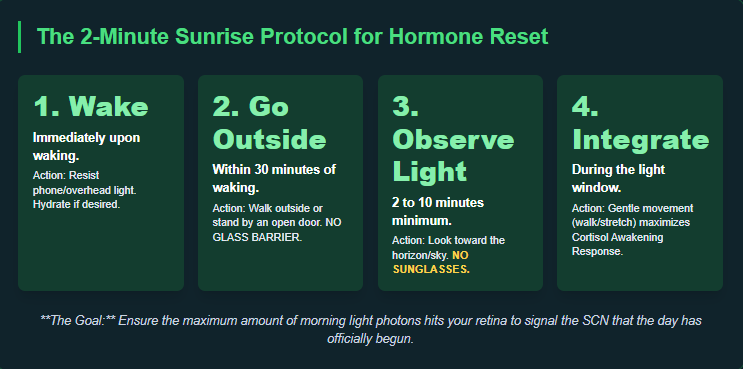
This protocol is simple, fast, and non-negotiable. It requires consistency over duration. Even just two minutes of intense light can be sufficient, though building up to ten minutes is ideal.
The Advocate’s Hormone Reset Checklist
| Step | Action | Timing & Duration | Key Restriction |
| Wake | Turn off the alarm and resist grabbing your phone. | Immediately upon waking. | Do not scroll social media or turn on harsh overhead lights. |
| Go Outside | Walk outside or stand by an open window/doorway. | Within 30 minutes of waking. | NO GLASS: Do not look through a window. |
| Observe Light | Look toward the horizon or general sky, not directly at the sun. | 2 to 10 minutes minimum. | NO SUNGLASSES: Keep bare eyes exposed to the light. |
| Integrate | If possible, combine this light with gentle movement. | During the 2–10 minute window. | A light walk or stretching maximizes the benefits of the CAR. |
The Goal: You are not trying to tan or read a book; you are simply ensuring the maximum amount of morning light photons hits your eye’s retina to signal the SCN that the day has officially begun.
Hormonal Benefits Summary
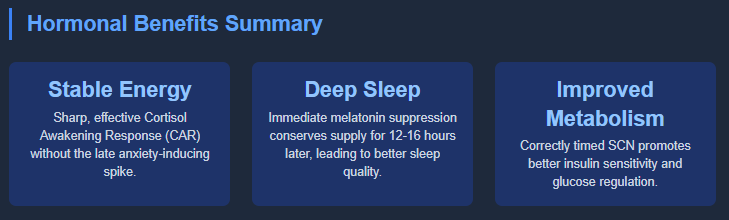
The immediate, daily execution of this protocol ensures:
- Optimal Cortisol: A sharp, effective Cortisol Awakening Response, providing stable energy and mood without the anxiety-inducing late spike.
- Deep Sleep: Immediate suppression of melatonin ensures that the body conserves its melatonin for release 12-16 hours later, leading to easier onset of sleep and better sleep quality.
- Improved Metabolism: A properly timed SCN sends correct signals to the organs involved in glucose and fat metabolism, promoting better insulin sensitivity.
Beyond the Sun: Integrating a Full Circadian Lifestyle
While the morning light reset is the single most powerful lever for hormonal balance, a full circadian lifestyle requires managing light exposure throughout the entire 24-hour cycle.
Supporting Your Circadian Rhythm
- The Sunset Signal (Evening Routine): Just as intense morning light signals “start,” seeing the less intense, red-shifted light of sunset signals “slow down.” If possible, briefly observe the sunset. This sets the timer for the evening melatonin release.
- Red-Light Restriction (After Sundown): After 10 PM, artificial light, particularly the blue light emitted by phones, TVs, and overhead LEDs, is interpreted by the SCN as daytime, actively blocking melatonin production. Wear blue-light-blocking glasses and dim indoor lights severely in the final two hours before bed.
- Consistent Sleep/Wake Time: The SCN thrives on consistency. Try to go to bed and wake up within the same 60-minute window every day, including weekends. This structure reinforces the hormonal reset signal.
- Timed Hydration/Nutrition: Avoid caffeine and food for the first 60–90 minutes after waking, focusing only on hydration. Allowing your body to utilize the natural cortisol energy (CAR) before introducing food maximizes the metabolic benefits.
A full circadian lifestyle ensures you are working with your hormonal tides, not against them.
My Personal Advice as a Health Advocate
When I first heard of the “morning light” protocol, my initial thought was, “What about cloudy days? That can’t work.” This is the most common hesitation, and it’s incorrect.
The intensity difference between indoor light (low hundreds of lux) and outdoor light (thousands of lux, even through heavy cloud cover) is so massive that the cloudy sky is still infinitely more powerful than the brightest lamp inside your house. Don’t wait for a sunny day; the protocol is essential on cloudy, foggy, or rainy days precisely because your SCN needs the signal the most.
I made it a non-negotiable rule: the first thing I do after turning off my alarm is walk to my balcony for 5 minutes of light exposure. I use that time to quietly observe the day and sip a glass of water. It has become a crucial “buffer” between the speed of the modern world and the quiet biological need of my body. It is the cheapest, most effective way to address the foundation of anxiety and energy regulation. Start small—commit to two minutes tomorrow.
Myths vs. Facts: Light and Hormone Misconceptions
Dispelling these common myths is essential for successfully implementing the hormone reset protocol.
| Myth | Fact |
| Myth: Sunlight through a window is good enough. | Fact: Window glass filters out the most powerful blue and green light frequencies required to trigger the SCN. You must go outside or stand directly in an open doorway. |
| Myth: My phone screen can substitute for sunlight. | Fact: The phone screen provides a negligible amount of lux (light intensity) compared to the sun. It also provides the wrong signal after sunset, confusing the SCN. |
| Myth: I must look directly at the sun. | Fact: Absolutely not. Looking directly at the sun can damage your retina. Look toward the horizon or the general sky, using peripheral vision to capture the light’s intensity. |
| Myth: I need to spend an hour outside for it to work. | Fact: While more time is great, studies show the SCN can be effectively reset with as little as 2 to 10 minutes of direct outdoor light exposure, provided it happens early in the day. |
FAQs (Frequently Asked Questions)
- What if I wake up before sunrise?Go outside anyway! The low-intensity pre-dawn light (even if it’s minimal) is still a far stronger signal than indoor light. Once the sun rises, repeat the process.
- How long is long enough?Aim for at least 2 minutes on a very bright day and 5 to 10 minutes on a very cloudy or dark day to ensure sufficient photons hit the ipRGCs.
- Can I wear my corrective glasses or contacts?Yes, standard prescriptive eyeglasses and contacts typically do not block the light wavelengths needed for the SCN reset. Sunglasses are the only eyewear that must be avoided.
- Should I be checking my phone during this time?No. The blue light from your phone is a low-intensity, confusing signal that distracts the SCN. Use this time for quiet observation or gentle movement.
- Does this protocol help with jet lag?Yes, this is the most critical tool for combating jet lag. Exposing yourself to morning light in the new time zone forces your SCN to immediately recalibrate to the new local time.
Conclusion & A Final Word of Encouragement
The master switch for your entire hormonal day is external, simple, and free. By committing just two to ten minutes of your morning to the Sunrise Protocol, you are performing the most profound act of self-care for your hormonal, metabolic, and neurological health.
You are ensuring a sharp, stable release of cortisol for energy, promoting metabolic health, and setting the stage for deep, restorative sleep that night. Do not let glass or a busy schedule rob you of this foundational biological need.
Make the commitment tomorrow: open the door, step outside, and reclaim control of your body’s master clock.
Disclaimer: I am a health advocate and writer, not a medical doctor. The information in this article is for informational purposes only and is not a substitute for professional medical advice, diagnosis, or treatment. Always consult your physician for concerns related to anxiety, chronic fatigue, or diagnosed hormonal disorders.