

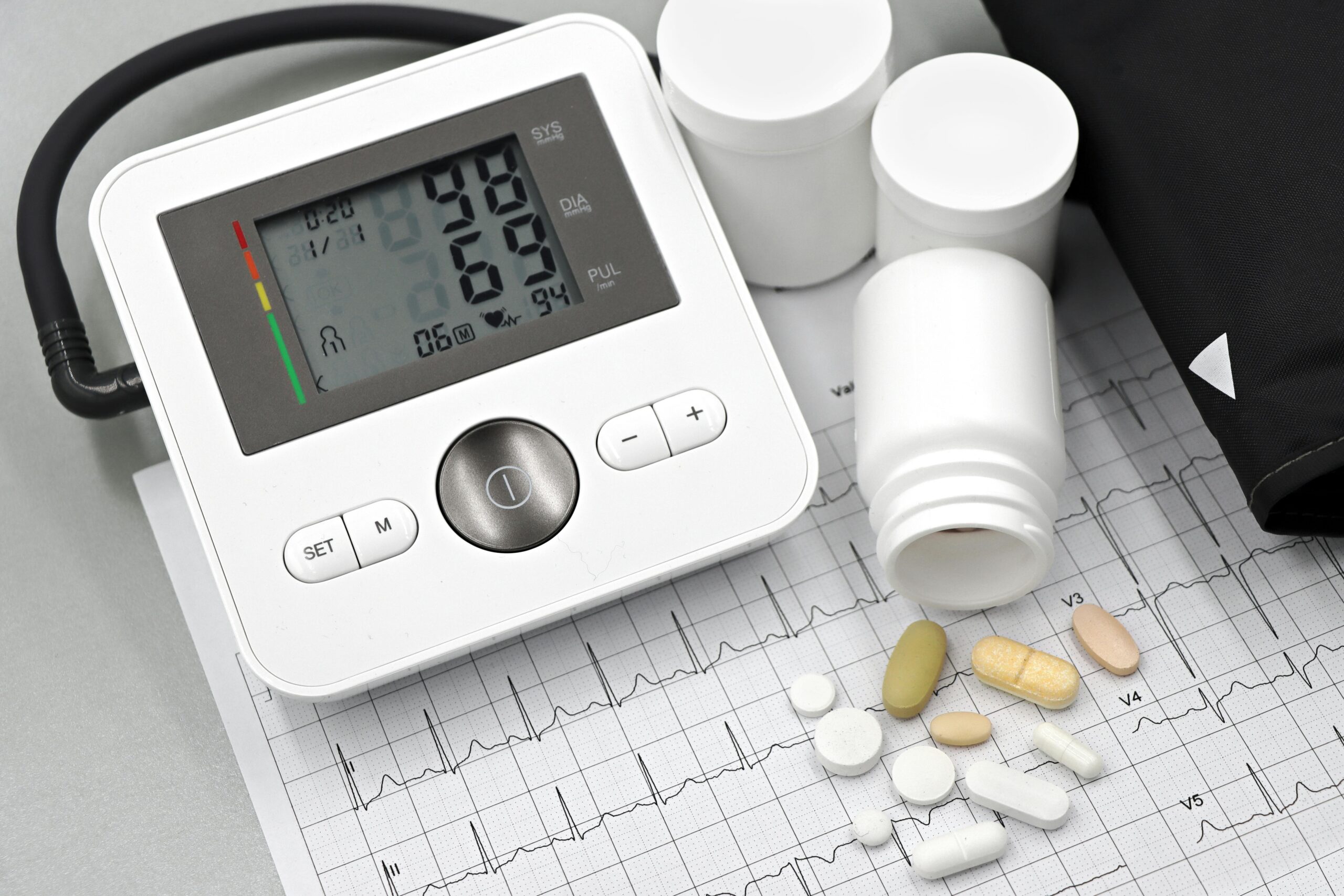
- The Real Health Metric: Learn why your Heart Rate Variability (HRV)—the time gap between heartbeats—is a more accurate predictor of health and mortality than your resting heart rate (RHR).
- The Vagal Brake: Understand how low HRV signals that your Autonomic Nervous System (ANS) is stuck in “fight-or-flight” mode, weakening your body’s resilience.
- The Elite Athlete’s Secret: Discover the simple, 5-minute daily micro-habit—Coherent Breathing—that instantly strengthens the Vagus nerve and rapidly improves your HRV.
The Misleading Metric
If you’ve ever tracked your fitness, worn a smartwatch, or visited a doctor, you’ve likely focused on one number above all others: your Resting Heart Rate (RHR).
We are taught that a lower RHR is always better. While RHR is important, it’s a gross oversimplification of your cardiovascular health. Focusing solely on RHR is like judging a car’s performance based only on its average speed, ignoring its horsepower, braking system, and suspension.
There is another number—a hidden biological signature—that is dramatically more predictive of your future health, your resilience to stress, and even your lifespan. That number is Heart Rate Variability (HRV).
This isn’t just a bio-hacker fad. Scientific studies have shown that HRV is a more powerful predictor of mortality from all causes than traditional markers like total cholesterol or resting blood pressure.
Why? Because your HRV isn’t just about your heart; it’s a window into the single most important system governing your health: your stress response. Low HRV means your body is chronically stressed, even when you think you’re relaxed.
The truly empowering secret is that improving this critical metric doesn’t require expensive drugs, complex diets, or hours in the gym. It requires one simple, 5-minute daily micro-habit that elite athletes and special forces operators practice—and almost nobody else does.
What HRV Really Is: The Dance of the Autonomic Nervous System
To understand HRV, you first have to stop thinking of your heartbeat as a steady, mechanical “thump… thump… thump.”
Your heart does not beat once every second, even if your heart rate is 60 beats per minute (BPM). If your RHR is 60, the time between beats is not always 1.0 seconds. It might be 0.98 seconds, then 1.03 seconds, then 0.99 seconds.
Heart Rate Variability (HRV) is the measurement of the small, milliseconds-long variations in the time intervals between successive heartbeats.
A high HRV—meaning the time intervals are highly variable and adaptable—is excellent. A low HRV—meaning the time intervals are tight and consistent—is poor.
Why is variability good? Because it reflects the health of your Autonomic Nervous System (ANS).
The ANS is the involuntary control system that governs everything you don’t consciously think about: breathing, digestion, heart rate, and stress response. The ANS has two main branches:
- The Accelerator (Sympathetic Nervous System): The “Fight or Flight” system. It speeds up your heart, raises blood pressure, and mobilizes energy for defense.
- The Brake (Parasympathetic Nervous System): The “Rest and Digest” system, primarily run by the Vagus Nerve. It slows your heart, relaxes muscles, and initiates recovery.
Your heart is constantly receiving signals from both the accelerator and the brake. A healthy heart is one that can quickly adapt and fluctuate between these two signals, like an adaptable suspension system on a high-performance car.
Low HRV means your accelerator is stuck. It means your Sympathetic (stress) system has overpowered your Parasympathetic (rest) system. Your body is perpetually in a state of high alert, unable to properly recover, regardless of how much you sleep.
The Root Cause: A Weak Vagus Nerve
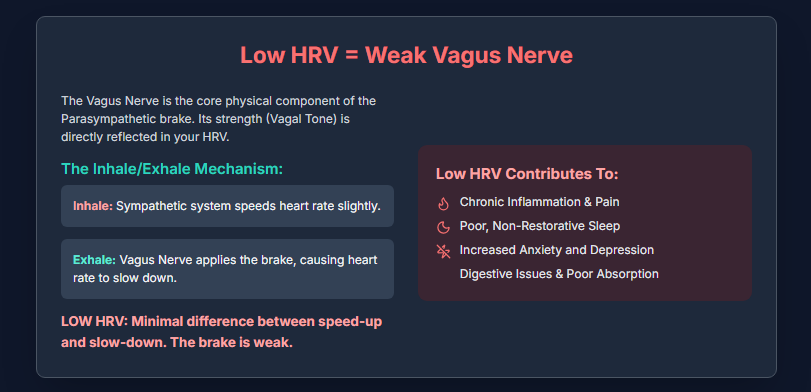
If your HRV is low, the diagnosis is simple: Your Vagus Nerve is weak.
The Vagus Nerve (Latin for “wandering nerve”) is the longest nerve in the body, connecting the brain to the heart, lungs, and gut. It is the core physical component of the Parasympathetic brake. Its strength, often called Vagal Tone, is directly reflected in your HRV.
The Mechanism of Low HRV
When you inhale, your sympathetic system slightly speeds up your heart rate. When you exhale, your Vagus nerve applies the brake, causing your heart rate to slow down.
- High Vagal Tone (High HRV): Your brake is strong. The difference between the inhale speed-up and the exhale slow-down is large. This means your ANS is highly adaptable and can handle stress efficiently.
- Low Vagal Tone (Low HRV): Your brake is weak. The difference between the speed-up and slow-down is minimal. Your heart is operating in a tight, rigid, inflexible rhythm, indicating that stress hormones (like cortisol) are dominating your system.
Low HRV Is a Disease Risk Factor
Low HRV is not just a predictor of stress; it’s a mechanism of disease. When the ANS is chronically imbalanced, it contributes to:
- Chronic Inflammation: The Sympathetic system fuels inflammation, leading to pain, stiffness, and increased risk of heart disease.
- Poor Sleep Quality: The body cannot drop into deep restorative sleep (when the Vagus nerve should be dominant).
- Digestive Issues: The Parasympathetic system governs digestion; when it’s weak, gut motility and nutrient absorption suffer.
- Increased Anxiety and Depression: Vagus nerve stimulation is profoundly linked to emotional regulation.
The great news is that because the Vagus nerve is a physical nerve that you can access through the diaphragm, you can strengthen your Vagal Tone—and, by extension, improve your HRV—faster than almost any other health metric.
The Daily Micro-Habit: Coherent Breathing
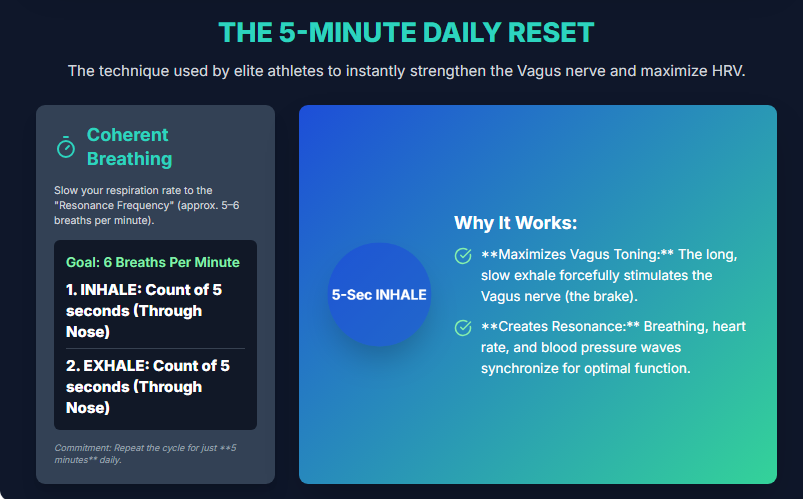
The trick to improving HRV is to intentionally maximize the difference between your inhale speed-up and your exhale slow-down. We do this by breathing at the specific frequency where your heart rate, blood pressure, and breathing waves all synchronize—a technique known as Resonance Frequency or Coherent Breathing.
The vast majority of adults breathe at a frantic, shallow rate of 12-18 breaths per minute. This doesn’t give the Vagus nerve enough time to engage the brake.
The goal of Coherent Breathing is to slow your respiration rate to approximately 5–6 breaths per minute.
The Technique: 5-Second Inhale / 5-Second Exhale
For most people, the resonance frequency sits around 0.1 Hz, which corresponds to 6 breaths per minute.
- Posture: Sit upright, feet flat on the floor, spine straight.
- Inhale: Breathe in slowly, deeply, and gently through your nose for a count of 5 seconds. Feel your diaphragm (belly) expand.
- Exhale: Breathe out slowly, gently, and fully through your nose for a count of 5 seconds. Feel your belly contract.
- The Commitment: Repeat this 5-second in / 5-second out cycle for five minutes.
Why It Works: Instant Vagal Toning
This slow, steady rhythm forces your respiratory rate to align perfectly with your body’s natural cardiovascular rhythm. The Vagus nerve is stimulated strongly during the long, slow exhale.
By practicing this daily, you are essentially taking your Vagus nerve to the gym. You are strengthening the brake, making your heart and ANS more flexible and resilient to everyday stressors.
This is the micro-habit elite athletes use. When they practice this breathing pre-competition, they are actively calming the sympathetic system and optimizing their recovery pathways, maximizing their body’s ability to handle the physical demands about to be placed on it. You can achieve this same systemic resilience in just five minutes a day.
Beyond HRV: The Systemic Benefits of ANS Balance
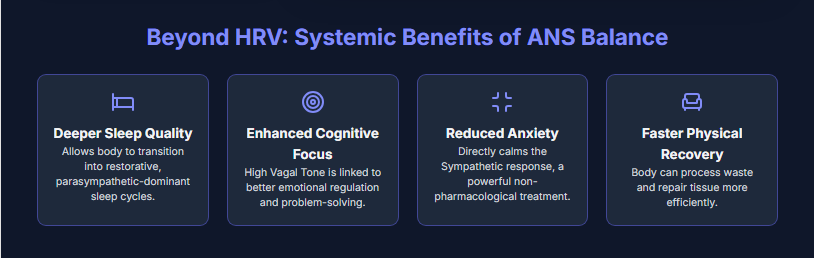
The rewards of shifting your Autonomic Nervous System out of perpetual stress mode are far-reaching and immediately tangible:
- Better Sleep Quality: By strengthening the Vagus nerve before bed, you allow your body to naturally transition into the deep, parasympathetic-dominant sleep cycles required for physical and cognitive restoration.
- Enhanced Cognitive Focus: High Vagal Tone is strongly correlated with increased focus, better emotional regulation, and enhanced problem-solving ability. When your brain isn’t worrying about an imaginary crisis, it can dedicate energy to complex tasks.
- Reduced Anxiety and Worry: Since anxiety is often the mental manifestation of a Sympathetic-dominant nervous system, directly calming the ANS through breathing is a powerful, non-pharmacological treatment for generalized anxiety.
- Faster Physical Recovery: Improved HRV means your body can process metabolic waste and repair damaged muscle tissue more efficiently, making you less susceptible to injury and soreness.
My Personal Strategy: The 5-Minute Morning Reset
I am a health advocate, and my life is often packed with deadlines, travel, and complex problem-solving—all classic Sympathetic triggers. The first thing I learned to control was my HRV, because I knew if I couldn’t manage my internal stress, I couldn’t help anyone else manage theirs.
My routine is simple and non-negotiable: The 5-Minute Morning Reset.
Before I check my phone, before I drink coffee, and before I even open my blinds, I sit on the edge of my bed. I set a timer for five minutes and practice Coherent Breathing. I use a simple meditation app or just count manually.
This simple act is my insurance policy against the day’s stress. It immediately takes my heart rate variability from the erratic, shallow pattern of a rush-hour driver to the deep, resilient pattern of a meditator. It ensures my Vagus nerve is strong, my digestive system is ready, and my brain is calm before I introduce the first external stressor of the day.
Myths vs. Facts: Busting HRV Excuses
Myth: “You need an expensive tracker (watch/ring) to measure and improve HRV.”
Fact: While trackers are great for measuring your progress and spotting trends, you don’t need them to start improving. The physiological effect of Coherent Breathing is immediate and measurable, regardless of whether you have a device or not.
Myth: “I run marathons; my HRV must be great.”
Fact: Not necessarily. Overtraining is a huge Sympathetic stressor. Many high-performing endurance athletes have chronically low HRV because their recovery time (Vagal Tone) is inadequate relative to their training load. They are physically fit but chronically stressed internally.
Myth: “When I’m anxious, I should breathe fast and deep to get more oxygen.”
Fact: This is the absolute opposite of what you should do. Fast, deep breathing (hyperventilation) exacerbates the Sympathetic response and can trigger a panic attack. Slow, controlled, Coherent Breathing is the only way to activate the Parasympathetic brake and signal safety to the brain.
FAQs (Frequently Asked Questions)
1. How do I find my exact resonance frequency?
While 5.5 to 6 breaths per minute is optimal for most, your precise resonance frequency maximizes HRV. It’s usually done in a clinical setting with biofeedback equipment, but you can find it yourself by slightly varying the inhale/exhale time around the 5/5 count (e.g., trying 4/6 or 6/4) while monitoring your HRV with a smartphone sensor or tracking app.
2. Is it better to breathe through my nose or mouth?
Always breathe through your nose. Nasal breathing naturally slows the rate and produces nitric oxide, which dilates blood vessels and increases oxygen absorption, maximizing the physiological benefit of the Vagus nerve stimulation.
3. If my HRV is very low, how quickly can I see results?
The Vagus nerve is highly responsive. You may feel a difference in anxiety and calmness after just one session. Consistent, daily practice can lead to measurable increases in your baseline HRV within 2–4 weeks.
4. Does Coherent Breathing help with panic attacks?
Yes. Since a panic attack is an extreme Sympathetic reaction, focusing intensely on the slow, deliberate 5-second exhale is one of the most powerful, immediate ways to signal safety to the brain, halting the adrenaline cycle.
Conclusion & A Final Word of Encouragement
You have an internal resilience switch—your Heart Rate Variability—that matters more than your cholesterol or your typical resting heart rate.
If you feel stressed, tired, anxious, or perpetually inflamed, your switch is simply stuck in the ‘On’ position.
The power to fix this isn’t found in a pill; it’s found in your breath. Invest five minutes today in Coherent Breathing. Strengthen your Vagus nerve, reset your body’s ability to recover, and reclaim the adaptable, resilient health that is your birthright.
Medical Disclaimer: I am a health advocate and writer, not a medical doctor. The information in this article is for informational purposes only and is not a substitute for professional medical advice, diagnosis, or treatment. Always seek the advice of your physician or other qualified health provider with any questions you may have regarding a medical condition.