


- High blood pressure is often a symptom of a nervous system stuck in a “fight-or-flight” (sympathetic) state, which constricts your arteries.
- This guide teaches a specific nasal breathing technique that instantly activates your “rest-and-digest” (parasympathetic) system, relaxing those arteries.
- The secret is a precise nasal breathing ratio where your exhale is significantly longer than your inhale (e.g., inhale for 4 seconds, exhale for 6-8 seconds), which stimulates the vagus nerve and lowers blood pressure.
The Panic Button in Your Chest

Let’s talk about that moment. The one where the blood pressure cuff on your arm starts to tighten, and you feel your heart start to thump.
You try to act casual. You try to think relaxing thoughts. But you can hear the whirrr of the machine, and you’re already bracing for the number.
The cuff deflates. The nurse looks at the screen. “150 over 95.”
Your stomach drops. How? I feel fine! I was even trying to be calm!
As a health advocate, I see this scenario play out every single day. That number feels like a judgment. It’s terrifying. It’s the “silent killer,” and it just sent you a very loud warning. Your doctor might look concerned, write you a prescription, and tell you to “cut back on salt and try to relax.”
If you’re like most people, you leave that office feeling a new kind of panic. But here’s what I want to tell you: That number is not a life sentence. And “just relax” is terrible advice.
What you need is not a vague suggestion. You need a manual. You need to know how to find the “off-switch” for the panic button that’s stuck inside your own body. What if I told you that the most powerful tool for lowering your blood pressure is not in a pill bottle, but inside your own lungs?
And what if I told you that you could use it, for free, in the next two minutes?
Why Medication Is Only Half the Answer
First, let me be perfectly clear: Medication for high blood pressure is a lifesaving, modern miracle. I am not, in any way, suggesting you stop taking it. Please, always follow your doctor’s advice.
But I want to talk about why it’s often not the whole answer.
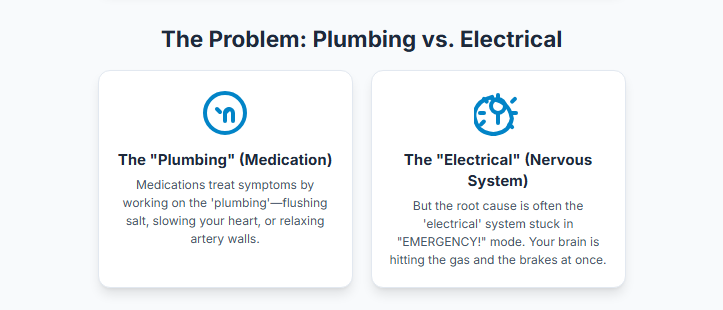
Most blood pressure medications work on the “plumbing” of your body. They are brilliant pieces of chemistry. They might be a diuretic, helping your kidneys flush out excess salt and fluid. They might be a beta-blocker, slowing your heart rate. Or they might be a vasodilator, telling the muscles in your artery walls to relax.
They are all treating the symptoms of a system under pressure.
But what if the pressure isn’t just in your “plumbing”? What if it’s in your “electrical” system?
This is what I see all the time. Many people suffer from “resistant hypertension,” meaning that even with two or three different medications, their blood pressure is still high, especially when they’re stressed.
Why? Because the medication isn’t designed to fix the root cause: a nervous system that is chronically, relentlessly stuck in “fight-or-flight” mode.
Your body doesn’t know the difference between a charging saber-toothed tiger and a 30-email-deep inbox. To your nervous system, “stress” is “threat.” And when threatened, it hits the panic button. Your heart pounds, your muscles clench, and your arteries constrict to build pressure and get you ready to run or fight.
This is a brilliant survival system… until it gets stuck in the “on” position.
Your pills are trying to relax the “plumbing,” while your brain is still screaming “EMERGENCY!” at your “electrical” system. You’re trying to hit the brakes and the gas at the same time.
The breathing technique I’m about to teach you is the first thing that actually fixes the electrical problem. It’s the manual override.
The “Precise Ratio” Most People Get Wrong
When someone tells you to “take a deep breath” to calm down, what do you do?
You probably do this: You open your mouth, and GASP!—a big, fast, noisy breath into your chest.
Congratulations, you’ve just made it worse.
You’ve just told your body you’re more stressed. A fast, thoracic (chest) breath is the biological signature of panic.
Here is the secret that will change your health forever. Your breath is the remote control for your nervous system.
You have two systems:
- The Gas Pedal (Sympathetic Nervous System): This is “fight or flight.” It constricts arteries and raises blood pressure.
- The Brake Pedal (Parasympathetic Nervous System): This is “rest and digest.” It relaxes arteries and lowers blood pressure.
You can’t just think your way into “rest and digest.” But you can breathe your way there. The “superhighway” for your “Brake Pedal” system is a massive nerve called the Vagus Nerve.
And here is the magic button:
- Inhaling gently stimulates the “Gas Pedal” (your heart speeds up slightly).
- Exhaling powerfully stimulates the “Brake Pedal” via the Vagus Nerve (your heart slows down).
The entire secret to relaxing your arteries is to make your exhale longer than your inhale.
This is the “precise ratio” that most people get wrong. They breathe in for 5 counts and out for 5 counts. That’s neutral. It does nothing.
The magic ratio that I’ve seen work miracles is Inhale for 4, Exhale for 6. Or 4-in, 8-out. Or 5-in, 7-out. The exact numbers don’t matter as much as the ratio. Your exhale must be longer than your inhale.
And it must be done through your nose.
The 2-Minute Artery-Relaxing Technique: A Step-by-Step Guide
I call this the “4-6 Relax” Method. You can do it right now, sitting in your chair. It will take less than two minutes.
Before we start, let’s establish one non-negotiable rule: Nasal Breathing Only.
You must inhale and exhale through your nose. This is not optional, and here’s why:
- It’s Your “Brake”: It’s physically impossible to exhale too fast through your nose. It provides natural resistance, forcing a slow, long exhale that automatically stimulates your Vagus Nerve.
- It’s a “Medicine Factory”: Your nasal sinuses produce a miracle gas called Nitric Oxide. This gas is a potent vasodilator—meaning it’s a chemical that tells your arteries to relax and widen. When you inhale through your nose, you pull this gas directly into your lungs. Mouth breathing produces zero nitric oxide.
Ready? Let’s do 10 breaths together.
The “4-6 Relax” Method
- Get Ready: Sit upright but comfortably. Relax your shoulders. Close your eyes if you can. Close your mouth. Place your tongue gently on the roof of your mouth, just behind your front teeth.
- The Reset: First, exhale everything you have through your nose. Get all the air out.
- INHALE (Nose): Silently, slowly, count in your head: 1… 2… 3… 4. Feel your belly expand, not your chest.
- EXHALE (Nose): Silently, slowly, and even more gently, count in your head: 1… 2… 3… 4… 5… 6. Make the exhale smooth and steady, from beginning to end.
- Repeat.
- INHALE (Nose): 1… 2… 3… 4.
- EXHALE (Nose): 1… 2… 3… 4… 5… 6.
- Continue this for 8 more breaths. (Total of 10 breaths).
…Okay, open your eyes.
How do you feel? You should feel a sense of stillness. You may feel your body temperature change. You might even feel a little tingle in your hands or feet—that’s a sign of vasodilation, of blood flow returning to your extremities.
You have just manually, in less than two minutes, hit the “Brake Pedal” on your nervous system. You’ve told your arteries to relax. You have, quite literally, breathed away high blood pressure.
How to Use This (And Make It a Habit)
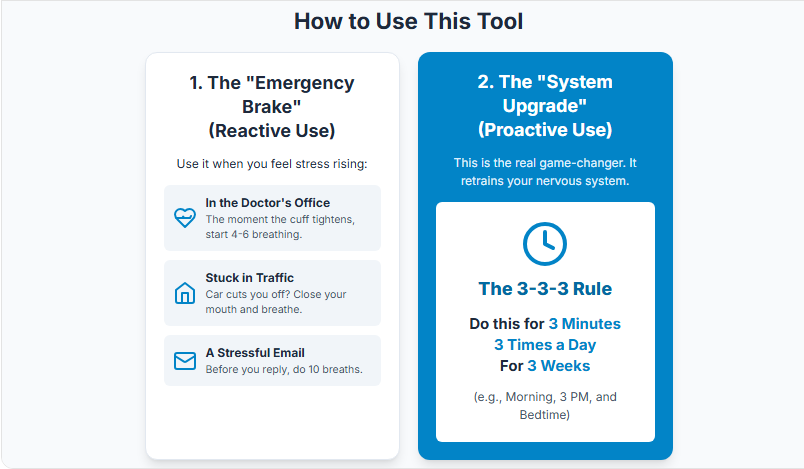
This technique is a tool, and like any tool, you need to know when and how to use it. There are two ways: reactively and proactively.
1. The “Emergency Brake” (Reactive Use)
This is for when you feel your stress and blood pressure rising in the moment.
- In the Doctor’s Office: This is my number one tip. The moment that cuff goes on, close your mouth and start your 4-6 breathing. I have had clients drop their systolic reading by 15-20 points, right in the chair.
- Stuck in Traffic: A car cuts you off. You feel that surge of hot anger. Close your mouth. Breathe 4-6.
- A Stressful Email: Your boss sends you a “we need to talk” message. Before you reply, you do 10 of these breaths.
- Waking at 3 AM: Your mind is racing. Don’t fight it. Just lie on your back and do your 4-6 breathing. It will pull you back into a “rest” state and help you fall back asleep.
2. The “System Upgrade” (Proactive Use)
This is the real game-changer. The reactive method is great, but the proactive method retrains your nervous system. It lowers your baseline stress level, so the panic button doesn’t get triggered as easily.
My prescription for this is simple: The 3-3-3 Rule.
- Do this practice for 3 minutes.
- Do it 3 times a day.
- Do it for 3 weeks to build a new, permanent habit.
A simple schedule:
- Morning: Before you get out of bed. Start your day in a “rest and digest” state.
- Afternoon: Set an alarm for 3 PM. Instead of a coffee, take a 3-minute “breath break.”
- Night: Do it in bed. It’s the most powerful, natural sleep aid you’ll ever find.
My Personal Advice as a Health Advocate
I’m a health advocate, but I am also human. I have deadlines. I have family stress. I get stuck in traffic.
I used to be a classic “chest breather.” I lived with my shoulders up around my ears. Years ago, I had a period of intense family stress—a loved one was in the hospital—and I could feel what it was doing to my body. My heart was thudding, not just beating. I had tension headaches. I was snapping at people.
I felt like a fraud. I’m supposed to be the “expert” on this stuff, and I was a walking ball of sympathetic-nervous-system panic.
One day, in that hospital waiting room, I just… stopped. I went into an empty bathroom, sat on a bench, and set my phone’s timer for five minutes. I closed my mouth and just did the 4-6 breath. Over and over.
The first minute was awful. My mind was racing. But in the second minute, something shifted. I could feel my shoulders… just… drop. The thudding in my chest softened. By the time the timer went off, I didn’t feel “cured,” but I felt “in control.”
This is your control panel. You are not a victim of your body’s automatic responses. You are the pilot. This technique is how you fly the plane. It’s not magic, it’s physiology. And it works.
Myths vs. Facts: Busting Blood Pressure Misconceptions
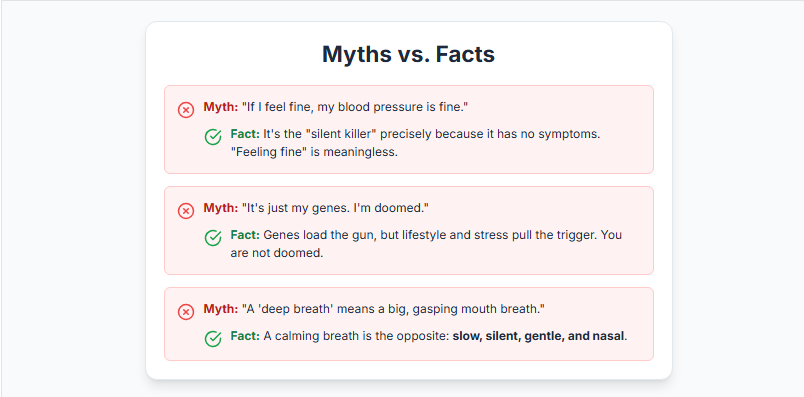
- Myth: “If I feel fine, my blood pressure can’t be that bad.”
- Fact: This is the deadliest myth. Hypertension is called the “silent killer” because it has no symptoms. You can’t feel your arteries hardening. You can’t feel the damage to your kidneys or your brain. “Feeling fine” is meaningless.
- Myth: “It’s all in my genes. My whole family has it, so I’m doomed.”
- Fact: Your genes only load the gun. It’s your lifestyle (and your stress) that pulls the trigger. You may be predisposed, but you are not doomed. This breathing technique is one of the most powerful ways to fight that genetic predisposition.
- Myth: “I just need to cut out salt, and I’ll be fine.”
- Fact: Sodium is a huge factor for many people. But for many others, stress is an even bigger, more powerful trigger. You can eat a perfect, low-sodium diet and still have high blood pressure if your nervous system is on fire.
- Myth: “A ‘deep breath’ means a big, gasping breath through my mouth.”
- Fact: A calming breath is the opposite. It’s slow, silent, gentle, and nasal.
FAQs (Frequently Asked Questions)
1. Can this breathing technique replace my blood pressure medication?
NO. Emphatically, no. Never, ever stop or change your medication without the direct supervision of your physician. This breathing technique is a powerful tool to be used alongside your medical treatment, not instead of it. Over time, your doctor may be able to reduce your dose as your numbers improve, but that is their decision.
2. How fast does it actually work?
You will feel calmer in 1-2 minutes. The positive effect on your nervous system is instant. To see a lasting, structural change in your baseline blood pressure, you need to practice this consistently (proactively) for several weeks.
3. I get dizzy or lightheaded when I do this. What’s wrong?
You’re trying too hard! You’re probably exhaling too forcefully and “blowing off” too much CO2. The key is to make the exhale gentle and slow, not a forceful “push.” Make it smooth. If 4-6 is too much, try 3-5.
4. Why is the nasal breathing part so important again?
Two reasons: 1. It’s the only way to produce Nitric Oxide, which is a gas that chemically relaxes your arteries. 2. It provides the perfect physical resistance to force your exhale to be slow, which is what stimulates the Vagus Nerve.
5. What if I can only exhale for 5 seconds, not 6?
That’s perfect! The only “rule” is that your exhale is longer than your inhale. If 4-in, 5-out is what’s comfortable, start there. You are still hitting the “Brake Pedal.”
6. How much do I need to do this?
As a “system upgrade,” my 3-3-3 rule (3 minutes, 3 times a day) is a fantastic start. But honestly, any amount is better than zero. Use it in traffic. Use it in a long line. Every 4-6 breath is a deposit in your “health bank.”
A Final Word of Encouragement
That number on the machine—the 150/95—it’s not a judgment. It’s not a grade. It’s just data. It’s your body’s way of communicating with you, and it’s telling you the system is overloaded.
For the first time, you now have a direct, physiological way to answer back.
You don’t need a prescription. You don’t need a special pillow or an expensive app. You have everything you need, right now, in this moment.
You are not a victim of your own biology. You are in control.
So, let’s start. Right now. Just one breath. Close your mouth.
Inhale… 1… 2… 3… 4.
Exhale… 1… 2… 3… 4… 5… 6.
You’re already doing it. You’re already on your way.
Disclaimer: I am a health advocate and writer, not a medical doctor. The information in this article is for informational purposes only and is not a substitute for professional medical advice, diagnosis, or treatment. Always seek the advice of your physician.