
SEO Summary:
- Walking backward, or retro-walking, is a powerful form of functional training that activates different muscle groups and, crucially, novel neural pathways in the brain.
- The lack of visual input forces the brain to rely on proprioception (spatial awareness), boosting the function of the cerebellum which governs balance, coordination, and cognitive control.
- This simple exercise significantly reduces the risk of falls, especially in older adults, and improves gait stability.
- Doing it safely requires a simple technique: slow, deliberate toe-to-heel steps in a safe, clear environment. Click to learn the precise protocol for starting today.
The Counter-Intuitive Workout: Why Retro-Walking is Revolutionary
We spend our entire lives moving forward. From the moment we learn to walk as toddlers, every step is a practiced, almost subconscious movement. Our brain has automated forward motion to such an extent that it demands very little conscious thought—which is efficient, but not stimulating.
The moment you turn around and walk backward, everything changes.
Walking backward, or retro-walking, is a powerful form of what I call intentional movement. It takes a heavily automated task and forces your brain to treat it as a brand-new skill. This immediate demand for heightened attention is precisely what makes it a cognitive powerhouse.
When you walk backward, two major systems are shocked into action:
- The Neurological Challenge (The Brain Boost): Your brain loses its primary navigational tool (vision) and must immediately rely on internal sensory information, a sense we call proprioception. This is your body’s ability to know where its parts are in space without looking. This activation heavily engages the cerebellum, the part of the brain that manages balance, fine-tunes motor movements, and is increasingly linked to higher cognitive functions like attention and working memory. By challenging the cerebellum, you are strengthening your entire cognitive command center.
- The Muscular Rebalancing (The Balance Boost): The mechanics of retro-walking reverse the typical forward gait pattern. It forces the muscles around your knees and hips to work harder. You rely less on your hamstrings and more on your quadriceps and anterior tibialis muscles. This balanced activation is crucial for correcting gait abnormalities, stabilizing the knee joint, and improving ankle stiffness—all factors that reduce your fall risk.
This simple reversal of motion turns a mundane walk into a profound, therapeutic tool for both body and mind.
The Quiet Loss of Proprioception and Balance
While falls may sound like an issue only for the elderly, the decline in proprioception and balance starts much earlier, often as a result of a sedentary lifestyle. If you spend most of your day sitting, your body’s awareness of its own position dulls.
Why Forward Walking is Insufficient

Forward walking is highly momentum-driven and requires minimal sensory feedback. Your body is perpetually compensating for a slight forward lean. This continuous, low-demand motion does little to challenge the vestibular system (inner ear balance) or proprioception, leading to what I call “sensory laziness.”
The Silent Dangers of Poor Balance:
- Increased Fall Risk: A fall is not a random event; it is often the failure of the central nervous system to make a rapid, small correction. Poor proprioception means a slower reaction time when stepping on an uneven surface.
- Compromised Rehabilitation: For those recovering from knee or hip injuries, forward walking often overuses certain muscles while ignoring weak stabilizers. Retro-walking forces engagement of the antagonist muscles, providing a more balanced rehabilitation.
- Brain Fog and Anxiety: Balance issues and vestibular system disturbances can contribute directly to general anxiety and brain fog, as the brain is constantly expending energy trying to stabilize the environment.
Retro-walking forces your feet to engage the ground with greater intention. You are stepping backward onto the forefoot/toe first, then rolling back to the heel, a reverse of the normal gait. This deliberate, mindful placement is exactly the training your balance system requires to stay sharp.
The Technique Trap: Why Speed is the Enemy of Safety
The single biggest barrier to receiving the therapeutic benefit of retro-walking is attempting to do it too fast or without attention to safety. Since you are performing a functional movement without the aid of vision, the risk of stumbling or falling is significantly higher, particularly for beginners.
The Critical Safety Mindset
The goal of this exercise is mindful, slow, controlled movement, not speed or distance. If you are breathing heavily or moving quickly, you are increasing the chance of a misstep and you are likely sacrificing the neurological engagement we are seeking. The brain needs time to process the new sensory data.
Key Safety Imperatives:
- Clear Environment: Never attempt this in a cluttered room, near stairs, or on uneven pavement. A clear hallway, a gym floor, or a flat, marked track is ideal.
- Slow and Steady Pace: Aim for a pace that allows you to consciously feel the placement of your foot on the ground at every step.
- Use Support (Initially): For the first few weeks, I strongly recommend walking alongside a wall or a sturdy railing where you can place one hand for immediate stabilization if needed. This builds confidence while still engaging the proprioceptive system.
By prioritizing safety and control over performance, you ensure that the exercise remains therapeutic, not dangerous.
The Safe Protocol for Retro-Walking
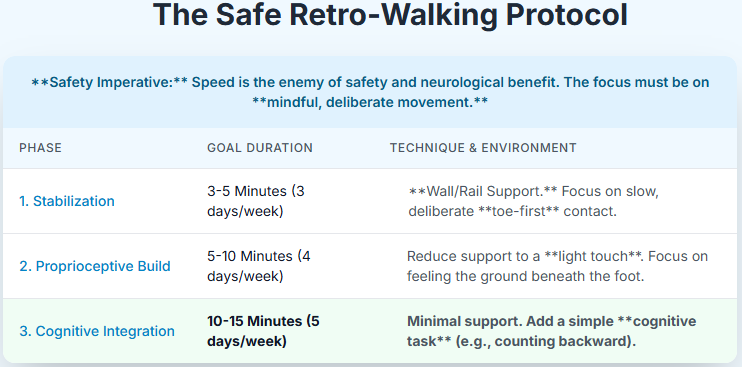
Once you have secured a safe environment, you can begin to implement the protocol. This exercise should be integrated into your regular movement routine 3 to 5 times per week.
The Healthcare Advocate’s Retro-Walking Protocol
| Phase | Goal Duration | Technique Focus | Environment |
| Phase 1: Stabilization | 3-5 Minutes (3 days/week) | Support is essential. Walk alongside a wall or use a railing. Focus on a very slow, toe-first contact. | Indoors, clear hallway, or flat track. |
| Phase 2: Proprioceptive Build | 5-10 Minutes (4 days/week) | Reduce hand support to a light touch. Focus on looking slightly over your shoulder to ensure clearance, then focus on feeling the ground. | Same as Phase 1, ensure no obstacles. |
| Phase 3: Cognitive Integration | 10-15 Minutes (5 days/week) | Minimal to no support. Try adding a simultaneous simple cognitive task (e.g., counting backward by sevens). | Long, flat surface with guaranteed clearance. |
The Proper Foot Technique:
Unlike forward walking where you strike with the heel, in retro-walking, you should step backward with a toe-first contact, gently rolling through the mid-foot to the heel. This places your body in a stable, shock-absorbing posture and forces the activation of your quads and shins, which is the desired muscular benefit.
Beyond the Walk: Integrating Brain-Boosting Movements
While retro-walking is a standout, its benefits are maximized when integrated with other functional movements that also challenge your balance, spatial awareness, and cognitive control. These are exercises that intentionally disrupt your routine and force neural adaptation.
Three Complementary Brain-Body Exercises
- Tandem Walking (The Tightrope Walk): Walking heel-to-toe in a straight line, as if on a tightrope. This severely narrows your base of support, dramatically increasing the challenge to the cerebellum and improving dynamic balance. Perform this next to a wall for safety.
- Single-Leg Balance (The Foundation): Stand on one leg. Start with 30 seconds, building up to 60 seconds. Progress by closing your eyes. The removal of vision exponentially increases the demand on proprioception and is a powerful brain workout.
- Cross-Body Marching: March in place, touching your right elbow to your left knee, and vice versa. This requires simultaneous contralateral (cross-body) movement and cognitive coordination, improving the communication between the two hemispheres of your brain.
By combining retro-walking with these simple movements, you ensure a holistic training regimen for your nervous system, guaranteeing that you are building resilience against both cognitive decline and physical falls.
My Personal Advice as a Health Advocate
I started retro-walking years ago, first as a rehabilitation tool and then as a regular cognitive boost. I remember the initial feeling of awkwardness—it felt profoundly unnatural, almost silly. That feeling of disorientation is your brain saying, “I haven’t done this in a while, and I need to reroute some pathways!” That feeling is the exact therapeutic signal you should embrace.
I integrated my retro-walking during my treadmill cool-down. After 20 minutes of forward walking, I switch the incline to a slight zero incline and the speed to a very slow 1.0 to 1.5 mph. Since I’m holding the side rails, I can focus entirely on the toe-to-heel mechanics and the proprioceptive feedback without fear of falling.
My advice: Don’t worry about looking strange. Don’t worry about the speed. Focus entirely on the quality of the movement and the conscious connection between your brain and your foot placement. A 10-minute retro-walk, done mindfully, is worth 30 minutes of subconscious forward movement for your balance and brain health.
Myths vs. Facts: Functional Movement Misconceptions
Despite its simplicity, retro-walking can raise some questions, often centered on joint health or effectiveness.
| Myth | Fact |
| Myth: Walking backward is bad for your knees. | Fact: It is often better for your knees. It reduces the impact on the knee joint and engages the quadriceps, strengthening the muscles that stabilize the knee. |
| Myth: You should walk backward quickly to get a cardio workout. | Fact: The primary goal is neurological and functional, not cardiovascular. Fast movement risks injury and diminishes the proprioceptive demands. Keep the pace slow and controlled. |
| Myth: This is only necessary for older people. | Fact: Everyone benefits from challenging their proprioception. For young athletes, it improves agility; for young professionals, it improves focus and working memory. |
| Myth: I can walk backward at the gym on the treadmill safely. | Fact: Treadmills are high-risk environments for retro-walking. If you use one, go extremely slow (1.0–1.5 mph), use a slight incline, and hold the side rails for absolute stability. |
FAQs (Frequently Asked Questions)
- How long does it take to see results in balance?Studies suggest that consistent retro-walking (3 times per week) can show measurable improvements in gait stability and balance within 4 to 6 weeks, as the neurological pathways begin to adapt.
- Should I look over my shoulder the whole time?Only occasionally to ensure your path is clear. The primary benefit comes from NOT relying on vision. Try to minimize visual checks and focus on the feeling of the ground beneath your feet.
- Does walking up a slight incline backward increase the benefit?Yes, once you are stable and comfortable, a slight incline (2–3 degrees) can increase the muscle activation (especially the quads) and add a controlled challenge to the balance system, but this should only be done with support initially.
- Can I do this barefoot?Yes, and it is highly recommended once you are comfortable. Walking barefoot on a safe surface (like a soft mat or carpet) increases the sensory feedback to your feet, which further enhances the proprioceptive benefit.
- Is there a point when I can stop doing it?No. Proprioception, like muscle strength, declines when not challenged. To maintain the benefits, you should aim to integrate at least 10 minutes of retro-walking into your routine 3–5 times per week for life.
Conclusion & A Final Word of Encouragement
The simple act of reversing your direction is a powerful cognitive hack. Walking backward is not just a physical exercise; it’s a deliberate challenge to your nervous system that forces the integration of sensory and motor skills, directly boosting the function of your cerebellum.
By committing to the safe protocol—slow, mindful, toe-first movement in a clear environment—you are taking one of the most proactive steps available to improve your dynamic balance, reduce your fall risk, and sharpen your memory and focus.
Embrace the awkwardness. Embrace the challenge. Turn around today and take the first deliberate step toward a more coordinated and cognitively resilient future.
Disclaimer: I am a health advocate and writer, not a medical doctor. The information in this article is for informational purposes only and is not a substitute for professional medical advice, diagnosis, or treatment. Always seek the advice of your physician or a physical therapist, especially if you have a history of falls or existing balance issues, before initiating this exercise.