


- Panic attacks often stem from a physiological feedback loop that can be hijacked directly via the Vagus nerve, which connects your diaphragm to your brain.
- This immediate calming response is activated by pairing your inhale with a specific, counterintuitive shoulder movement that forces maximal diaphragmatic activation.
- Learn the precise technique, which we call the “Vagal Lock,” to interrupt panic and high anxiety in less than thirty seconds without relying on medication or standard grounding exercises.
The Panic Trap: Why Traditional Methods Fail

If you have ever experienced a full-blown panic attack, you know it is one of the most terrifying, visceral experiences a person can have. It’s not just “stress.” It’s a sudden, overwhelming, physiological event: your heart pounds, your chest tightens, you may feel dizzy, and your thoughts spiral into a terrifying place.
When this happens, the standard advice—Take a deep breath, Try grounding yourself, Focus on your surroundings—can feel useless, or even antagonistic. Why? Because the panic attack has already hijacked your body’s control tower, and your conscious mind is no longer in charge of the symptoms.
Panic isn’t a thought problem; it’s a physiological problem where your Sympathetic Nervous System (the “Fight or Flight” system) has gone into overdrive. Your body genuinely believes you are in mortal danger, and it shuts down all non-essential functions (like digestion and rational thought) to prepare for survival.
To stop a panic attack quickly, you can’t reason with the emotion. You must speak directly to the body’s control tower using its own language—physiology.
And that language is spoken through your diaphragm.
I’ve spent years researching and teaching methods that bridge the mind-body gap. This technique, rooted in respiratory neuroscience, is the most powerful and rapid physiological reset I have ever encountered. It doesn’t ask you to calm your mind; it forces your body to calm itself by flicking a specific “off” switch in the brainstem.
The Diaphragm-Brain Connection: Your Built-In Calm Switch
To understand how a simple shoulder movement can stop a panic attack, we need to talk about the Vagus nerve.
The Vagus nerve is the longest nerve in your body, running from your brainstem all the way down to your colon. It is the primary operator of the Parasympathetic Nervous System (the “Rest and Digest” system). Crucially, a huge network of Vagus nerve fibers surrounds your lungs and attaches directly to your diaphragm, the dome-shaped muscle beneath your lungs responsible for deep breathing.
When you are in a panic attack:
- Breathing is shallow: You breathe rapidly high in your chest, using accessory muscles instead of the diaphragm.
- The Vagus is silent: Because the diaphragm isn’t fully engaging, the Vagus nerve sends no “all clear” signal to the brain.
- The loop perpetuates: The brain receives no safety signal, so it keeps the Sympathetic alarm blaring.
This specific technique works by forcefully hijacking the diaphragm-brain feedback loop. By making a calculated change to the mechanics of your inhale, you compel the diaphragm to fully descend. This movement sends a massive, immediate “SYSTEM RESET” signal directly up the Vagus nerve to the brain, overriding the panic alarm in a flash.
Unlocking the Vagal Lock: The Counterintuitive Movement
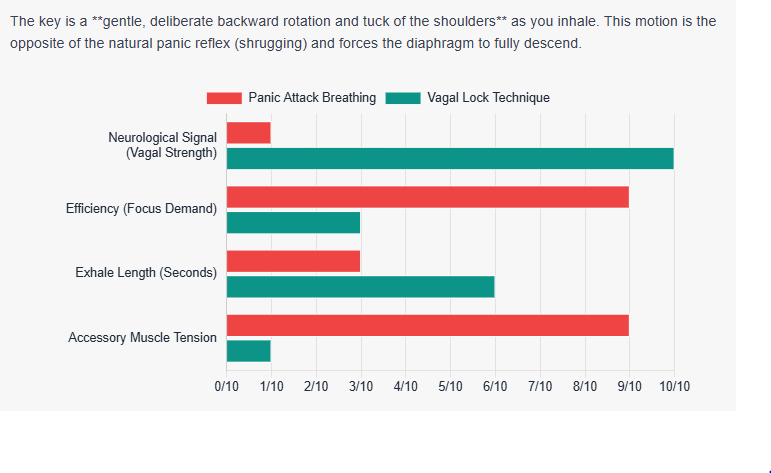
The key to activating this reflex is not just taking a deep breath; it’s how you initiate the inhale.
When people try to take a “deep breath” during panic, they often lift their shoulders up toward their ears. This motion is called inhalation shrugging, and it actually tenses the upper chest and accessory breathing muscles, preventing true diaphragmatic expansion.
The technique requires the counterintuitive shoulder movement: a gentle, deliberate backward rotation and tuck of the shoulders as you inhale.
I call this the Vagal Lock because this simultaneous movement forces the full expansion of the lower ribcage and diaphragm, effectively “locking” the Vagus nerve into the parasympathetic “calm” state.
Why the Backward Tuck Works
- Creates Space: By gently tucking the shoulders backward, you naturally extend your spine and open the chest cavity. This is an anatomically superior position for the diaphragm to descend.
- Signals Safety: Hunching forward is the posture of fear and self-protection. Drawing the shoulders gently back and down is the posture of confidence and openness, which provides an immediate non-verbal safety cue to the brain.
- Maximizes Exhalation: While the shoulder tuck is for the inhale, the proper opening of the chest allows for a complete, slow, and unforced exhalation, which is the primary driver of Vagus nerve activation.
I’ve compiled a comparison table to show you exactly how the Vagal Lock differs from your body’s default panic response.
| Feature | Panic Attack Breathing | Vagal Lock Technique (Anti-Phase) |
| Pace | Rapid, shallow, upper chest | Slow, deep, diaphragmatic (belly expands) |
| Inhale Shoulder Motion | Shoulders rise toward ears (shrugging) | Shoulders gently tuck backward and down |
| Exhalation Timing | Short, held, or ragged (brain signals danger) | Long, slow, controlled (brain signals safety) |
| Neurological Signal | Fight or Flight (Sympathetic) | Rest and Digest (Vagus Nerve Activated) |
| Effect Time | Perpetuates anxiety | Interrupts panic in under 30 seconds |
The 30-Second Reset: Practical Application
When you feel the first flutter of panic, you have a brief window—that moment when the symptoms begin to surge—to activate the Vagal Lock. The speed of the result depends entirely on the precision of the pairing.
Phase 1: The Vagal Lock Inhale (4 Seconds)
- Posture: Sit up straight or stand tall. If sitting, plant your feet firmly on the floor.
- The Move: As you begin to slowly draw air in through your nose, simultaneously and gently tuck your shoulders backward and slightly down. Focus on pushing your belly out, not lifting your chest.
- Duration: Inhale for a slow count of four. Ensure the shoulder motion and the breath start and end at the same moment. This is the Lock.
Phase 2: The Parasympathetic Exhale (6 Seconds)
- The Slow Release: Without holding your breath, immediately begin to exhale the air through pursed lips (as if blowing through a straw).
- The Stretch: Focus on making this exhalation feel long and slow. The key to stimulating the Vagus nerve is the slow release of air, which actively lowers your heart rate.
- Duration: Exhale for a slow count of six or seven. Let the air trickle out until your diaphragm feels fully relaxed.
The 30-Second Command
Repeat this precise 4-second Inhale (with Shoulder Tuck) / 6-second Exhale pattern three times.
- Repetition 1: Hijacks the sympathetic response.
- Repetition 2: Triggers parasympathetic dominance (calm).
- Repetition 3: Stabilizes the new, lowered heart rate.
In thirty seconds, you have sent a powerful, undeniable signal to your brainstem that the danger has passed.
Beyond Panic: Using the Vagal Lock for Daily Stress
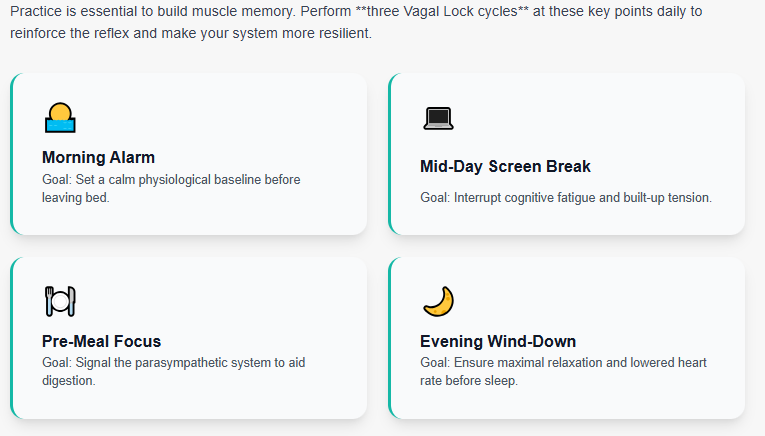
The Vagal Lock is not just an emergency brake; it’s a powerful tool for proactively managing the general anxiety and high-stress levels that plague modern life. By practicing this technique daily, you can strengthen the Vagus nerve’s regulatory function and make your entire nervous system more resilient.
Consistency allows your brain to quickly recognize and respond to the shoulder-tuck-on-inhale cue, making the panic-stopping reflex faster and more automatic over time.
Your Vagal Lock Daily Resilience Checklist
Practice this sequence three times a day to reinforce the reflex, even when you aren’t feeling panic.
- [ ] Morning Alarm: Complete three full cycles (4-in, 6-out with the shoulder tuck) before getting out of bed. Goal: Set a calm physiological baseline for the day.
- [ ] Mid-Day Screen Break: Complete three cycles during a short break from your computer or phone. Goal: Interrupt tension and cognitive fatigue.
- [ ] Pre-Meal Focus: Complete three cycles before you eat lunch or dinner. Goal: Signal the parasympathetic system to aid digestion (Rest and Digest).
- [ ] Evening Wind-Down: Complete five slow cycles before you start reading or turn out the lights. Goal: Ensure maximal relaxation before sleep.
Self-Correction Cue: If you feel your chest rising or your shoulders shrugging during the inhale, stop. Exhale completely, reset your spine, and restart the inhale with a firm mental command to tuck the shoulders backward.
When to Use It (And Who It Helps Most)
The Vagal Lock is particularly effective for those whose anxiety manifests primarily through physical symptoms: rapid heart rate, shortness of breath, chest tightness, or stomach churning. If your panic starts as a physical surge before the thoughts catch up, this is your perfect tool.
- When to Use It:
- The Onset of Panic: The moment you feel the first symptom.
- High-Stakes Moments: Before a presentation, a difficult conversation, or a flight.
- Transition Points: When moving from a highly stimulating environment (like a commute or a crowd) to a quiet one.
- The Crucial First Step: Don’t wait for the third cycle to feel “totally calm.” The success is measured by the interruption of the panic spiral. The moment the surge stops rising—when your heart rate plateaus and begins to descend—you have won. The full calm will follow naturally.
My Personal Advice as a Health Advocate
I once worked with a young professional who suffered from debilitating, sudden panic attacks, usually while driving. She had tried everything—grounding, counting exercises, music—but nothing worked fast enough to prevent her from needing to pull over.
When I taught her the Vagal Lock, she was skeptical because it seemed too simple, and the shoulder movement felt ridiculous. But she committed to practicing the daily routine.
The next time a surge of panic hit her on the freeway, she remembered the shoulder tuck. She performed just one 4/6 cycle with the precise backward movement. Her immediate report was transformative: “I didn’t feel calm, but I felt stable. My heart rate just stopped spiking. It was like I hit a governor on the engine.”
That’s the power of this technique. It doesn’t instantly dissolve the anxiety; it seizes the body’s control panel and forces a physiological halt to the escalating panic.
My final piece of advice is to practice when you are well. When you are calm, practice the Vagal Lock. When panic hits, your body needs to instinctively draw on muscle memory, not mental effort. Make the “counterintuitive shoulder movement” the most intuitive thing you do.
Myths vs. Facts: Busting Panic and Breathing Misconceptions
- Myth: Panic attacks mean I’m mentally weak or need strong medication.
- Fact: Panic attacks are a sign of a highly sensitive and overworked nervous system. The Vagal Lock technique proves that physiological reset often works faster and more effectively than cognitive intervention.
- Myth: Any deep breathing will calm a panic attack.
- Fact: Inaccurate. Shallow chest breathing (even if slightly deeper) will perpetuate the hyperventilation cycle. Only breathing that forces full diaphragmatic movement and, crucially, features a long, slow exhalation will successfully activate the Vagus nerve and parasympathetic system.
- Myth: You should inhale deeply and hold the breath to oxygenate your blood.
- Fact: Holding your breath can often trigger more panic in high-anxiety states. The key to calming the body is the slow release of air (the long exhale), which directly signals the heart rate to slow down.
FAQs (Frequently Asked Questions)
1. Is it bad if I make a noise during the long exhale?
Absolutely not. Making a gentle, audible “shhh” sound as you exhale through pursed lips is actually helpful. It ensures the air is leaving your body slowly and controllably, maximizing Vagus nerve stimulation.
2. Can I do this standing up, or do I need to sit down?
You can do this in any position—standing, sitting, or even lying down. The most important factor is maintaining a straight spine so that the chest is open, allowing the shoulder tuck and diaphragm expansion to be most effective.
3. What if I feel a little lightheaded after the first cycle?
A tiny bit of lightheadedness is a common side effect of forcing a deeper breath than usual. It’s temporary. Reduce the duration of the inhale slightly (e.g., inhale for 3.5 seconds instead of 4) while keeping the exhale at 6 seconds.
4. How does this compare to a standard box breathing technique (4-4-4-4)?
Box breathing is excellent for maintenance. However, the Vagal Lock is a superior emergency interrupt because it adds the specific shoulder movement to mechanically force diaphragmatic action, overriding the panic feedback loop much faster than simple timing alone.
5. I can’t breathe out for 6 seconds; my chest is too tight. What should I do?
Don’t strain. Start by exhaling for the longest, slowest count you comfortably can, even if it’s only 4 seconds. Focus only on making the exhale slower than the inhale. As you practice daily, your ability to extend the exhale will naturally increase.
Conclusion & A Final Word of Encouragement
The feeling of a panic attack taking hold is one of the most helpless feelings in the world. But I want you to remember this: You are not helpless. You are equipped with a rapid, powerful, physiological tool that requires no special equipment, no training, and only a minute of focused attention.
The discovery of the Vagal Lock confirms that the fastest route to calm is not through deep thought, but through precise motion.
By committing to the simple, counterintuitive shoulder tuck paired with your inhale, you are taking back ownership of your nervous system. You are telling your body, with authority and clarity, that you are safe.
Keep this technique in your back pocket. Practice it daily. And know that the next time panic tries to hijack your life, you have a physical “off” switch ready to deploy in under thirty seconds.
Disclaimer: I am a health advocate and writer, not a medical doctor. The information in this article is for informational purposes only and is not a substitute for professional medical advice, diagnosis, or treatment. Always seek the advice of your physician.