

SEO Summary:
- Many popular chemical sunscreens contain compounds, such as Oxybenzone and Octinoxate, that are classified as Endocrine Disrupting Chemicals (EDCs).
- EDCs are absorbed into the bloodstream at high levels, where they have been shown to mimic or block crucial hormones like estrogen and thyroid hormones, posing potential risks to reproductive and metabolic health.
- The safe alternative is mineral sunscreen, using non-nano Zinc Oxide and Titanium Dioxide, which sit safely on the skin’s surface and are not systemically absorbed.
- Click to learn the “Toxic Six” chemicals to strictly avoid and the essential protocol for protecting your skin without jeopardizing your hormonal balance.
The Hidden Cost of UV Protection: Chemical Absorption

For decades, we’ve been diligent about applying sunscreen, rightfully fearing the damaging effects of ultraviolet (UV) radiation. However, in our quest for skin health, many of us have unknowingly traded one risk for another. The very chemicals designed to protect us from the sun are now a documented source of concern for our deepest biological systems: our hormones.
There are two primary categories of sunscreen, and the difference between them is profound:
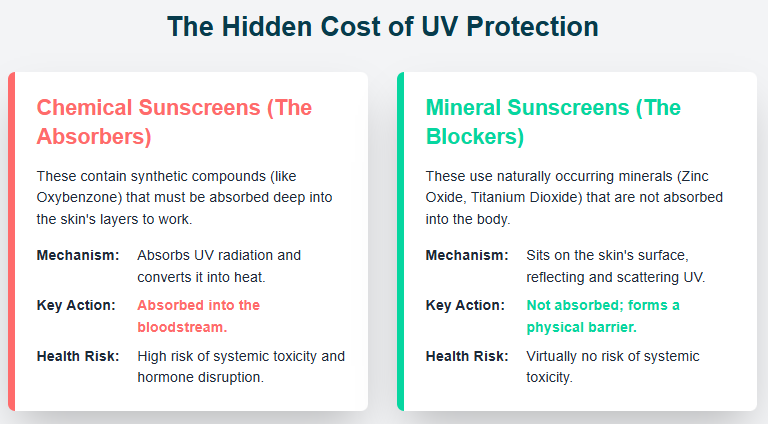
- Chemical Sunscreens (The Absorbers): These contain synthetic carbon-based compounds (like Oxybenzone). They work by absorbing UV radiation and converting it into heat, which is then released from the skin. Crucially, in order to perform this conversion, they must be absorbed deep into the skin’s layers. Recent FDA studies confirmed that many of these compounds are absorbed into the bloodstream at concentrations far exceeding safety guidelines, where they remain for extended periods.
- Mineral Sunscreens (The Blockers): These use naturally occurring minerals (Zinc Oxide and Titanium Dioxide). They work by sitting on the surface of the skin, forming a physical barrier that reflects and scatters UV radiation. Because they are not absorbed into the body, they pose virtually no risk of systemic toxicity or hormone disruption.
The systemic absorption of chemical UV filters is the root of the problem. Once these foreign chemicals enter the bloodstream, they begin to interact with our body’s most sensitive signaling systems—the endocrine system.
The Endocrine Alarm: How Chemicals Disrupt Hormones
To understand the risk, we must understand the endocrine system. This system is the body’s master communication network, using hormones (like estrogen, testosterone, and thyroid hormone) to control everything from metabolism and growth to mood and fertility.
Endocrine Disrupting Chemicals (EDCs) are synthetic chemicals that, when ingested or absorbed, interfere with this delicate system. They can do this in three primary ways:
- Mimicking Hormones: The chemical can trick the body into thinking it’s a natural hormone (like estrogen), binding to the hormone receptor sites and over-stimulating the target cells.
- Blocking Hormones: The chemical can bind to the receptor sites, blocking the body’s natural hormones from doing their job.
- Altering Hormone Metabolism: The chemical can interfere with the body’s natural production or breakdown of hormones, leading to unnaturally high or low levels.
Specific Health Risks Associated with Chemical Filters
Research has specifically linked certain chemical filters found in sunscreens to potential interference with two major systems:
- Reproductive Health: EDCs often display estrogenic and anti-androgenic activity, which is concerning for fertility, fetal development, and conditions like endometriosis and PCOS.
- Thyroid Function: Certain UV filters have been shown to interfere with thyroid hormone signaling, which is essential for metabolism, energy levels, and brain health.
The presence of these foreign chemicals circulating in the body for days or weeks after application is the alarm bell we must heed.
The “Toxic Six”: Chemicals to Avoid
When you pick up a bottle of sunscreen, the first thing you must do is flip it over and inspect the “Active Ingredients” panel. If you see any of the following six chemicals listed, I strongly advise you to put the product back on the shelf.
These compounds have been singled out by health advocacy groups and regulatory bodies for their known or suspected endocrine-disrupting properties and high absorption rates.
The Healthcare Advocate’s Chemical Sunscreen Avoid List
| Chemical Name | Primary Concern | Status & Notes |
| Oxybenzone (Benzophenone-3) | High Endocrine Disruptor | Most common EDC in sunscreens. Linked to estrogenic activity, low birth weight, and high systemic absorption. MUST AVOID. |
| Octinoxate (Ethylhexyl Methoxycinnamate) | Endocrine & Environmental Disruptor | Absorbed readily; thyroid and reproductive hormone concerns. Also highly toxic to coral reefs. |
| Octocrylene | High Absorption & Allergies | High systemic absorption. Can degrade into benzophenone, a known carcinogen, and is often linked to skin allergies. |
| Homosalate | Endocrine & Absorption | Absorbed in large amounts. Shown to interfere with estrogen, androgen, and progesterone activity. |
| Octisalate (Ethylhexyl Salicylate) | Absorption & Enhancement | Less studied for EDCs, but readily absorbed and used as an absorption enhancer for other chemicals. |
| Avobenzone | Stability Concern | Generally less toxic than Oxybenzone, but breaks down rapidly in sunlight, and its breakdown products are less known. Often paired with other EDCs. |
My advice is simple: if the active ingredient list contains anything other than Zinc Oxide or Titanium Dioxide, find an alternative.
The Safe Switch: Adopting the Mineral Protocol
The good news is that you do not have to compromise on sun safety. The solution is readily available, highly effective, and completely non-toxic: mineral sunscreen.
Mineral sunscreens provide broad-spectrum protection (UVA and UVB) and act as a physical shield. They do not penetrate the skin barrier, ensuring you get protection without systemic exposure to EDCs.
The Advocate’s Mineral Sunscreen Checklist
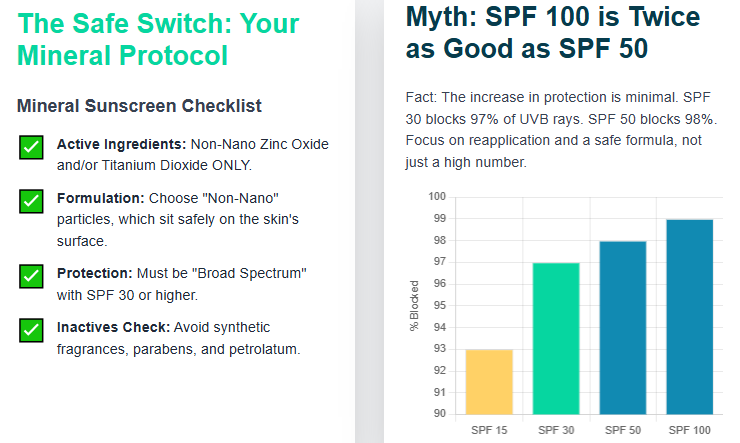
- Active Ingredients MUST Be: Non-Nano Zinc Oxide (best for broad spectrum and stability) and/or Titanium Dioxide.
- Formulation Type: Choose non-nano. Nano-particles are small enough that there is a theoretical, though low, risk of absorption. Non-nano particles are larger and confirmed to sit safely on the skin’s surface.
- Broad Spectrum: Ensure the label explicitly states “Broad Spectrum” and an SPF 30 or higher. SPF 30 blocks 97% of UVB rays; higher SPF offers only marginal increases in protection.
- Inactives Check: Look for clean inactive ingredients. Avoid unnecessary chemicals, synthetic fragrances, parabens, and petrolatum. Look for soothing ingredients like aloe, coconut oil, or shea butter.
Application Protocol
Mineral sunscreens work instantly, but proper application is critical to avoid the chalky, white film they are known for:
- Warm It Up: Rub the sunscreen thoroughly between your palms before applying.
- Small Sections: Apply a small amount to one area of skin at a time and rub it in completely before moving to the next section.
- Reapply Diligently: Reapply every two hours, or immediately after swimming or heavy sweating.
Beyond the Sunscreen: Lifestyle for Endocrine Support
Switching to mineral sunscreen is a massive victory, but achieving optimal hormonal health is a holistic endeavor. Your endocrine system is influenced by toxins in plastic, food, and the environment.
Holistic Endocrine Protection Strategy
- Avoid Heating Plastics: Never microwave food in plastic containers or drink hot beverages from plastic cups. Heat causes EDCs (like BPA/BPS) to leach into food and drink at a rapid rate. Use glass or stainless steel.
- Filter Your Water: Invest in a high-quality water filter (carbon filter or reverse osmosis) to remove pesticides and synthetic chemicals that can act as EDCs.
- Eat Clean: Prioritize a diet rich in fiber and cruciferous vegetables (broccoli, kale, cabbage). These foods contain compounds that help the liver detoxify and safely excrete excess hormones and EDCs from the body.
- Limit Synthetic Fragrances: Many synthetic fragrances found in perfumes, air fresheners, and body washes contain phthalates, another class of EDCs linked to hormonal interference. Choose fragrance-free products or those scented with pure essential oils.
My Personal Advice as a Health Advocate
I know the frustration of searching for a good mineral sunscreen. For years, they were thick, pasty, and left a visible white cast, making them unwearable under makeup or on darker skin tones.
The industry has changed dramatically. I encourage everyone to test newer, high-quality zinc oxide formulas. Many now contain non-nano, non-whitening zinc oxide and are tinted with iron oxides, which blend beautifully into a wide range of skin tones. Yes, they require a bit more rubbing than chemical sprays, but that small extra effort is your insurance against absorbing hormone disruptors.
The key is to become a relentless label reader. Do not trust the marketing claims on the front of the bottle (“Natural,” “Reef-Safe”); flip it over and verify the “Active Ingredients” are only Zinc Oxide and/or Titanium Dioxide. Your hormonal health is worth the extra ten seconds of scrutiny.
Myths vs. Facts: Sunscreen Misconceptions
There are several persistent myths that prevent people from making the necessary and safe switch to mineral sunscreens.
| Myth | Fact |
| Myth: Mineral sunscreens are all chalky and leave a white residue. | Fact: Newer formulations use advanced zinc oxide technology and often contain tints to reduce the white cast. The aesthetic quality has improved significantly. |
| Myth: Using sunscreen causes Vitamin D deficiency. | Fact: Sunscreen blocks UVB rays, which make Vitamin D, but it is nearly impossible to block 100%. The vast majority of people get enough D from incidental sun exposure or from high-quality supplements. Do not risk skin cancer for minimal vitamin D gain. |
| Myth: SPF 100 is twice as good as SPF 50. | Fact: The increase in protection is minimal. SPF 15 blocks 93%, SPF 30 blocks 97%, and SPF 50 blocks 98%. Focus on reapplication and choosing a safe SPF 30 or 50. |
| Myth: Spray sunscreens are easier and better. | Fact: Sprays are dangerous. They create airborne particles that can be accidentally inhaled into the lungs, where chemical filters pose an even higher toxicity risk. AVOID SPRAY SUNSCREENS. |
FAQs (Frequently Asked Questions)
- Are these chemical sunscreens bad for children?Yes. The developing endocrine system of children and infants is highly sensitive to disruption. It is even more critical to exclusively use non-nano Zinc Oxide sunscreens on babies and young children.
- What about Retinyl Palmitate (Vitamin A)?Some older sunscreens contain Retinyl Palmitate (a form of Vitamin A), which is used as an antioxidant. However, studies suggest that when applied to skin exposed to sun, it can accelerate skin damage and tumor growth. Avoid sunscreens that contain Retinyl Palmitate.
- Can I still use a tinted moisturizer with chemical filters?It is best to transition to a tinted moisturizer or BB cream that uses mineral-only filters. Even a small amount of daily chemical exposure adds up over years and decades.
- Is Zinc Oxide safe for acne-prone skin?Yes. Zinc is a natural anti-inflammatory agent and is often beneficial for acne-prone or sensitive skin. Look for oil-free or non-comedogenic formulas.
- Why are these chemical sunscreens still on the market?Regulatory processes are slow, and the industry is complex. While the FDA has requested more data on the safety of the chemical filters due to the absorption concerns, they remain legal for use until definitive action is taken. Consumer choice remains your fastest path to safety.
Conclusion & A Final Word of Encouragement
The time for complacency regarding our sunscreen is over. Scientific evidence confirms that many popular chemical UV filters are absorbed into the bloodstream, where they have the potential to disrupt the delicate balance of our endocrine system.
Your action plan is clear and simple: Switch today. Eliminate the “Toxic Six” chemical filters and choose a high-quality, non-nano Zinc Oxide or Titanium Dioxide mineral formula. This switch is one of the most effective, easy, and direct steps you can take to reduce your daily toxic load and protect your hormonal health.
Take control of your health decisions. Read that label, choose mineral, and enjoy the sun safely and confidently.
Disclaimer: I am a health advocate and writer, not a medical doctor. The information in this article is for informational purposes only and is not a substitute for professional medical advice, diagnosis, or treatment. Always seek the advice of your physician regarding specific medical conditions or hormonal concerns.