


- A specific sleep position that forces your neck into extreme rotation or hyper-extension can mechanically restrict the arteries supplying blood to your brain.
- This chronic, silent restriction can damage the artery walls over years, accelerating the risk factors for stroke and TIA (Transient Ischemic Attack).
- The fix is a simple pillow adjustment and an awareness of achieving neutral spine alignment while you sleep—a practice most people overlook every single night.
The Invisible Nighttime Threat
We spend nearly a third of our lives asleep. We assume that when we close our eyes, our body goes into repair mode, performing all its essential maintenance without our interference.
For most of the body, that’s true. But for the delicate network of arteries that feed your brain, the way you choose to position your head every night can quietly be doing more harm than good.
The key to brain health is constant, perfect blood flow. Your brain demands $20\%$ of the body’s entire blood supply, and if that flow is momentarily restricted or chronically compromised, the downstream effects on your cognition and overall stroke risk are severe.
The biggest culprit isn’t a complex disease or a faulty gene. It’s a simple mechanical stress—the result of a poor sleep habit that most people start in childhood and never correct. The good news? The fix requires only a moment of awareness and, perhaps, a trip to the linen closet.
The Two Riskiest Positions (And Why)
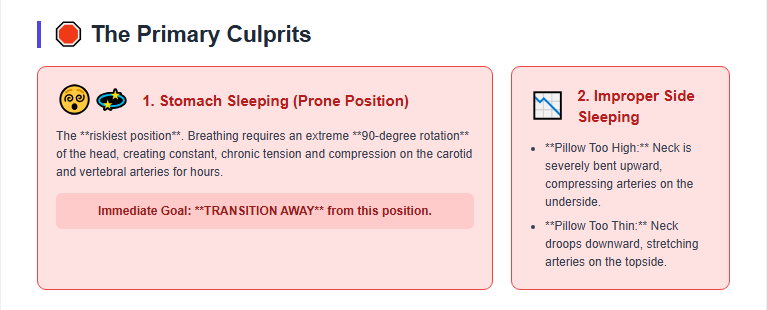
The problem position is any posture that forces your neck to bend or rotate sharply away from the midline for hours on end. This creates a mechanical squeeze on the crucial arteries that run through your neck.
1. The Primary Culprit: Stomach Sleeping (Prone Position)
This is the riskiest position for your circulation. If you sleep on your stomach, you must turn your head almost 90 degrees to breathe.
Imagine turning your head as far as you can and holding that position for eight hours straight. That extreme rotation creates a constant, chronic tension on the major arteries in your neck, including the vertebral and carotid arteries. Over years, this consistent stretching and compression can damage the inner lining of the artery (the endothelium), making it prone to plaque formation or small tears that can lead to blood clots.
2. The Second Risk: Side Sleeping with Improper Support
Side sleeping is generally considered safe and healthy, but only if you maintain a neutral spine.
- Pillow Too High: Your neck is severely bent upward toward your shoulder. This compresses the arteries on one side.
- Pillow Too Thin: Your neck droops downward toward the mattress. This stretches the arteries on the other side.
In both cases, you are applying unnecessary strain on the vessels designed to carry blood without resistance.
The Science: The Arterial Squeeze and Stroke Risk
The primary scientific concern in poor neck alignment relates to two pairs of vessels: the carotid arteries (along the front/sides of the neck) and the vertebral arteries (which run up through the tiny holes in the cervical spine bones).
The Vertebral Artery Risk
The vertebral arteries are particularly vulnerable. They are encased within the bones of your neck, and when the neck is sharply rotated, the blood vessel is physically squeezed by the surrounding bone structure.
When this happens night after night:
- Chronic Damage: The repetitive mechanical stress can cause what is called an arterial dissection, a small tear in the inner layer of the artery wall.
- Clot Formation: The body rushes to heal this tear, which can lead to the formation of a clot (thrombus).
- Embolism: If a piece of this clot or damaged lining breaks off and travels up to the smaller vessels in the brain, it can cause an ischemic stroke. This is often referred to in extreme cases as Vertebral Artery Dissection (VAD), though the long-term, low-grade stress of poor posture is a more silent, chronic risk factor.
The problem isn’t that one night of poor sleep will cause a stroke. The problem is that millions of people are spending 30% of their lives increasing the wear-and-tear on these vital vessels, quietly accelerating a stroke risk that they attribute to genetics or diet.
The Fix: Mastering Neutral Spine Alignment
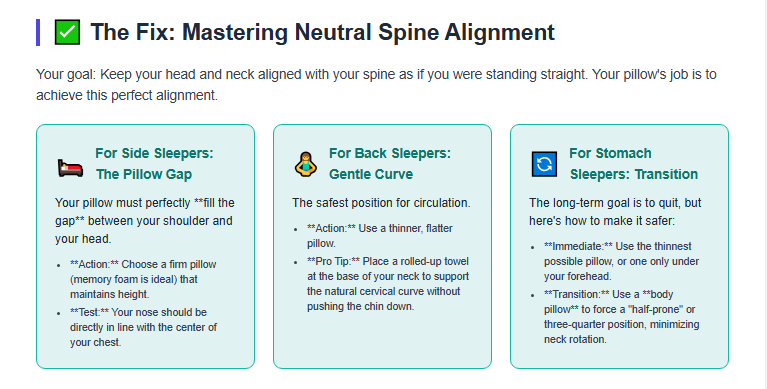
The good news is the correction is entirely mechanical, free, and simple. Your goal is to keep your head and neck aligned with your spine as if you were standing straight. This is called Neutral Spine Alignment.
1. The Fix for Side Sleepers (The Pillow Gap)
Your pillow’s sole job is to fill the gap between your shoulder and your head.
- Test: Lie on your side. Have a partner look at your head from behind. Your nose should be directly in line with the center of your chest. If your head is tilted up or down, your pillow is wrong.
- Solution: You need a firm, supportive pillow (like memory foam or a well-packed feather pillow) that maintains its height throughout the night. If you have broad shoulders, you need a thicker pillow.
2. The Fix for Back Sleepers
This is the safest position for blood flow.
- Solution: You need a thinner, flatter pillow that supports the natural curve of your neck but prevents your chin from jutting down onto your chest (which restricts the front of the neck). A rolled towel at the base of your neck can help.
3. The Fix for Stomach Sleepers (The Transition)
This position is inherently dangerous for your neck arteries. The only true fix is to transition away from it.
- Immediate Step: If you absolutely cannot stop, use the thinnest possible pillow, or use a pillow under your forehead only, allowing your chin to rest on the mattress to reduce the angle of rotation.
- Long-Term Goal: Start using a body pillow to hug. This forces your body into a three-quarter prone position, which is much safer and uses the body pillow to prop your spine into a healthier alignment.
My Personal Advice as a Health Advocate
I’ve always considered myself a side sleeper, and I thought I was doing everything right. But then I read the research on neutral spine alignment, and I got honest with myself.
My old feather pillow was fluffy when I went to bed, but it collapsed after two hours. I would wake up every morning with a stiff neck and just assume I’d slept “wrong.”
What was actually happening was that my pillow was collapsing, and my head spent the second half of the night drooped at a dangerous angle, chronically stretching one side of my vertebral arteries.
My simple fix was replacing that pillow with a firm, contoured memory foam pillow that perfectly filled the space between my shoulder and my head.
The result wasn’t just less neck stiffness. It was better sleep, less tossing and turning, and a quiet reassurance that I was no longer putting my brain’s lifeline under unnecessary stress every night. This isn’t about being perfectly still—it’s about ensuring that when you are still, your body is aligned for optimal circulation.
Myths vs. Facts: Sleep Posture Edition
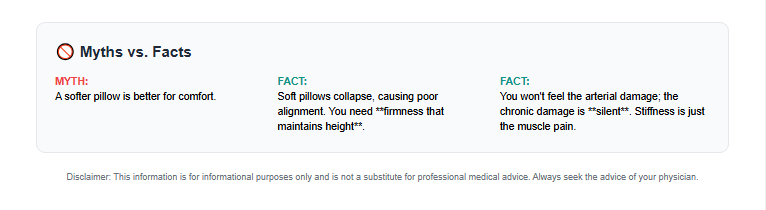
- Myth: “A softer pillow is more comfortable and better for my neck.”
- Fact: A soft pillow collapses, causing your neck to flex or droop. This is comfortable only because it’s soft, but it’s detrimental to your neck alignment and arteries. You need firmness that maintains height.
- Myth: “Tossing and turning means I’m a bad sleeper.”
- Fact: Moving around is your body’s natural intelligence correcting poor alignment or circulation. If you toss and turn, it’s often a sign that your pillow or mattress isn’t supporting your spine properly.
- Myth: “If I wake up without pain, my position is fine.”
- Fact: The damage to the artery lining is silent and chronic. You won’t feel the artery wall weakening or the chronic compression. You feel the muscle stiffness.
FAQs (Frequently Asked Questions)
1. What is scientifically the absolute best sleep position?
Back sleeping is generally considered the best for neutral spine alignment and minimizing pressure on the major blood vessels. Side sleeping is a close second, provided the pillow is perfect.
2. How do I know if my pillow is the right height?
As mentioned, the best test is visual: Your head should not be tilted up or down. A quick at-home test is to lie down and place a hand under your chin. If you can slide your hand in easily without resistance, your pillow is probably too thin.
3. I have to sleep on my stomach to fall asleep. What should I do?
If you must, try the “half-prone” position: Lie almost on your stomach but with one knee bent and lifted toward your chest (as if climbing a stair). Place a firm pillow under that knee and under your chest. This prevents the full 90-degree rotation of the neck and opens up the chest and spine slightly.
4. I wake up with my arms numb. Is that related?
Yes. Numbness in the arms or hands often suggests a nerve being compressed (like the ulnar or median nerve) or temporary blood flow restriction in the shoulder/arm due to sleeping directly on your arm or wrist. This is a sign of poor posture that needs correction.
Conclusion & A Final Word of Encouragement
You spend one-third of your life in bed. That time should be reserved for repair, not risk.
You have the power to protect the lifeblood that flows to your brain with a single, small adjustment. This isn’t about buying a magic new gadget; it’s about respecting the biomechanics of your own body.
Tonight, before you drift off, check your alignment. Ensure your head is perfectly in line with your spine. Give your vertebral arteries a night off.
Disclaimer: I am a health advocate and writer, not a medical doctor. The information in this article is for informational purposes only and is not a substitute for professional medical advice, diagnosis, or treatment. Always seek the advice of your physician.