

- The 20-Minute Satiety Gap: Learn why your brain is 20 minutes behind your stomach, and how eating fast guarantees you’ll overeat.
- The Metabolic Cost: Fast eating spikes your blood sugar and insulin, promoting fat storage and inflammation, even with “healthy” food.
- The Automatic Slow-Down Trick: Discover a simple breathing technique that uses your Vagus Nerve to shift your body into “rest and digest” mode instantly.
The 5-Minute Meal: A Modern Health Crisis
I’ve been a health advocate for a long time, and I’ve sat across from hundreds of clients who are frustrated. They say, “I’ve switched to salads. I’ve cut out sugar. I’m eating all the right things, but I’m still bloated, gaining weight, and my energy crashes every afternoon.”
I listen patiently, and then I ask them a question that almost always stops them in their tracks: “How long does it take you to eat that healthy salad?”
The answer is almost always the same. “Oh, I don’t know. Five, maybe ten minutes? I eat at my desk.”
And right there, we find the problem.
We live in a culture that treats eating as an inconvenience. It’s a task to be checked off our to-do list as quickly as possible. We shovel food in while scrolling on our phones, answering emails, or driving in traffic. We’ve completely lost the art of eating and, in doing so, we’ve declared war on our own biology.
It doesn’t matter if your plate is full of organic kale and wild-caught salmon. If you inhale that meal in five minutes, your body can’t process it. You are creating a metabolic traffic jam, spiking your stress hormones, and preventing the critical signals of fullness from ever reaching your brain.
Your speed is sabotaging your health. But I’m here to tell you that the fix is simple, free, and something you can start doing at your very next meal—and no one will even know you’re doing it.
Why Fast Eating Makes You Sick (The Hormonal Lag)
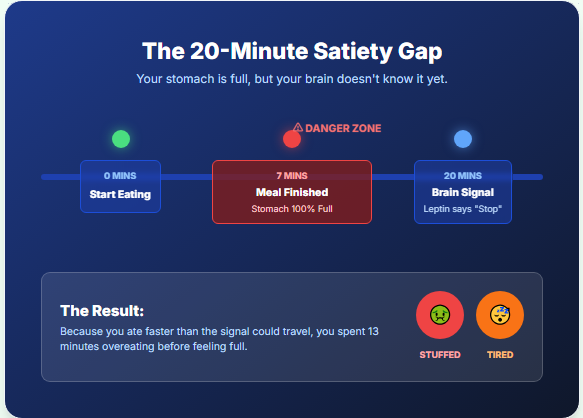
The most important thing to understand is this: Your stomach is not in charge of your hunger. Your brain is. And there is a 20-minute delay in the connection.
Your digestive system is a sophisticated communication network that uses hormones to tell your brain what’s going on. The two most important hormones in this conversation are:
- Ghrelin: The “hunger hormone.” It screams, “I’M EMPTY, FEED ME!”
- Leptin: The “satiety hormone.” It says, “Okay, we’re good, you can stop now.”
When you start eating, your stomach begins to stretch, and your digestive tract starts to process the food. This triggers the release of leptin and other fullness hormones. But here’s the catch: it takes approximately 20 minutes for those hormones to travel through your bloodstream, reach the hypothalamus in your brain, and flip the “fullness” switch.
This is the 20-Minute Satiety Gap.
If you finish your entire meal in seven minutes, you have packed your stomach to 100% capacity (and probably 120%) before your brain has even received the first memo that you’ve started.
You aren’t “full” until 13 minutes after you’ve already put your fork down. This is why you feel fine one minute and “thanksgiving-stuffed” and miserable the next. You didn’t give your brain a chance to hit the brakes. Eating fast is a biological guarantee that you will overeat.
The Metabolic Price of Speed: Blood Sugar & Inflammation
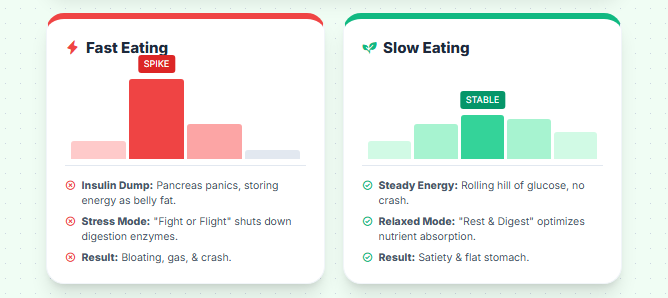
The damage from eating fast goes far beyond just eating too much. It creates a state of internal stress that directly contributes to weight gain and chronic disease.
1. The Insulin Spike
When you “dump” a large amount of food into your stomach all at once, you force a massive, rapid flood of glucose into your bloodstream. Your pancreas panics and responds by releasing a huge surge of insulin—the “fat-storage” hormone—to get that sugar out of your blood as fast as possible.
This massive insulin spike does two terrible things:
- It promotes immediate fat storage, especially around your abdomen.
- It causes the inevitable “crash” an hour later, making you feel sleepy, foggy, and hungry for more sugar.
A slow eater, by contrast, delivers that same food over 20-30 minutes, resulting in a gentle, rolling hill of blood sugar and a modest, appropriate insulin response.
2. The “Fight-or-Flight” Digestion
Your nervous system has two main modes:
- Sympathetic: “Fight or Flight.” Stress, danger, rushing.
- Parasympathetic: “Rest and Digest.” Calm, safe, repairing.
Digestion can only happen properly in the “Rest and Digest” state. When you are eating fast at your desk, you are in a stressed, “Fight-or-Flight” state. This means your body shuts down optimal digestion. Blood is diverted away from your stomach, acid production is reduced, and enzyme release is blunted.
You end up with poorly digested food fermenting in your gut, leading to the gas, bloating, and indigestion you blame on the food itself. It wasn’t the broccoli; it was the speed at which you ate the broccoli.
How to Slow Down: The Breathing Trick Nobody Notices
Telling a fast eater to “just slow down” is like telling an anxious person to “just relax.” It’s useless advice because the habit is unconscious. You need a physical mechanism to break the pattern.
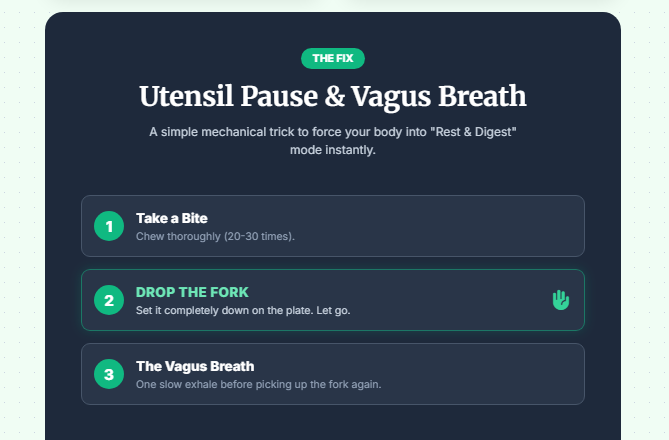
This is the trick I teach all my clients. It’s discreet, it’s powerful, and it works every single time. I call it the “Utensil Pause & Vagus Breath.”
It’s based on activating your Vagus Nerve, the massive nerve that runs from your brain to your gut and acts as the primary on/off switch for your “Rest and Digest” system.
Here’s how you do it:
- Take a normal bite of food.
- Put your fork (or spoon) down. Set it completely down on the plate. Do not hold it in your hand, hovering for the next bite. This is the crucial mechanical step that breaks the “scoop-chew-scoop” reflex.
- Chew your food. Really chew it. Aim for 20-30 chews.
- AFTER you swallow, and BEFORE you pick your fork back up, do this: Take one, slow, silent breath. Inhale through your nose, and exhale slowly (either through your nose or mouth).
- Now, pick your fork back up and take your next bite.
That’s it. That one, slow exhale between bites is a direct signal to your Vagus Nerve. It chemically tells your body, “We are safe. We are not running from a tiger. You can digest this food.”
This simple pause-and-breath automatically shifts you from a stressed state to a calm one. It forces you to chew. It inserts space into the meal. And before you know it, you’ve stretched your meal to 15 or 20 minutes. And the best part? No one at the table will have any idea you’re doing a “breathing exercise.” You just look like a calm, mindful eater.
When to See a Doctor (And What to Ask)
This habit is a powerful tool, but it’s not a cure-all. If you’ve been a chronic fast eater for years, you may have done some underlying damage. Please see your doctor if you experience:
- Persistent, painful bloating or gas after every meal, even when you eat slowly.
- Symptoms of acid reflux (GERD) that don’t improve.
- Signs of metabolic distress, like a fasting blood sugar over 100 mg/dL or an A1c in the pre-diabetic range.
When you see your doctor, don’t just list your symptoms. Give them the context. Say, “I’ve been a chronic fast eater, and I’m concerned about my digestive health and insulin resistance.”
My Personal Advice as a Health Advocate
I used to be the worst fast eater. I grew up in a busy family, and the unspoken rule was that the fastest eater got to talk. I carried that habit into my adult life, priding myself on my “efficiency.” I’d finish lunch in three minutes and get back to work, wondering why I felt bloated and exhausted by 3 PM.
The “click” for me was when I reframed eating not as fueling, but as healing.
My body was trying to repair itself, and I was throwing a pile of bricks at it and yelling “fix it!” The Utensil Pause trick was the first thing that worked for me because it’s mechanical. I couldn’t “forget” to do it. It’s now so automatic that I feel anxious if I try to eat fast. It’s my daily 20-minute meditation, and it’s done more for my digestion and energy than any diet ever has.
Myths vs. Facts: Busting Fast-Eating Excuses
Myth: “I’m just an ‘efficient’ eater. It’s not a problem.”
Fact: You’re being an inefficient digester. Your efficiency is creating a 3-hour traffic jam in your gut and spiking your fat-storage hormones. That’s the opposite of efficiency.
Myth: “I don’t have time to take 30 minutes for lunch.”
Fact: You don’t have time not to. The 2-3 hours you lose to brain fog and low energy every afternoon cost you far more time than the extra 15 minutes you’d spend eating. Eat slowly, and you win that time back with focused, stable energy.
Myth: “It doesn’t matter how I eat my salad, it’s still healthy.”
Fact: A healthy meal eaten in a state of stress becomes a stressful event for your body. Your body can’t extract the nutrients from that salad when it’s in “fight-or-flight” mode.
FAQs (Frequently Asked Questions)
1. How long should a meal take?
Aim for a minimum of 20 minutes. This is the biological sweet spot that gives your satiety hormones (like leptin) time to reach your brain and signal that you are full.
2. Can this breathing trick really help me lose weight?
Yes, absolutely. It’s one of the most effective tools for weight management. By slowing down, you allow your brain to “catch up” and register fullness, which means you naturally stop eating when you are satisfied, not when you are stuffed. It’s effortless, automatic portion control.
3. What if I’m eating with other people?
This trick is perfect for social settings. Putting your fork down between bites is simply good table manners. Taking a calm breath just makes you look like a relaxed, engaged listener.
4. What if I’m eating “finger food” like a sandwich or pizza?
The rule is the same. Put the food down completely between bites. Set the sandwich on the plate. Take your breath. Then pick it up again.
5. How long until this feels natural?
It will feel forced and awkward for the first 3-5 meals. After about a week of doing it consistently, you’ll find you start to do it automatically. It’s just re-wiring an old motor pattern.
Conclusion & A Final Word of Encouragement
For years, you’ve been told to change what you eat. Today, I’m asking you to change how you eat.
You don’t need to buy expensive organic food. You don’t need to start a restrictive new diet. You just need to give your body the time it needs to do its job.
Try the “Utensil Pause & Vagus Breath” at your very next meal. It is the kindest, simplest, and most powerful gift you can give your digestive system. It’s not just a trick to slow you down; it’s a way to signal safety, peace, and healing to your entire body. Food is medicine, but only if you take the time to let it work.
Medical Disclaimer: I am a health advocate and writer, not a medical doctor. The information in this article is for informational purposes only and is not a substitute for professional medical advice, diagnosis, or treatment. Always seek the advice of your physician or other qualified health provider with any questions you may have regarding a medical condition.