
- The Science of Longevity: How coffee reduces the risk of Alzheimer’s, Type 2 Diabetes, and heart disease.
- The Right Way to Drink It: Why timing matters (and why you should wait 90 minutes after waking up).
- Avoiding the Sugar Trap: How to keep your morning ritual from becoming a metabolic disaster.
The Black Nectar: From “Guilty Pleasure” to “Health Elixir”
For years, I treated my morning coffee like a necessary vice. It was the jittery fuel I needed to drag myself out of bed and function in a 9-to-5 world. I assumed—like many of us do—that anything that tastes this good and wakes you up this fast must be bad for you.
We’ve been told it dehydrates us. We’ve been told it stunts our growth. We’ve been told it causes heart palpitations and ulcers.
But if you look at the actual data, the story changes completely.
Coffee is not just a caffeine delivery system. It is chemically complex plant water.1 It is, quite literally, a vegetable broth made from roasted seeds. And in the world of nutrition science, it is emerging as one of the most potent “longevity drugs” we have legal access to.
I’m not talking about the sugar-laden, whipped-cream-topped milkshakes that pass for coffee in drive-thrus. I’m talking about the bean itself.
When stripped of the sugar and the guilt, coffee is a powerhouse of antioxidants, a neuro-protector, and a metabolic shield. It is one of the few habits where the advice isn’t “stop doing that,” but rather, “do it right.”
Let’s dive into why your morning cup might be adding years to your life—and how to optimize it for maximum brain power.
The Chemistry of the Bean: It’s Not Just Caffeine
Most people think coffee equals caffeine. But that is like saying an orange equals Vitamin C. It’s true, but it misses the bigger picture.
The coffee bean is actually the seed of a fruit (the coffee cherry).2 Like other seeds, it is packed with nutrients designed to protect the plant. When we roast and brew it, we are extracting a massive cocktail of bioactive compounds.
Here is what is actually swirling in your mug:
- Chlorogenic Acid: This is the superstar polyphenol. It is a potent antioxidant that helps reduce inflammation and regulate blood sugar.3
- Diterpenes (Cafestol and Kahweol): Oily substances that, while they can raise cholesterol slightly in unfiltered coffee, have shown potential in fighting cancer cells.4
- Magnesium and Potassium: Essential minerals for heart health and muscle function.5
- Niacin (Vitamin B3): Created during the roasting process, essential for converting food into energy.6
In the standard Western diet, which is sadly low in fruits and vegetables, coffee is often the number one source of antioxidants for the average person. That says a lot about our diet, but it also says a lot about the power of the bean.
The Brain: Armor Against Alzheimer’s and Dementia
I have a family history of cognitive decline, so this is the benefit that hits closest to home for me. We often drink coffee for the immediate “buzz”—the focus, the alertness. That comes from caffeine blocking adenosine (the “sleepy chemical”) in the brain.7
But the long-term benefits are far more profound.
Research has consistently shown a correlation between regular coffee consumption and a reduced risk of neurodegenerative diseases.8
- Alzheimer’s Disease: Studies suggest that mid-life coffee drinkers have a significantly lower risk of developing Alzheimer’s/dementia later in life—some data puts the risk reduction as high as 65%.
- Parkinson’s Disease: The link here is even stronger. Caffeine appears to protect the dopamine-producing neurons that are lost in Parkinson’s.9
How does it work?
It’s likely a combination of insulin sensitivity (the brain loves stable blood sugar) and the reduction of inflammation in the brain. Coffee essentially helps keep the neural pathways clear of the “gunk” (amyloid plaques) associated with aging.10
When I drink my morning brew, I don’t just feel awake; I feel like I’m putting a shield up around my neurons.
The Metabolic Shield: Coffee and Type 2 Diabetes
This is one of the most surprising findings in nutrition science, mostly because we associate energy boosts with sugar spikes. But black coffee does the opposite.
Large-scale epidemiological studies (tracking hundreds of thousands of people over decades) have found that people who drink more coffee have a lower risk of developing Type 2 Diabetes.11
The mechanism involves our friend Chlorogenic Acid.
- It slows down the absorption of glucose in the gut.
- It improves the liver’s ability to metabolize sugar.
- It may improve the sensitivity of your cells to insulin.
The Critical Caveat:
This benefit is erased—and reversed—if you fill your cup with sugar.
If you take a beverage that naturally lowers diabetes risk and add 50 grams of caramel syrup and whipped cream, you have turned a medicine into a poison. The coffee is trying to help your insulin; the sugar is trying to break it. Don’t let them fight in your stomach.
The Liver’s Best Friend
If you drink alcohol, eat processed foods, or take medications (which is most of us), your liver is working overtime. It is the filtration plant of your body.
Ideally, we should all live pristine lives. Realistically, we need liver support.
Coffee is remarkably protective of the liver.12 Consistently, data shows that coffee drinkers have lower levels of liver enzymes (a marker of damage) and lower risks of:
- Cirrhosis (scarring of the liver).13
- Liver cancer.
- Fatty liver disease.
It seems that the specific antioxidants in coffee prevent the scar tissue formation that leads to liver failure. It’s a detox drink that actually works—unlike those expensive juice cleanses.
The “Dark Side”: Anxiety, Sleep, and Adrenal Fatigue
I am a health advocate, not a salesman for the coffee industry. We have to talk about the downsides, because they are real.
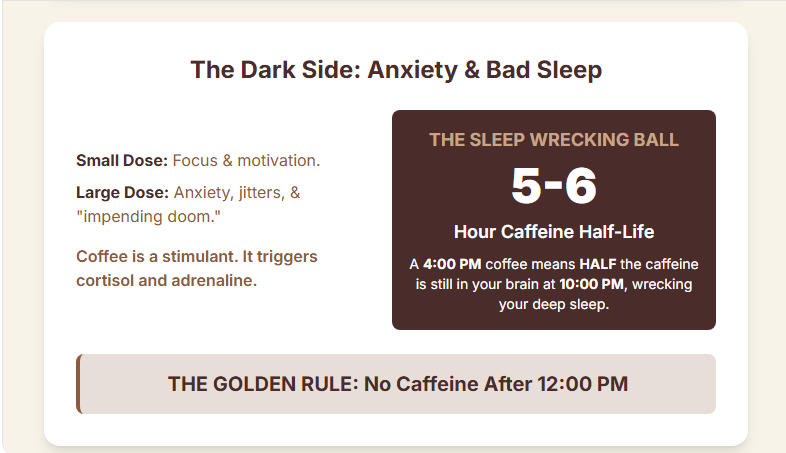
Coffee is a stimulant.14 It triggers the release of cortisol and adrenaline.15 This is the “fight or flight” response.
- In small doses: This feels like focus, energy, and motivation.
- In large doses: This feels like anxiety, jitteriness, and “impending doom.”
The Sleep Wrecking Ball
Caffeine has a “half-life” of about 5 to 6 hours.16 This means if you drink a cup of coffee at 4:00 PM, half of that caffeine is still active in your brain at 10:00 PM. Even if you can “fall asleep” fine, the caffeine disrupts your deep sleep architecture.17 You wake up tired, so you drink more coffee, and the cycle continues.
My Rule: No caffeine after 12:00 PM (noon). Period. This gives my body time to clear the stimulant before bed.
Protocol: How to Optimize Your Coffee Habit
If you want to turn coffee from a habit into a longevity strategy, you need to pay attention to how and when you drink it. Here is my personal protocol.
1. The 90-Minute Wait
This is a game-changer I learned from neurobiology. When you first wake up, your cortisol levels naturally spike to wake you up.18 You also have residual adenosine (sleep pressure) that needs to clear out.
If you drink coffee immediately (within 10 minutes of waking), you blunt that cortisol spike and crash harder later.
Try this: Wake up, drink water, move around, and wait 60–90 minutes before your first cup. The energy will last longer, and you won’t get the afternoon crash.
2. Filter vs. Unfiltered
There is a nuance here regarding cholesterol.
- Paper Filter (Pour-over, Drip): Removes the oily diterpenes (cafestol).19 This is better if you have high cholesterol.
- Metal Filter/No Filter (French Press, Espresso, Turkish): Keeps the oils. This is tastier and contains more of the cancer-fighting compounds, but can slightly raise LDL cholesterol.
- My Advice: Mix it up, or choose based on your lipid panel results.
3. The Roast Debate
- Light Roasts: Higher in chlorogenic acid (antioxidants) and slightly higher in caffeine. They taste acidic, fruity, and tea-like.
- Dark Roasts: Lower in acid (easier on the stomach) and lower in caffeine. They contain a compound called N-methylpyridinium (formed during roasting) which helps reduce stomach acid production.
- Winner: Light roast for maximum health benefits; Dark roast for a sensitive stomach.
5 Ways to Upgrade Your Brew (Without Sugar)
If you hate black coffee, don’t force it. But don’t reach for the sugar bowl. Try these functional additions.
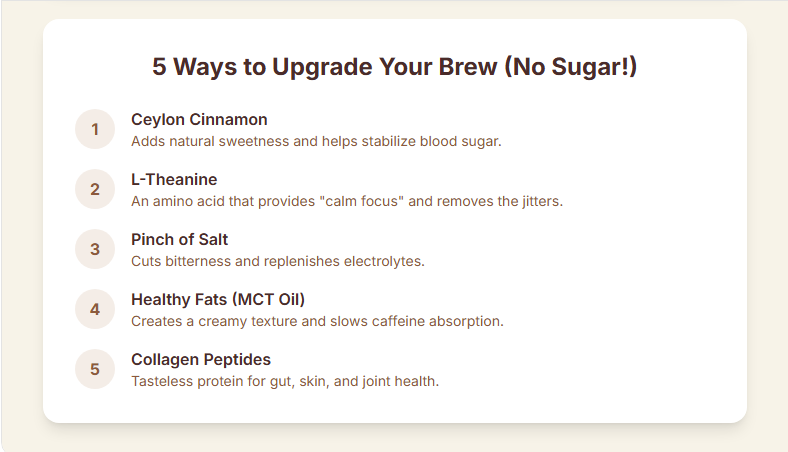
1. The “Real” Cinnamon Hack
Add a dash of Ceylon cinnamon to the grounds before you brew. Cinnamon stabilizes blood sugar and adds a natural sweetness without the calories.20 It pairs perfectly with the coffee flavor profile.
2. L-Theanine Pairing
If coffee makes you jittery, pair it with L-Theanine. This is an amino acid found in green tea. Taking 100-200mg of L-Theanine with your coffee smooths out the “buzz,” giving you “calm focus” rather than “anxious energy.”
3. Pinch of Salt
This sounds weird, but hear me out. A tiny pinch of high-quality salt (sea salt or pink salt) in black coffee cuts the bitterness immediately. It smooths the flavor and replenishes sodium (electrolytes) that coffee’s diuretic effect might deplete.
4. Healthy Fats (MCT or Butter)
This is the “Bulletproof” concept. Blending a teaspoon of MCT oil, coconut oil, or grass-fed butter into your coffee creates a creamy latte texture. The fat slows caffeine absorption and keeps you full.21 Just don’t overdo it—calories still count.
5. Collagen Peptides
Collagen powder is tasteless and dissolves instantly in hot liquids.22 It adds protein (good for gut lining and skin) without altering the flavor. It turns your morning cup into a beauty treatment.
Myths vs. Facts
Myth: Coffee dehydrates you.
Fact: While caffeine is a mild diuretic (makes you pee), the water in the coffee makes up for it.23 Regular coffee drinkers develop a tolerance to the diuretic effect.24 You are net-hydrated by a cup of coffee.
Myth: Coffee stunts your growth.
Fact: This is an old wives’ tale with zero scientific backing. It likely started because early studies didn’t separate coffee drinkers from smokers (who were often the same people).
Myth: Decaf is useless.
Fact: Decaf contains almost all the same polyphenols and antioxidants as regular coffee, just without the stimulant. If you want the longevity benefits without the jitters, decaf is an excellent choice.
Myth: Coffee causes ulcers.
Fact: Coffee stimulates acid production, which can irritate an existing ulcer or worsen heartburn (GERD), but it does not cause ulcers.25 Most ulcers are caused by H. pylori bacteria.
FAQs

1. How many cups is “safe”?
Most studies show a “U-shaped” curve. The sweet spot for longevity benefits seems to be between 2 to 4 cups (8oz each) per day. Going beyond 5 or 6 cups yields diminishing returns and higher anxiety risks.
2. What about Cold Brew?
Cold brew is steeped for hours in cold water.26 This process extracts fewer acidic compounds, making it 60-70% less acidic than hot coffee. It is much gentler on the stomach and teeth enamel.
3. Does adding milk ruin the benefits?
Not really. Some studies suggest dairy proteins might bind to some antioxidants, slightly reducing absorption, but the effect is minor.27 If a splash of milk keeps you away from the sugar syrup, do it.
4. Is organic coffee necessary?
Coffee is one of the most heavily sprayed crops in the world.28 While the roasting process destroys many pesticides, I personally prioritize organic or “tested for toxins” coffee to avoid mold toxins (mycotoxins) and chemical residues.
5. Can I drink coffee while intermittent fasting?
Yes. Black coffee has negligible calories and will not break a fast.29 In fact, it can help suppress hunger and boost the autophagy (cellular cleaning) process that fasting promotes.30
Final Thoughts: The Ritual
There is something undeniably spiritual about the morning coffee ritual. The grinding of the beans, the smell filling the kitchen, the warmth of the mug in your hands.
For a long time, I thought health meant stripping away these small joys. I thought I had to drink wheatgrass juice and suffer.
But the science of coffee teaches us a beautiful lesson: nature often hides its best medicine in our favorite foods.
You don’t need to quit coffee to be healthy. You just need to respect it.
Respect the bean. Respect your sleep. And for the love of your liver, respect the sugar limit.
So tomorrow morning, when you take that first sip, don’t feel guilty. Feel grateful. You aren’t just waking up; you’re fueling your longevity.
Medical Disclaimer: I am a health advocate and writer, not a medical doctor. The information in this article is for informational purposes only and is not a substitute for professional medical advice, diagnosis, or treatment. Always seek the advice of your physician or other qualified health provider with any questions you may have regarding a medical condition.
Would you like me to write a follow-up article on “The Ultimate Guide to Tea: Green, Black, and Herbal Benefits” to compare with coffee?