

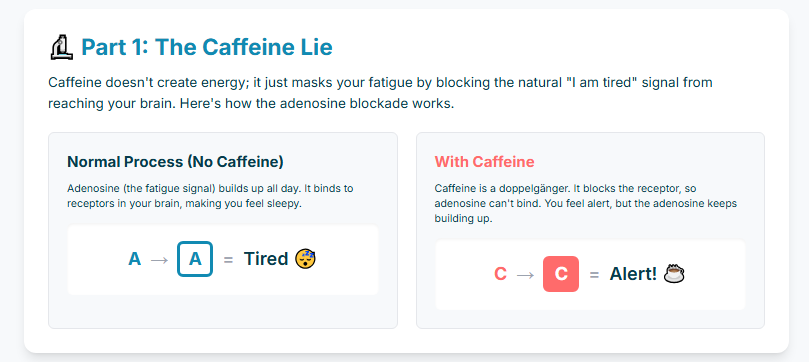
- The Energy Illusion: Caffeine does not provide energy; it works by blocking the brain’s receptors for adenosine, the molecule responsible for signaling fatigue and sleepiness.
- The Debt: By blocking the fatigue signal, you are simply delaying it. When the caffeine wears off, all the built-up fatigue (adenosine) crashes down on you at once, creating the feeling of a massive afternoon slump.
- The Golden Window: To maximize benefit and minimize harm, you must wait until your natural morning waking hormone (cortisol) has peaked and begun to drop. This optimal time is typically 9:30 AM to 11:30 AM.
The Great Caffeine Lie
For many of us, the first act of the day isn’t meditation or exercise; it’s pouring a cup of coffee. We believe that rich, dark liquid is the engine that jump-starts our day—the fuel our body requires.
We’ve all been there: It’s 7:15 AM, you take that first hot sip, and instantly, the brain fog lifts. The world comes into focus. You feel energized.
But what if I told you that feeling of energy is a lie? What if I told you that coffee isn’t giving you energy at all, but rather, it’s allowing you to take out a loan against the future—a loan you have to pay back with interest in the form of a painful afternoon crash?
As a health advocate, I want to challenge the way you view your daily cup. Caffeine is a powerful drug that, when used strategically, can be a valuable tool. But when used habitually and incorrectly, it becomes an energy thief, hijacking your body’s natural rhythm and keeping you in a state of perpetual, low-grade exhaustion.
The good news? You don’t have to quit coffee. You just need to change the time on your clock.
The Science: The Energy Thief (Adenosine Blockade)
To understand why coffee “steals” energy, you need to meet the molecule that signals fatigue: adenosine.
Every time your brain cells use energy, they create adenosine as a metabolic byproduct. Think of adenosine like the exhaust coming out of your body’s engine. The longer you are awake, the more adenosine builds up in your brain, and the stronger the signal is to your body: “I am tired. It is time to rest.” This is how you feel sleepy at night.
How Caffeine Works
Caffeine is a chemical doppelgänger. It is structurally similar enough to adenosine that it can fit perfectly into the brain’s adenosine receptors—the same receptors that are supposed to receive the “I am tired” signal.
Here is what happens when you drink coffee:
- Blockade: Caffeine blocks the receptors. The “I am tired” signal is still being produced, but the brain literally cannot receive the message.
- Forced Wakefulness: You feel awake and alert because the natural fatigue signal has been silenced.
- The Debt: The adenosine doesn’t disappear; it continues to build up outside the blocked receptors.
- The Crash: When the caffeine eventually wears off, all those receptors suddenly open up, and they are slammed by the huge backlog of built-up adenosine.
The inevitable result is the crushing, inescapable afternoon slump. You didn’t get energy; you simply masked your fatigue and accumulated a massive “sleep debt” that comes due right around 2:00 PM.
The Cortisol Clash: Why 7 AM Coffee is Self-Sabotage
Understanding the adenosine blockade is only half the battle. The second, and more crucial, factor is your body’s natural waking cycle, governed by the hormone cortisol.
Cortisol is often misunderstood as just the “stress hormone.” But in the morning, cortisol is your body’s natural alarm clock. Your cortisol levels naturally surge to their highest point 30-60 minutes after you wake up, peaking to give you energy and alertness.
The Problem with Early Coffee
When you drink caffeine at 7:00 AM, you are ingesting a stimulant when your cortisol levels are already at their natural peak. This is deeply problematic for two reasons:
- Tolerance Acceleration: The caffeine interferes with and dulls the effectiveness of your natural cortisol. Your body learns to rely on the external jolt rather than its internal system. Over time, your body may produce less cortisol in the morning, essentially making you chemically dependent on that 7:00 AM cup just to feel “normal.”
- Wasted Potential: You’re wasting the effect. You’re using a powerful drug when you are already at your most naturally alert, robbing yourself of the benefit later in the day when you actually need the help.
This is why almost everyone gets it wrong. They drink their caffeine when their body is already screaming “WAKE UP!” They are interfering with their own natural, free, and efficient energy system.
The Golden Window: Your New Coffee Protocol
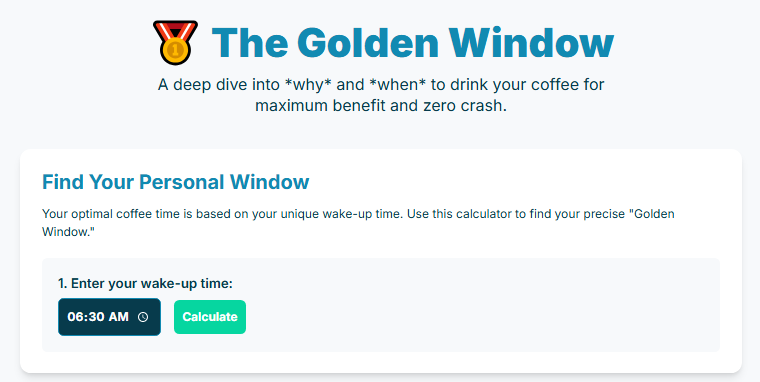
The goal is to introduce caffeine after your natural cortisol peak has done its job, but before the midday slump sets in. This is how you use the caffeine to smooth out the energy curve, not cause a giant spike.
⏰ The Rule of Three Hours
The optimal time to drink your first cup of coffee is 3 to 4 hours after you wake up.
For example:
- If you wake up at 6:00 AM, your optimal window is 9:30 AM to 11:30 AM.
- If you wake up at 7:00 AM, your optimal window is 10:30 AM to 12:30 PM.
By waiting, you are allowing your body’s natural circadian rhythm to handle the initial wake-up process. When you drink coffee later, the caffeine acts as a gentle, strategic boost to carry you through the mid-morning, preventing the energy dip that often hits before lunch.
🚫 The 10-Hour Sleep Rule
The second rule is a non-negotiable one for sleep quality. Caffeine has a half-life of about 5 hours, meaning after 5 hours, half of the caffeine is still in your system. For some people, it can take up to 10 hours to clear the system enough to prevent sleep disruption.
- Rule: Do not consume caffeine within 10 hours of your planned bedtime.
- Example: If you want to be asleep by 10:00 PM, your last sip of coffee should be no later than 12:00 PM (noon). If you are sensitive, cut it off at 11:00 AM. Protecting your sleep is the single most important action you can take to rebuild your long-term energy.
My Personal Advice as a Health Advocate
I used to be a chronic 6:30 AM coffee drinker. I needed it to function. I was foggy, grumpy, and perpetually felt like I was running on fumes. I believed the “energy” was real.
The idea of waiting until 9:30 AM terrified me. I thought I would be a zombie.
Here is what I did to make the shift painless:
- Hydrate First: When I woke up, I drank a huge glass of water with a pinch of sea salt. This helped with hydration and gave me a sense of ritual replacement.
- Move My Body: For the first hour after waking, I walked. A 15-minute walk outside helps solidify the cortisol spike and naturally raises alertness better than any drug.
- The Decaf Bridge: For the first few days, I drank a cup of decaf or herbal tea during the 7:00 AM slot, just to satisfy the habit and the warmth.
The result was astonishing. My “need” for the caffeine vanished. When I had my coffee at 10:00 AM, the effect was smooth, potent, and lasting. The massive 2:00 PM crash disappeared because I wasn’t carrying a huge adenosine debt.
Don’t let caffeine dictate your energy levels. Use it as a precision tool.
Myths vs. Facts: The Caffeine Chronicle
- Myth: “Coffee is the single best pre-workout drink.”
- Fact: Caffeine is an incredible pre-workout, as it improves performance. However, timing matters. Drinking it too close to waking (e.g., 6 AM) interferes with cortisol. Drinking it too late (e.g., 5 PM) wrecks your sleep.
- Myth: “Decaf is 100% caffeine-free.”
- Fact: Decaf coffee still contains caffeine, often 10-30% of a regular cup. For highly sensitive individuals, this small amount can still affect sleep if consumed late in the day.
- Myth: “Coffee severely dehydrates you.”
- Fact: Coffee is a mild diuretic, but the fluid in the coffee often offsets this effect. However, it’s never a substitute for water. You should always follow a cup of coffee with a cup of water.
FAQs (Frequently Asked Questions)
1. What if I wake up very early, like 5 AM?
You should still follow the 3-4 hour rule. If you wake at 5 AM, your cortisol peak has passed by 8:00 AM. Your optimal window is 8:00 AM to 9:30 AM.
2. Does black tea or green tea follow the same rule?
Yes, the rule is based on the physiology of your hormones and the caffeine molecule, not the beverage. Tea contains caffeine and will interfere with cortisol. Wait 90 minutes to 3 hours after waking for the best effect.
3. What should I drink right when I wake up instead?
Plain water is always the best. Adding a squeeze of lemon or a pinch of sea salt (for minerals) can boost hydration and signal your digestive system to wake up gently.
4. I can’t function without that early cup. What do I do?
You are experiencing a physical dependency. Use the Decaf Bridge strategy. Switch your 7 AM cup to half-caff or decaf for two weeks. Replace the ritual, but slowly detox from the chemical dependency. After two weeks, you can jump to the 9:30 AM optimal window.
Conclusion & A Final Word of Encouragement
Your energy is your most precious resource. Don’t let your morning habits erode it.
You now know the secret: The cup of coffee you enjoy at 7:00 AM is a choice to start the day in debt. The cup you enjoy at 10:00 AM is a choice to strategically support your body’s natural rhythm.
It’s a simple change, but it’s one of the most powerful things you can do to flatten your energy curve, break the afternoon crash cycle, and stop stealing energy from your tomorrow.
Disclaimer: I am a health advocate and writer, not a medical doctor. The information in this article is for informational purposes only and is not a substitute for professional medical advice, diagnosis, or treatment. Always seek the advice of your physician.