
- Epigenetics Explained: The groundbreaking science showing your diet controls your genes, turning protective genes “on.”
- The Sulforaphane Secret: How the compound in broccoli activates over 200 detoxifying and anti-cancer pathways in your body.
- The Crucial Cooking Mistake: Why microwaving or boiling your broccoli destroys the key cancer-fighting enzyme (and the simple two-minute hack to fix it).
The Myth of Genetic Destiny
For decades, we lived with the fear of fate. We thought our future health was written in stone the day we were born. If heart disease or Alzheimer’s ran in the family, that was simply the hand we were dealt. We felt powerless against the “bad luck” of our DNA.
I want to tell you that this outdated way of thinking is completely wrong.
In the last thirty years, science has delivered a revolutionary truth: Your genes load the gun, but your lifestyle pulls the trigger. And the biggest trigger of all isn’t exercise or sleep (though those help); it’s your fork.
Food doesn’t just supply calories. Food carries information. And no food speaks a clearer language to your genetic code than the humble, often-maligned broccoli.
I’m here to show you how a tiny compound in this common green vegetable can act as a literal genetic control panel, switching on over 200 protective pathways in your cells that specialize in hunting down cancer, neutralizing toxins, and safeguarding your longevity.
Your destiny isn’t written. Your fork is your pen. Let’s learn how to use it.
The Revolution: Food Is Your Genetic Control Panel
The complex field of Epigenetics is the key to understanding this. You can think of your DNA like the script of a movie—it’s fixed and cannot be changed. But the epigenome is the producer, the lighting designer, and the director. It decides which lines are emphasized, which scenes are cut, and what the final tone of the movie will be.
Epigenetic tags (diet, stress, environment) determine whether a specific gene is “on” (highly expressed) or “off” (silenced).
- The Bad Genes: You may carry a gene that makes you prone to colon cancer, but if you eat the right foods, you can turn its volume dial down to zero.
- The Good Genes: You have genes responsible for making detoxification enzymes. Broccoli turns their volume dial up to 11.
It is a profound realization: every time you eat, you are casting a vote for health or disease. And the star of the show, the most potent genetic programmer in your kitchen, is the family of cruciferous vegetables.
The Hero Compound: Sulforaphane (SUL)
What exactly is the message broccoli is sending to your DNA? It’s a chemical compound called Sulforaphane (SUL).
SUL isn’t present in the plant in its active form. It is created as a defense mechanism when the plant is chewed or chopped—a fascinating evolutionary response to damage. When we chop or chew, we activate the defense system, and we reap the powerful rewards.
Pioneering research out of Johns Hopkins University showed SUL’s dramatic effect. It’s not just a run-of-the-mill antioxidant; it’s a master regulator of your body’s entire defense system.
How SUL Activates Your Defense System: The NRF2 Pathway
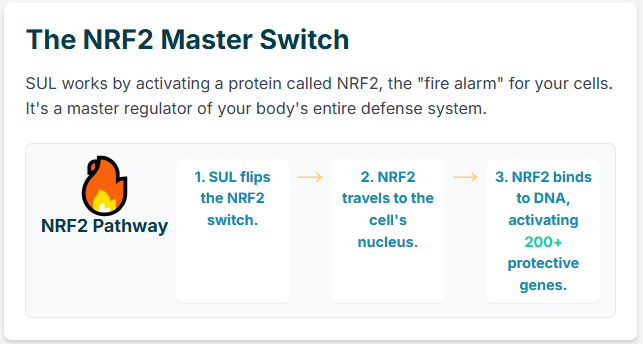
SUL works by activating a protein called NRF2 (Nuclear factor erythroid 2-related factor 2). Think of NRF2 as the fire alarm for your cells.
- When SUL enters your cell, it flips the NRF2 switch.
- NRF2 then travels to the cell’s nucleus and binds to your DNA.
- This binding activates hundreds of genes responsible for creating your body’s internal, most powerful antioxidants (like glutathione, the master detoxifier).
SUL doesn’t just clean up damage; it instructs your body to build stronger shields and better cleaning crews against future damage and inflammation.
The DNA Dialogue: Liver Detoxification and Beyond
The 200+ genes that SUL activates mostly fall into two categories vital for cancer prevention:
1. Phase II Detoxification
When your body encounters a toxin (pesticides, car exhaust, medications, alcohol), your liver processes it in two steps.
- Phase I: Turns the toxin into an intermediate form. This intermediate form is often more dangerous than the original toxin.
- Phase II: This is the crucial cleanup phase, where the intermediate form is neutralized and made water-soluble so you can excrete it.SUL drastically upregulates (turns up the volume on) the enzymes needed for Phase II. Without adequate Phase II enzymes, those dangerous intermediate toxins just stick around, increasing cancer risk.
2. Hunting Down Cancer Cells
SUL is a genius at spotting and neutralizing potential cancer cells.
- Apoptosis (Cell Suicide): SUL encourages damaged cells—the ones that could become cancerous—to self-destruct before they can replicate.
- Anti-Angiogenesis: SUL has been shown to inhibit the formation of new blood vessels that tumors need to grow and spread.
When I talk about food as medicine, this is the gold standard. You are not buying a supplement; you are eating a powerful programmer that protects your body at the deepest level.
The Crucial Cooking Mistake (And The 10-Minute Fix)
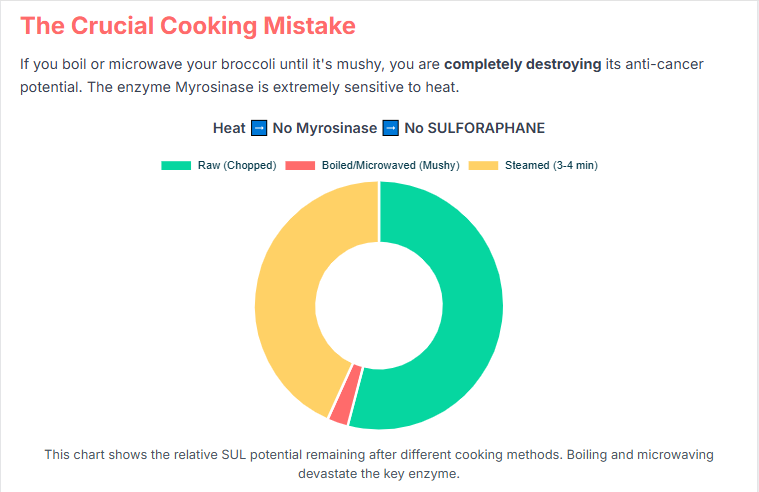
If you follow the crowd and boil or microwave your broccoli until it’s mushy, you are completely destroying its anti-cancer potential. I need you to commit this rule to memory.
The enzyme needed to create SUL—the aforementioned myrosinase—is extremely sensitive to heat.
- Glucoraphanin (the precursor) + Myrosinase (the enzyme) = SULFORAPHANE (the benefit)
- Heat $\rightarrow$ No Myrosinase $\rightarrow$ No SULFORAPHANE.
My Personal Protocol: The Chop-and-Wait Rule
To bypass this, you must apply the following simple trick:
- Chop it Fine: Cut your broccoli (or kale, or cabbage) into small pieces. This mixes the glucoraphanin and myrosinase.
- The 10-Minute Wait: Let the chopped vegetable sit on the cutting board for at least 5 to 10 minutes before cooking. This crucial time allows the enzyme to generate the maximum amount of SUL before the heat kills the enzyme.
- Light Cooking: Steam or lightly stir-fry the broccoli for only 3-4 minutes. Keep it crisp-tender. Avoid boiling or deep-frying.
The Myrosinase Booster Hack
What if you are cooking quickly, or reheating frozen broccoli (which has already had its myrosinase destroyed by blanching)?
- Add Mustard Seed Powder: Mustard, horseradish, and wasabi all contain myrosinase. A tiny sprinkle of dried mustard powder or a dollop of horseradish sauce on cooked broccoli will reactivate the creation of SUL in your stomach!
The Ultimate Source: The Broccoli Sprout Power-Up
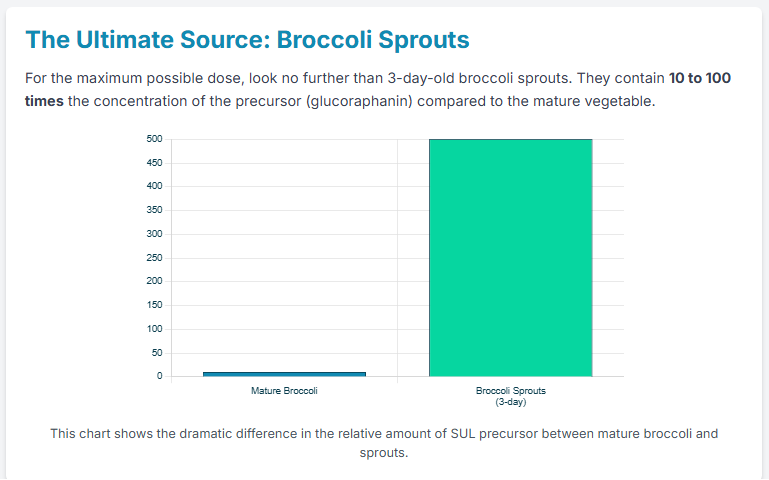
If you want the maximum possible dose of Sulforaphane, you have to look beyond the mature head of broccoli.
Broccoli sprouts (the three-day-old seedling) are a purple-cow food. They are tiny, crunchy, and taste slightly peppery, like a mild radish.
- Concentration: Sprouts contain anywhere from 10 to 100 times the concentration of glucoraphanin compared to the mature vegetable.
- Convenience: You can grow them yourself easily on a tray, or buy them pre-sprouted at most grocery stores.
I love adding a small handful of sprouts to my salads, sandwiches, or even blending them raw into a morning smoothie. It’s the closest thing we have to a guaranteed daily genetic programmer.
Benefits Beyond the Lab Coat
While the cancer research is groundbreaking, the systemic anti-inflammatory effect of SUL translates to widespread improvements in daily wellness.
Targeting The Gut-Brain Axis
Studies have shown SUL to be highly effective against Helicobacter pylori (H. pylori), the bacteria responsible for most stomach ulcers and chronic gastritis. By eradicating or controlling this bacteria, SUL promotes a healthier gut lining. Given the strong connection between gut health and mood/cognition (the gut-brain axis), this is a significant win.
Supporting Brain Resilience
Chronic brain inflammation, as we discussed with walnuts, is a major concern. SUL’s ability to activate NRF2 means it directly reduces oxidative stress in the brain, offering neuroprotective benefits against potential damage from toxins and aging. It’s like giving your brain cells a powerful deep clean every day.
My Personal Broccoli Strategy
I approach cruciferous vegetables not as an optional side dish, but as a mandatory daily medicine. Here is how I ensure I get my SUL dose:
- Daily Dose: I eat 1-2 cups of raw or properly prepared cruciferous vegetables every day.
- Sprout Insurance: I add a 1/2 cup of fresh broccoli sprouts to my lunch salad or morning eggs as my insurance policy against poor absorption from other foods.
- The Freezer Cheat: I always keep a bag of frozen broccoli florets on hand. To cook them, I let them thaw for 5-10 minutes, chop them up (to release myrosinase), and then steam them lightly. This maximizes the benefit of a convenient food.
- Rotation is Key: I don’t just eat broccoli. I rotate through Brussels sprouts, kale, cabbage, and bok choy to get a wide variety of other phytonutrients.
Myths vs. Facts
Myth: Eating broccoli makes you gassy and bloated, so it must be bad for you.
Fact: Cruciferous vegetables contain high amounts of complex, non-digestible fibers (oligosaccharides). The gas is simply your healthy gut bacteria fermenting this fiber. This is a sign the fiber is feeding your microbiome! If it’s severe, start with small amounts of lightly steamed veggies and gradually increase your intake.
Myth: Freezing ruins all the nutritional value.
Fact: While blanching (pre-freezing) destroys myrosinase, the glucoraphanin precursor remains intact. Use the “thaw, chop, and add mustard powder” trick, and you regain the SUL-creating power.
Myth: You have to eat the whole head of broccoli to get the benefit.
Fact: No. Even eating just a few tablespoons of broccoli sprouts or a single cup of raw, chopped broccoli is enough to initiate the powerful NRF2 anti-cancer pathway. Consistency trumps volume here.
FAQs (Frequently Asked Questions)
1. Is there a link between cruciferous veggies and hypothyroidism (thyroid problems)?
This is a popular but highly exaggerated myth. Cruciferous vegetables contain goitrogens, which can interfere with iodine uptake. However, you would need to eat massive, ungodly amounts of raw kale/broccoli—far beyond a normal diet—to cause a problem. As long as you have adequate iodine intake (iodized salt, seafood), daily consumption of cruciferous veggies is safe and recommended.
2. Should I take a Sulforaphane supplement instead?
Supplements can be useful if you can’t tolerate the fresh vegetables. However, many supplements are poorly formulated. If you do choose a supplement, look for “Broccoli Seed Extract” that guarantees a specific amount of glucoraphanin and contains active myrosinase.
3. What about juicing?
Juicing is effective because the shredding process fully mixes the glucoraphanin and myrosinase. Just be sure to wait 5-10 minutes after juicing (before drinking) to allow the SUL to form.
4. Can children benefit from Sulforaphane?
Absolutely. Introducing these vegetables early sets up a lifetime of good epigenetic programming. SUL has been shown to support detoxification and neurological function, making it great brain food for growing kids.
Conclusion
The thought that we can communicate directly with our genetic code is no longer science fiction. It is a daily reality that begins the moment you approach your cutting board.
You have the power to turn up the volume on your protective genes and create an internal environment where chronic disease struggles to take root. This isn’t complex, expensive, or rare. It’s the simple, honest power of a green vegetable.
So, the next time you prepare your broccoli, remember the simple rules: Chop it. Wait. Cook it lightly. And know that you aren’t just making dinner; you are writing a script for a longer, healthier life.
Medical Disclaimer: I am a health advocate and writer, not a medical doctor. The information in this article is for informational purposes only and is not a substitute for professional medical advice, diagnosis, or treatment. Always seek the advice of your physician or other qualified health provider with any questions you may have regarding a medical condition.