
- Group 1 Defined: Understanding why the World Health Organization (WHO) classifies bacon and other processed meats in the same risk category as asbestos and tobacco.
- The Chemical Culprits: A deep dive into Nitrates, Nitrites, and N-nitroso compounds (NOCs)—the cancer-causing agents formed in your gut.
- The Colorectal Risk: Clear data on how much processed meat increases your specific risk of colorectal cancer, and what to eat instead.
The Hard Truth About The Sizzle

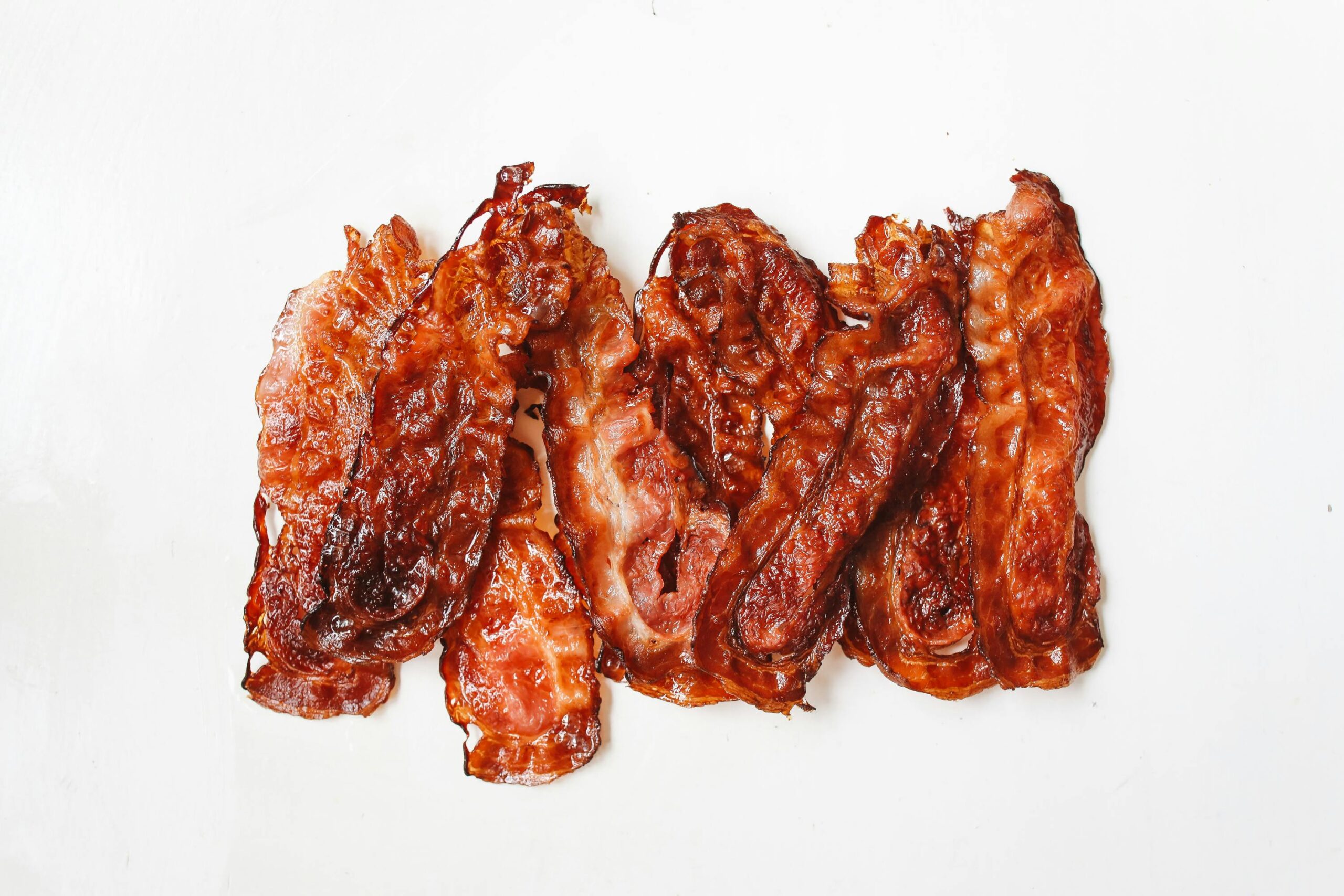
For many of us, the smell of sizzling bacon is the scent of comfort, of Sunday mornings, and of indulgence. It’s a fundamental element of the classic American breakfast.
I understand the allure. I also understand the data.
I have to deliver a hard truth that is often obscured by marketing and dietary trends: Processed meat is a known killer.
In 2015, the World Health Organization’s (WHO) research arm, the International Agency for Research on Cancer (IARC), issued a report that shocked the food industry and confused the public. They classified processed meat as a Group 1 Carcinogen.
When you hear “Group 1 Carcinogen,” your mind should immediately go to smoking, asbestos, and plutonium. You are correct. These are all in the same category.
This is not a message of judgment or fear-mongering. This is a clear, urgent health warning, and I need you to treat it with the same respect you would treat a surgeon’s advice. Eating bacon is not a joke; it is a direct, daily risk factor for disease.
Let’s dismantle the confusion, understand the actual science behind the classification, and learn how to protect yourself.
What Does “Group 1 Carcinogen” Actually Mean?
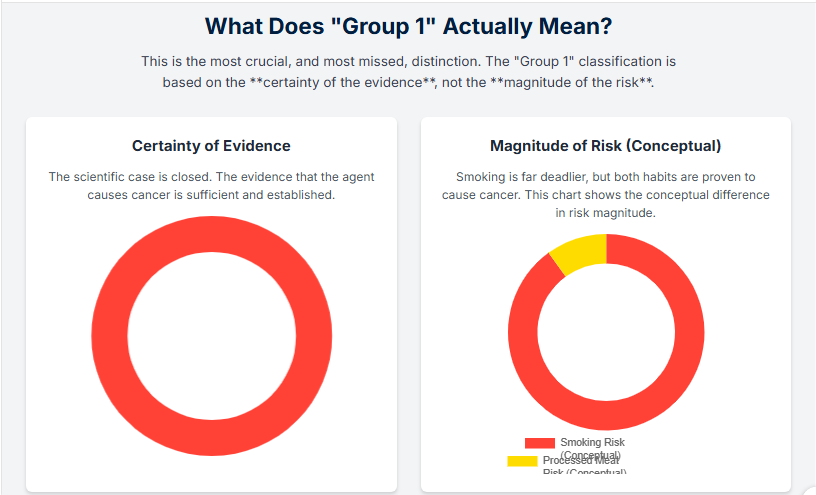
The IARC classification is based on the certainty of the evidence, not the magnitude of the risk. This is the crucial distinction that often gets missed.
- Group 1: Carcinogenic to Humans. This means there is sufficient evidence from human epidemiological studies that the agent causes cancer. The scientific case is closed.
- Example: The evidence that smoking causes lung cancer is in Group 1. The evidence that bacon causes colorectal cancer is also in Group 1.
- Group 2A: Probably Carcinogenic. Limited human evidence, but strong animal evidence. (Example: Red meat, specifically).
- Group 2B: Possibly Carcinogenic. Limited evidence in general.
The magnitude of risk is different. Smoking a pack of cigarettes daily carries a far greater overall cancer risk than eating two strips of bacon daily. However, the certainty that both agents cause cancer is scientifically established.
The takeaway is not that bacon is as dangerous as smoking, but that eating processed meat is a habit that causally leads to cancer, just like smoking.
The Specific Chemical Culprits: The Poison in the Preservation
Why are hot dogs, sausage, and bacon so dangerous? It all comes down to the process of curing and preservation.
The primary issue is the use of Nitrates and Nitrites.
These chemicals are added to processed meats for two reasons:
- Preservation: To prevent the growth of harmful bacteria, especially Clostridium botulinum.
- Aesthetics: To give the meat that pinkish color and distinct preserved flavor (without them, cured meat would look gray).
1. N-nitroso Compounds (NOCs)
When nitrates and nitrites hit the high-acid environment of your stomach and the high-heat environment of cooking, they convert into highly reactive chemicals called N-nitroso compounds (NOCs).
NOCs are the true cancer villains. They travel through your digestive system and chemically bind to your DNA, creating damaging adducts that lead to genetic mutations—the very definition of cancer initiation.
2. Heme Iron Damage
Processed meats are primarily red meats. The high concentration of heme iron in red meat can be released into the colon, where it promotes the formation of damaging free radicals and cytotoxic (cell-damaging) aldehydes, further injuring the colon lining and priming it for attack by NOCs.
3. HCAs and PAHs
Cooking bacon or sausage at high heat (frying until crispy or grilling) also produces Heterocyclic Amines (HCAs) and Polycyclic Aromatic Hydrocarbons (PAHs). These are the same carcinogenic compounds found in the char of grilled meats and cigarette smoke.
The Target: Colorectal Cancer
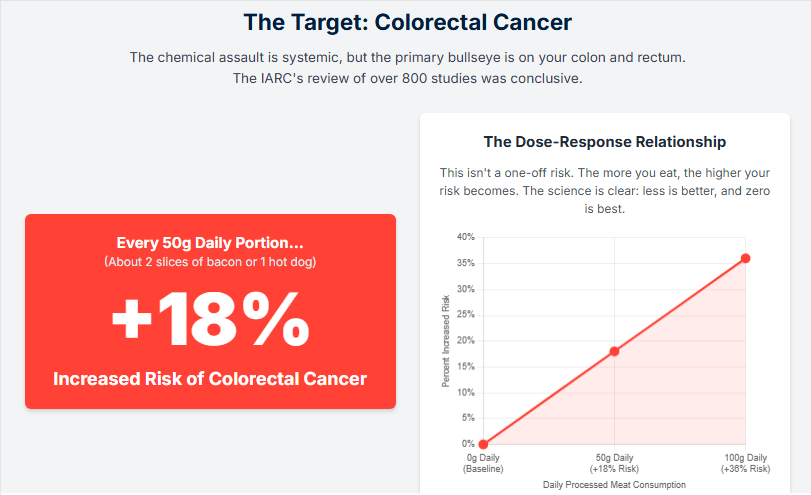
While the chemical assault is systemic, the primary target of processed meat consumption is the colon and rectum.
IARC reviewed over 800 studies and concluded that every 50-gram portion of processed meat eaten daily (that’s roughly one sausage or two slices of bacon) increases the risk of colorectal cancer by 18%.
This is not a small, theoretical risk. Colorectal cancer is the third most common cancer diagnosed in both men and women in the United States. Your daily bacon habit is literally stacking the odds against the health of your colon.
The Dose-Response Relationship:
If you eat one serving a day, your risk goes up by 18%. If you eat two servings, the risk almost doubles. The science clearly indicates a dose-response relationship: less is better, and zero is best.
The Marketing Trap: The “Uncured” Lie
Because of the mounting scientific evidence, the food industry has tried to create a loophole to retain the pink color and flavor without using synthesized nitrates. This is where you see the packaging labeled: “No Added Nitrates or Nitrites” or “Uncured.”
This is a marketing lie. Do not fall for it.
Instead of sodium nitrite, these companies use large quantities of celery powder, celery juice, or beet powder. Celery is naturally extremely high in nitrates.
- The manufacturers add celery powder, which is then cultured with a bacteria to convert the natural nitrates into nitrites.
- The finished product contains the exact same amount of cancer-causing nitrites as traditionally cured meat—sometimes even more!
- The only difference is that the USDA allows them to claim “No Added Nitrates” because the chemicals came from a vegetable source.
My Advice: If the product is pink and shelf-stable, assume it contains nitrites, and treat it as a Group 1 carcinogen, regardless of what the front of the package says.
The Harm Reduction Strategy (Since We Are Human)
My absolute recommendation is to eliminate processed meat entirely, especially if you have a family history of colorectal cancer. But since perfection is the enemy of progress, here is the harm reduction strategy:
1. Limit Consumption to a Rare Treat
If you must have it, treat it like a luxury item or a celebration food, not a daily staple. Aim for no more than one serving per month. This minimizes the chronic exposure that leads to DNA damage.
2. Never Cook It Crispy
The darker the meat, the more HCAs and PAHs you create. Low-temperature heating (like heating it gently in a frying pan) is safer than frying it until it is brittle and burnt. Avoid charring at all costs.
3. Pair It With Protection (Phytochemical Armor)
Your best defense against NOCs is the consumption of polyphenols and antioxidants.
- Fiber: Always eat processed meat with a huge serving of fibrous vegetables (like broccoli, cabbage, or beans) to speed up transit time and flush the carcinogens out faster.
- Vitamin C: Vitamin C has been shown to inhibit the formation of NOCs. If you are going to eat a processed meat sandwich, pair it with a citrus fruit or a glass of orange juice.
Healthy Breakfast Swaps: What to Eat Instead
Your breakfast should fuel your longevity, not attack your colon. Here are alternatives that satisfy the savory craving without the carcinogenic payload:
| Processed Food to Avoid | Healthy Longevity Alternative | Why It Wins |
| Bacon/Sausage | Lentil or Black Bean Hash | Fiber, resistant starch, low-GI, cheap protein. |
| Deli Slices (Ham/Turkey) | Roasted Chicken Breast (homemade) | Unprocessed protein, no added nitrites or chemical preservatives. |
| Store-Bought Breakfast Burrito | Tofu or Egg Scramble | High-quality protein. Add turmeric and black pepper for inflammation control. |
| Hot Dogs | Carrots and Hummus | Satisfies the salty, savory craving with fiber and monounsaturated fats. |
Final Thoughts: Treat It Like Smoking
No one starts smoking expecting to get cancer. They do it because it’s a social norm, an addiction, or a routine. The same is true for processed meat. It’s socially normalized, heavily marketed, and often part of a routine.
But now you know the truth: the evidence is clear.
If you carry a Group 1 classified agent—a proven carcinogen—into your kitchen every day, you are making a choice to increase your risk of colorectal cancer.
Be empowered by the science. Treat bacon, sausage, and deli meats not as a staple food, but as a known poison that you must limit or eliminate entirely.
Your fork writes your future. Write a long, healthy one.
Medical Disclaimer: I am a health advocate and writer, not a medical doctor. The information in this article is for informational purposes only and is not a substitute for professional medical advice, diagnosis, or treatment. Always seek the advice of your physician or other qualified health provider with any questions you may have regarding a medical condition.