
- The blood sugar impact of a carbohydrate-heavy food depends entirely on the order in which you eat the components of your meal.
- By eating fiber, protein, and fat first, you create a “firewall” in your digestive system that drastically slows down glucose absorption.
- This simple change—changing the order, not the food—can flatten your blood sugar curve by up to 75%, promoting steady energy and better health.
Your Blood Sugar is a Rollercoaster — And You’re the Conductor
If you’ve ever felt sluggish, foggy, or exhausted an hour after a big lunch, you’ve experienced the blood sugar rollercoaster.
You ate a pastry, a slice of bread, or a bowl of rice. The glucose hit your bloodstream fast, your body panicked and dumped insulin, and now you’ve crashed. That constant spiking and crashing of blood sugar is exhausting for your body. Over time, it is one of the biggest drivers of inflammation, weight gain, hormonal imbalance, and, eventually, type 2 diabetes.
For years, we’ve tried to fix this by obsessively counting carbs, calories, and points. We’ve focused entirely on what is on the plate.
But a quiet revolution in nutrition science has proven that we’ve been looking in the wrong place. The answer isn’t about eliminating food groups. It’s about changing the sequence in which they enter your body.
The difference between a healthy, stable blood sugar curve and a damaging spike isn’t the slice of bread. It’s what you eat immediately before it. This is a scientific fact, and it’s a game-changer because you can literally train your body to process food more gently, simply by picking up your fork differently.
The Science: The “Fiber-First” Firewall
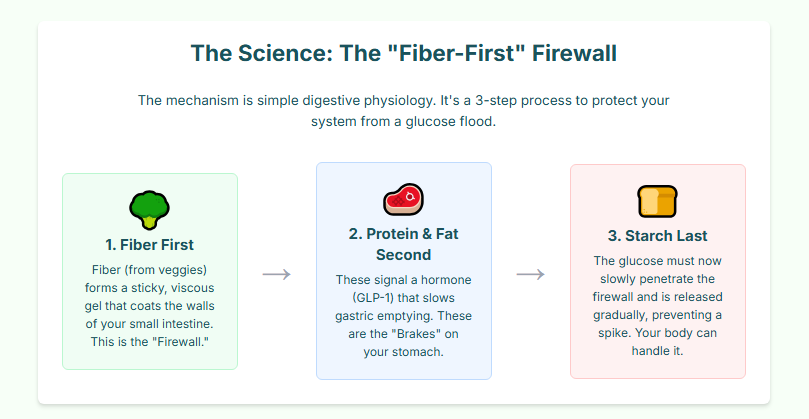
The mechanism behind this is surprisingly simple and rooted in digestive physiology.
When you eat food, it travels to your small intestine, where nutrients are absorbed into the bloodstream.
The Wrong Sequence (Starch First)
If you eat a naked carbohydrate (like a piece of toast or a handful of pretzels) first, the glucose-absorbing enzymes in your small intestine immediately get to work. The glucose floods your system instantly, leading to a massive spike that stresses your insulin response.
This is the typical, energy-draining rollercoaster we all know.
The Right Sequence (The Firewall)
The correct sequence is to frontload your meal with fiber, protein, and fat.
- Fiber (Non-Starchy Vegetables): When fiber hits your stomach, it forms a sticky, viscous gel that acts as a physical barrier—the “firewall.” This gel coats the walls of your small intestine.
- Protein and Fat: These macronutrients are naturally harder to digest and take up physical space. They also signal a hormone called GLP-1, which slows down the rate at which your stomach empties (gastric emptying).
When you finally eat the starch (the bread or rice) 10 or 15 minutes later, the glucose is forced to penetrate this sticky, protein-fat, fibrous firewall. This radically slows down the speed at which the glucose hits your bloodstream.
The result is staggering: Studies show that eating food in this simple sequence can flatten your glucose spike by up to 75% compared to eating the same foods in the reverse order.
The “Healthy” Eating Sequence: A Three-Part Prescription
The new prescription for stable blood sugar is a blueprint for your plate. You don’t have to be perfect, but you need to honor the order.
🍽️ Rule #1: Veggies/Fiber First (The Firewall)
This is the most critical step. Your first 5-10 bites should be non-starchy vegetables. They are the scaffolding of your meal.
- Examples: A large side salad, raw carrots, broccoli, green beans, or cucumber slices.
- The Goal: To coat your digestive tract with fiber-rich gel before the glucose arrives.
🥩 Rule #2: Protein and Healthy Fats Second (The Slow Down)
This course provides the building blocks for your muscles and brain, and critically, slows down gastric emptying.
- Examples: Fish, chicken, tofu, lentils, eggs, and a healthy oil (like olive oil or avocado oil).
- The Goal: To signal satiety and apply the “brakes” to your stomach, slowing the entire digestive process.
🍰 Rule #3: Starch and Sugar Last (The Treat)
This is the reward. By the time the starchy, glucose-laden foods arrive, your body is ready for them.
- Examples: Bread, potatoes, pasta, rice, or dessert.
- The Goal: Because the other foods have paved the way, the glucose from these foods will be absorbed slowly, giving your body plenty of time to deal with it gently, avoiding the crash.
Practical Application: Sequencing Your Favorite Meals
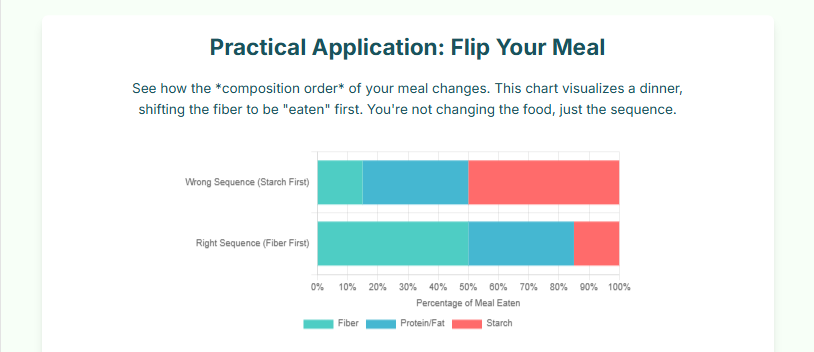
Most people eat their meals backward, starting with bread, reaching for the pasta, and finishing with a side vegetable. Here is how to flip the script on common meals:
| The Meal | The Wrong Sequence (High Spike) | The Healthy Sequence (Flat Curve) |
| Dinner | Rice $\to$ Chicken $\to$ Broccoli | Broccoli $\to$ Chicken $\to$ Rice |
| The Sandwich | Bread $\to$ Meat $\to$ Veggies | Lettuce/Tomato $\to$ Meat/Cheese $\to$ Bread |
| Breakfast | Toast $\to$ Eggs $\to$ Spinach | Spinach $\to$ Eggs $\to$ Toast |
| A Bowl of Chili | Kidney Beans/Starch $\to$ Meat/Fat | Mix well. Ensure every spoonful has meat/fat/beans first, then the starch/carbs. |
| Takeout Pizza | Dough $\to$ Cheese/Toppings | Pick off the toppings (meat/veg/cheese) and eat them first, then have the crust. |
The key is that you are not restricting the food; you are simply shifting the order. This is a behavioral hack, not a diet.
My Personal Advice as a Health Advocate
I know this seems too simple to be true. I was skeptical too, until I started tracking my own energy levels.
My biggest “aha” moment was with fruit. I used to think of a banana or an apple as a healthy stand-alone snack. But when I would eat an apple at 3 PM, I would get a burst of energy followed by a foggy, irritable slump an hour later.
Once I learned about sequencing, I changed one thing: I started having my apple after a small handful of almonds, or with a scoop of peanut butter.
The same banana. The same apple. But because I introduced the protein and fat first, the sugar hit my system gradually. The result? No spike. No crash. Just steady, lasting energy.
You don’t need fancy equipment to track this. You just need to listen to your body. If you feel tired or hungry shortly after a meal, it’s a sure sign that you hit the glucose jackpot too fast. Change the sequence. See how you feel 90 minutes later. The energy difference will convince you.
Myths vs. Facts: Sequencing Edition
- Myth: “If the food is whole grain or brown, the sequence doesn’t matter.”
- Fact: Whole grains are better than refined grains because the fiber is still intact, but they are still a starch. You still get a massive benefit by coating your stomach with extra fiber (from a salad) before the whole grain arrives.
- Myth: “I must wait 30 minutes between courses.”
- Fact: While some studies use a 10-20 minute wait, you don’t need to be so rigid in real life. Simply finishing your fiber and protein/fat portions before moving on to the starch/carb is usually enough to achieve the blunting effect.
- Myth: “Drinking vinegar is a magic fix.”
- Fact: Apple Cider Vinegar (ACV) does help blood sugar control by temporarily deactivating some starch-digesting enzymes. It’s a great tool, but it works best in combination with the correct food sequencing. The sequence is the foundation.
FAQs (Frequently Asked Questions)
1. Does this sequence work for everyone?
Yes. The principles of fiber slowing absorption and protein/fat slowing gastric emptying are universal physiological facts. This benefits everyone, regardless of current health status.
2. What about liquids? Should I drink my smoothie first?
Be careful with liquids. When you blend food, you break down the fiber, allowing glucose to be absorbed faster. If your smoothie is fruit-heavy, save it for the end. If it’s pure protein and spinach, it can be your first course.
3. What about starchy vegetables like potatoes or corn?
Starchy vegetables (potatoes, corn, sweet potatoes) should be treated like your bread and rice. They contain a lot of glucose. Eat them after your non-starchy vegetables (broccoli, leafy greens, asparagus).
4. Will this help me lose weight?
Many people find that stabilizing their blood sugar dramatically curbs their cravings and reduces fat storage. When you avoid the crash, you avoid the desperate hunger that causes overeating. It is a powerful tool for weight management.
Conclusion & A Final Word of Encouragement
You don’t need a new, restrictive diet. You don’t need expensive supplements. You don’t need to completely eliminate the foods you love.
You only need to change one tiny, free habit: the order in which you eat.
This single change gives you the power to manage your energy, reduce inflammation, curb cravings, and ease the burden on your body’s most essential systems. This is the ultimate health hack.
Start tonight. Eat your greens and protein first. Save the slice of bread for last. The same food, but a completely different result. You’ll feel the difference tomorrow.
Disclaimer: I am a health advocate and writer, not a medical doctor. The information in this article is for informational purposes only and is not a substitute for professional medical advice, diagnosis, or treatment. Always seek the advice of your physician.