

- Your calf muscles function as a “second heart,” and they are essential for pumping blood from your legs back to your chest against gravity.
- A weak “second heart” forces your real heart to work much harder, leading to higher blood pressure, poor circulation, and increased cardiac strain.
- Most people’s “second heart” is dangerously weak due to sitting, but a specific, deep muscle called the soleus can be activated while you sit, and almost no one knows how to train it.
The “Second Heart” Hiding in Your Calves
As a health advocate, I’ve spent my life talking to people about their hearts. We’re obsessed with it. We check its beat, we monitor its pressure, we worry about its arteries.
But we are all making one massive mistake. We’re only looking at half the system.
We think of the heart as a single, brilliant pump. And it is. It’s powerful enough to push blood out to every corner of your body, down to the tips of your toes. But here’s the billion-dollar question: How does that blood get back?
Your heart does not have the power to “suck” blood all the way back up from your feet, fighting gravity all day. It has a helper. You have a “second heart.”
This “second heart” is the system of muscles in your calves. Every time you walk, your calf muscles contract and squeeze the deep veins in your legs. This action, called the calf muscle pump, shoves the blood upward, from valve to valve, back to your chest.
It’s a brilliant, elegant system. And in the modern world, for most of us, it is completely broken.
The “heavy” feeling in your legs, the swollen ankles at the end of the day, the new spider veins—we write these off as “just part of getting older.” They are not. They are the early warning signs of a failing “second heart.” They are a sign that blood is pooling in your legs, and your real heart is being forced to pull a double shift, straining against this “stuck” column of blood.
But there is a fix. It’s a secret that hides in plain sight. You have a superpower muscle in your legs that most people have never trained, and you can use it to lower the strain on your heart while you are sitting at your desk.
Signs Your “Second Heart” is Failing You
This isn’t just a problem for the elderly or infirm. This is a problem for everyone who sits. When you sit, your “second heart” is offline. Your knees are bent, your ankles are still. The pump is off. For the 8, 10, or 12 hours you spend in a chair, gravity takes over.
How do you know the pump is failing? Your body is already sending you signals.
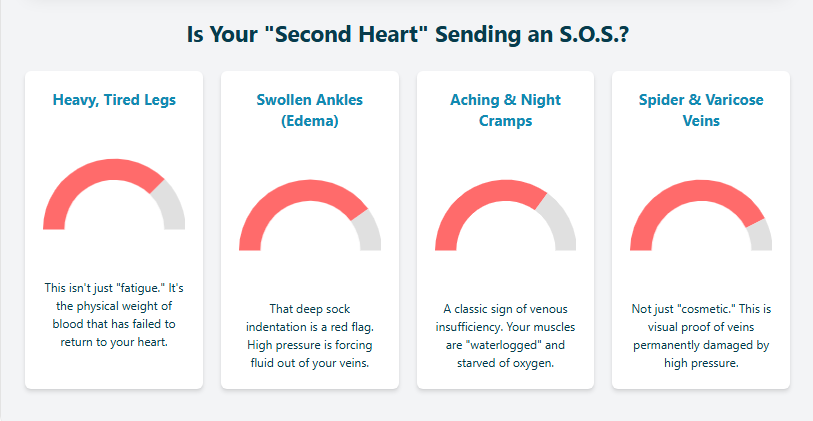
- Heavy, Tired Legs: This is the most common sign. It’s that feeling at 5 PM when your legs feel like lead weights. This isn’t just “fatigue”; it’s the physical weight of blood that has failed to return to your heart.
- Swollen Ankles & Feet (Edema): When you take your socks off, do you have a deep indentation on your ankle? That’s edema. Fluid and blood proteins are being forced out of your veins and into your tissues because the pressure is too high.
- Aching, Throbbing, or Cramping: Especially at night, this is a common sign of chronic venous insufficiency (a failing pump). Your muscles are aching from being waterlogged and starved of fresh, oxygenated blood.
- Spider Veins & Varicose Veins: These are not just a “cosmetic” problem. They are the visual evidence of a broken system. They are veins that have been permanently damaged and stretched by the constant, high-pressure pooling of blood.
Every single one of these symptoms points to one thing: your heart is working harder than it should. It is straining to do its own job and the job of your lazy, untrained “second heart.”
The Sitting Epidemic: Why We Are Starving This Muscle
The problem is our modern life. Our bodies were designed to move, walk, and squat—all actions that constantly engage the calf pump.
Our modern life is built around the chair. When you sit for hours on end, you are creating a “perfect storm” for heart strain:
- Gravity Wins: Blood flows down to your feet and just… stays there.
- The Pump is Off: Your calf muscles are completely relaxed. They are not squeezing, they are not pumping.
- Your Heart Pays the Price: Your heart, sensing that blood isn’t returning, pumps harder and faster to try and compensate, raising your blood pressure and increasing wear and tear on your entire system.
You might think, “But I’m active! I walk 10,000 steps a day!”
I love that. Walking is fantastic. It’s one of the best things you can do. But it’s not the whole answer. Walking primarily trains the big, superficial calf muscle you can see in the mirror—the gastrocnemius.
But the real hero, the magic muscle for blood return, is hiding deeper. And walking doesn’t train it to its full potential.
The Soleus: Your Secret Blood Pressure Muscle
Deep beneath your main gastrocnemius muscle lies the soleus.
This is not a normal muscle. It’s a cardiovascular phenomenon.
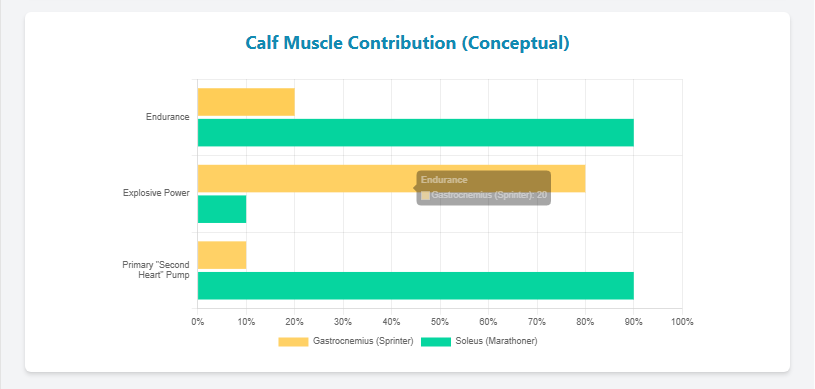
The gastrocnemius is a “phasic” muscle. It’s like a sprinter. It’s powerful, it’s fast (it’s what you use to jump and run), but it gets tired quickly.
The soleus is a “tonic” muscle. It’s a marathon runner. It is a massive, dense, slow-twitch muscle made almost entirely of endurance fibers. It is designed to work for hours and hours without fatiguing. Its primary job? To be the main engine of your “second heart.”
It’s the soleus that tirelessly pumps blood back to your heart while you are standing in line, washing dishes, or just shuffling around.
But when you sit, it’s completely turned off. Until now.
There is a specific exercise that isolates the soleus from the gastrocnemius. It’s an exercise you can do while sitting down. It turns your “dead” sitting time into active pumping time.
The Exercise: The “Soleus Pushup”
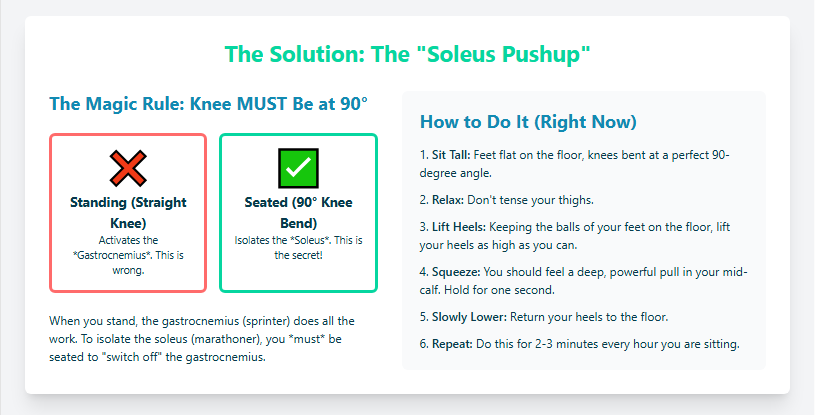
This is not a standard, standing calf raise. In fact, standing up will ruin this exercise.
When you stand up, your knee is straight. This engages the gastrocnemius.
To isolate the soleus, your knee must be bent at a 90-degree angle. This “switches off” the gastrocnemius, forcing the soleus to do 100% of the work.
Here is how you do it, right now, in your chair:
- Sit tall. Sit in a chair with your feet flat on the floor and your knees bent at a 90-degree angle.
- Relax. Relax your legs. Don’t tense your thighs.
- Keep your toes down. While keeping the balls of your feet on the floor, lift your heels as high as you can possibly go.
- Squeeze. You should feel a deep, powerful, pulling contraction in your lower/mid-calf. It feels different than a normal calf raise.
- Hold for a second at the very top.
- Slowly lower your heels back to the floor.
- Repeat.
That’s it. That’s the entire exercise. You have just activated the primary engine of your “second heart.” You are manually pumping blood from your feet back to your chest. You are doing your heart’s job for it, lowering your blood pressure and cardiac strain with every single rep.
When to See a Doctor (This Is Not Just ‘Tired Legs’)
While a weak soleus is a massive, overlooked problem, some symptoms are red flags for serious medical conditions. This technique is for support and strength, not a cure for advanced disease.
Please, see your doctor immediately if you experience:
- Sudden, painful swelling in only one leg. This can be a sign of a blood clot (Deep Vein Thrombosis or DVT), which is a medical emergency.
- Skin that becomes discolored. If the skin on your lower legs turns reddish-brown, leathery, or becomes dry and flaky, this is a sign of chronic, severe venous disease.
- Wounds or ulcers that won’t heal. Especially around the ankle, this means the circulation is so poor that your body can’t repair itself.
- Extreme, painful varicose veins.
Do not try to “fix” these with exercise. Get a medical evaluation immediately.
My Personal Advice as a Health Advocate
I’m a writer. I sit at a desk for a living, just like millions of others. And for years, I was a “pacer.” I would get up from my desk after two hours and my legs would feel like they were filled with wet cement. I felt “heavy” and sluggish.
Like everyone, I went to the gym. I did my cardio. I even did standing calf raises, thinking I was strengthening my “second heart.” But the heavy feeling always came back.
Then I learned about the soleus. It was a “lightbulb” moment. I realized I was training the wrong muscle.
I started doing seated soleus pushups while I was in meetings. I did them under my desk while answering emails. No one knew. I would just sit there, tapping my heels, for 5-10 minutes every hour.
After one week, the “heavy leg” feeling was gone. Completely.
After a month, I noticed my feet and ankles weren’t swollen in the evening. I felt “lighter.” It was a paradigm shift. My desk, which I used to see as a “health trap,” had become my new heart-health station. I am no longer just sitting; I am actively pumping blood all day long. This is a hack, in the best sense of the word.
Myths vs. Facts: Busting Calf-Training Lies
- Myth: “I walk 10,000 steps a day, so my ‘second heart’ is strong.”
- Fact: Walking is fantastic, but it’s an “ankle” motion that primarily uses the gastrocnemius. It’s not a substitute for the deep, isolating contraction of a seated soleus pushup.
- Myth: “Standing calf raises are the best calf exercise.”
- Fact: They are the best for building the gastrocnemius (the “vanity” muscle). They are almost useless for isolating the soleus (the “health” muscle). You must be seated.
- Myth: “Leg swelling and heavy legs are just a normal part of getting older.”
- Fact: They are a normal part of having a weak, untrained pump. You are not destined to have “old” legs. You have an untrained muscle.
- Myth: “I need to go to the gym to do this.”
- Fact: You can do the single most effective exercise for your “second heart” for free, right now, without standing up.
FAQs (Frequently Asked Questions)
1. How often should I do soleus pushups?
As often as you can! The soleus is an endurance muscle; it’s designed to work for hours. A great goal is to do 2-3 minutes of continuous reps every hour you are sitting.
2. Will this build big, bulky calves?
No. The soleus is a dense, “tonic” muscle. It doesn’t “hypertrophy” (grow) like the gastrocnemius. It will get incredibly strong and efficient, not bulky.
3. Does this replace my blood pressure medication or my cardio?
ABSOLUTELY NOT. This is a powerful supplement to your healthy lifestyle, not a replacement for your doctor’s advice or your aerobic exercise. Think of this as something you do in addition to walking, not instead of it.
4. Why can’t I just do it while standing?
I can’t stress this enough: The moment your knee is straight, the gastrocnemius takes over. The magic of this exercise is the 90-degree angle. You must be seated.
5. How fast will I see benefits?
You will feel the muscle working immediately. Like me, you will likely notice a reduction in “heavy legs” within a few days to a week. The long-term benefits to your circulation and heart strain are built over months of consistency.
Conclusion & A Final Word of Encouragement
For years, we’ve been told that sitting is the new smoking. We’ve been told to “get up and move,” as if the chair itself is the enemy.
But what if the problem isn’t just the sitting, but the passivity?
With this one, simple exercise, you can transform your “dead” time into “active” time. You can turn your desk into a health-promoting, blood-pumping station. You can take a direct, active role in easing the burden on your heart, all while answering your email.
Your heart’s fate isn’t just in your chest. A huge part of it is in your calves. You have two hearts. It’s time to start training the second one.
Disclaimer: I am a health advocate and writer, not a medical doctor. The information in this article is for informational purposes only and is not a substitute for professional medical advice, diagnosis, or treatment. Always seek the advice of your physician.