


The pursuit of a perfect night’s sleep often focuses entirely on the evening routine: dimming the lights, avoiding screens, drinking chamomile tea, and silencing the world. We treat sleep like a fire that must be desperately stoked just before bedtime.
However, modern chronobiology is revealing a profound truth that flips this conventional wisdom on its head: sleep quality is largely determined by what you do immediately after waking up, not just what you do before bed.
The key hormone governing the sleep-wake cycle, melatonin, is not just produced when darkness falls; its evening release is meticulously programmed by an event that occurs 12 to 14 hours earlier: your morning light exposure. Most people miss this critical timing window, inadvertently sabotaging their nighttime sleep before the day has truly begun.
This principle makes melatonin less of a simple sleep aid and more of a time-release hormone, set in motion at dawn. Understanding and optimizing this simple, free habit is the most powerful tool you have to fix your circadian rhythm, reduce stress, and achieve the deep, restorative sleep your body needs.
https://www.youtube.com/watch?v=z7oK4oE8sQg
💡 The Circadian Master Clock: Setting the Rhythm
The entire sleep-wake cycle is governed by your circadian rhythm, a roughly 24-hour internal clock present in every cell of your body. The central pacemaker for this rhythm is a tiny cluster of neurons in your brain called the Suprachiasmatic Nucleus (SCN), located just above where the optic nerves cross. The SCN is your Master Clock.
The Master Signal: Light
The SCN is exquisitely sensitive to light. The most potent external signal that sets this clock is light—specifically, the bright, full-spectrum light of the sun. The human eye contains specialized cells called melanopsin-containing Retinal Ganglion Cells (ipRGCs) that are solely dedicated to sensing light intensity, particularly in the blue-green spectrum(the spectrum abundant in morning light). These cells send a direct signal to the SCN, communicating one essential message: “It is morning, wake up!”
The Melatonin Program
Melatonin, often called the “Dracula of Hormones,” is secreted by the pineal gland. Its job is to signal the onset of biological night and lower core body temperature, preparing the body for sleep.
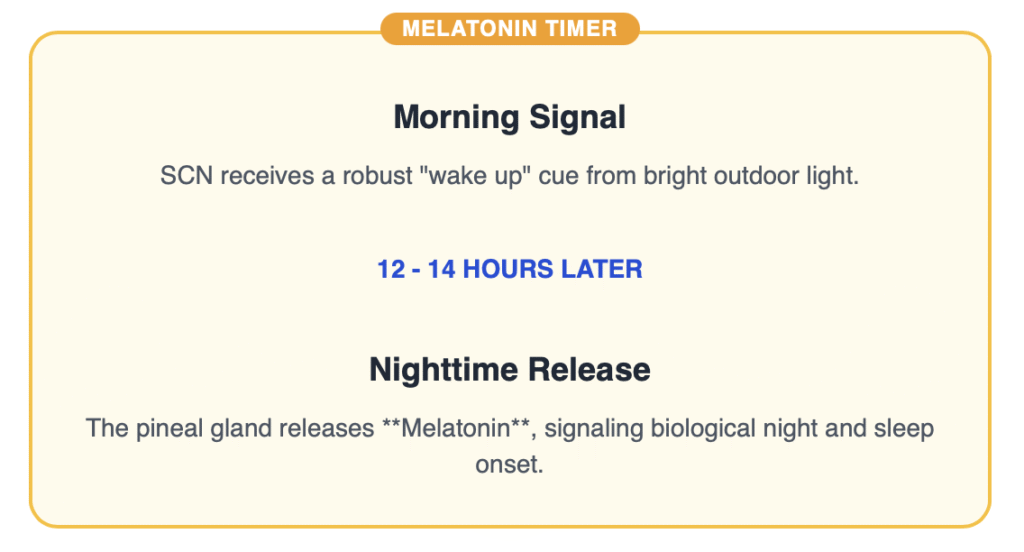
Crucially, the SCN sets the timer for melatonin’s release. When the SCN receives that robust signal of morning light:
- It registers the time of the signal (e.g., 7:00 AM).
- It uses this morning signal to calculate the optimal time for the onset of darkness and the initiation of sleep—usually 12 to 14 hours later.
- Melatonin production is actually inhibited during the day, with the goal of releasing a powerful, concentrated pulse 12 to 14 hours after the light signal.
If the morning light signal is weak, mistimed, or absent, the SCN receives a muddy, delayed, or weak cue, resulting in a delayed and diminished melatonin release at night.
🧠 The Modern Problem: Sabotaging the Morning Signal
The modern lifestyle is perfectly structured to sabotage the vital morning light signal, thereby delaying and weakening nighttime melatonin production.
The Indoor Barrier
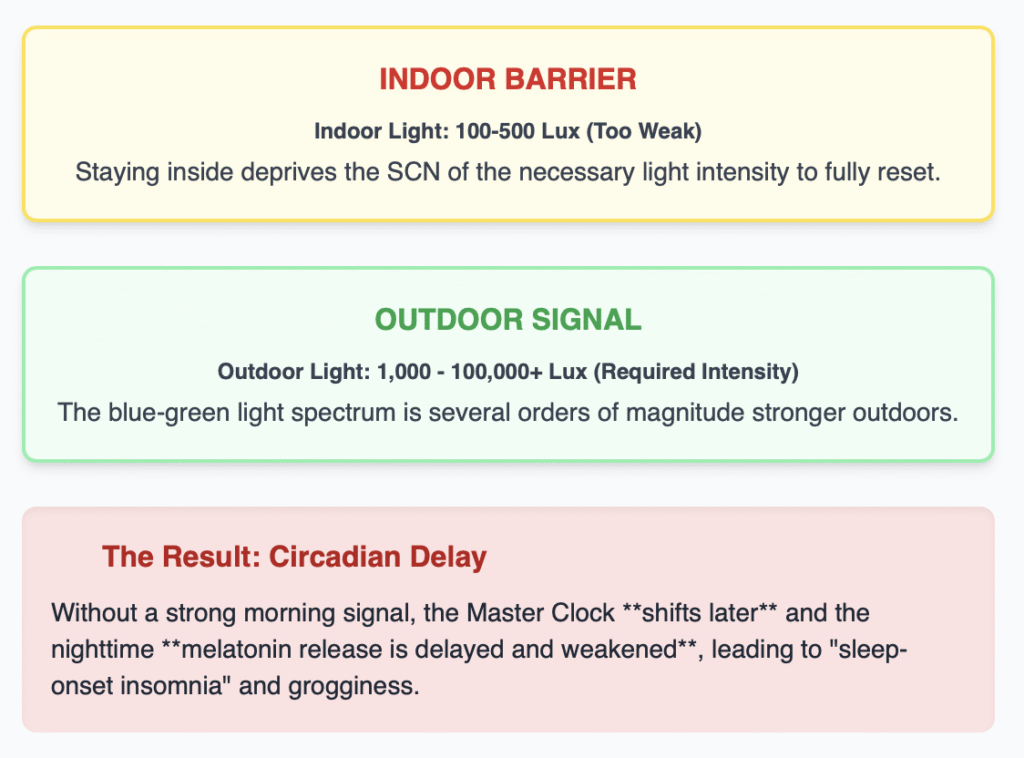
Most people wake up, turn on dim indoor lights (which range from 100 to 500 lux), and immediately start their day indoors, perhaps commuting in a car or subway.
- Indoor light is too weak: Daylight, even on a cloudy morning, ranges from 1,000 to over 100,000 lux (a measure of light intensity). The bright morning sun is several orders of magnitude more powerful than any indoor lamp. By staying inside, we deprive the SCN of the necessary intensity to trigger the robust “wake up” message.
- The Delay: Without the strong light cue, the Master Clock remains in a state of confusion, potentially shifting later and later—a condition known as Circadian Delay. When the clock is delayed, the evening melatonin release is also delayed, leading to “sleep-onset insomnia” (the feeling of being tired, but unable to fall asleep until late).
The Evening Problem (Rooted in the Morning)
When the SCN doesn’t receive the strong morning signal, it becomes much more vulnerable to disruption later in the day.
- Melatonin Suppression: The weak morning signal means the system is poorly timed. If you then expose your eyes to bright artificial light (from phone, TV, or overhead lamps) after sunset, the melatonin release is easily suppressed, leading to shallow sleep, frequent awakenings, and difficulty staying asleep.
The core message is that fixing your morning light exposure is the most powerful leverage point to ensure that your body is ready and primed for sleep when evening arrives.

👀 A 60-Second Morning Habit Flips the Switch
The most effective, accessible, and fast way to set your clock and program your melatonin is a simple, non-negotiable morning habit.
The Correct Timing: 30 to 60 Minutes After Waking
The SCN is most sensitive to light immediately upon waking and for the first 30 to 60 minutes of the day. This is the critical window when the system is ready to be reset and timed for the 24-hour cycle.
The Habit: Immediate Outdoor Light Exposure
- Goal: Expose your eyes (not your skin) to bright outdoor light.
- Duration: Aim for 2 to 10 minutes of direct outdoor exposure. On cloudy days, aim for the longer 10-minute duration. On bright, clear days, 2 minutes is often sufficient.
- How to Do It:
- Immediately upon waking, go outside.
- Stand or sit facing the sky (not necessarily directly at the sun, which can be damaging).
- Do not wear sunglasses (sunglasses filter the blue-green light spectrum required to activate the melanopsin cells).
- Do not look through a window (most glass windows block significant portions of the necessary light spectrum).
- Allow the light to enter your eyes naturally.
This 60-second to 10-minute commitment immediately sends the strong, unequivocal signal to your SCN that the day has begun.

The Biological Benefits of the Dawn Reset
Beyond simply timing your sleep, early morning light triggers a cascade of hormonal and metabolic benefits that enhance physical and mental well-being throughout the day.
1. Cortisol Timing and Stress Reduction
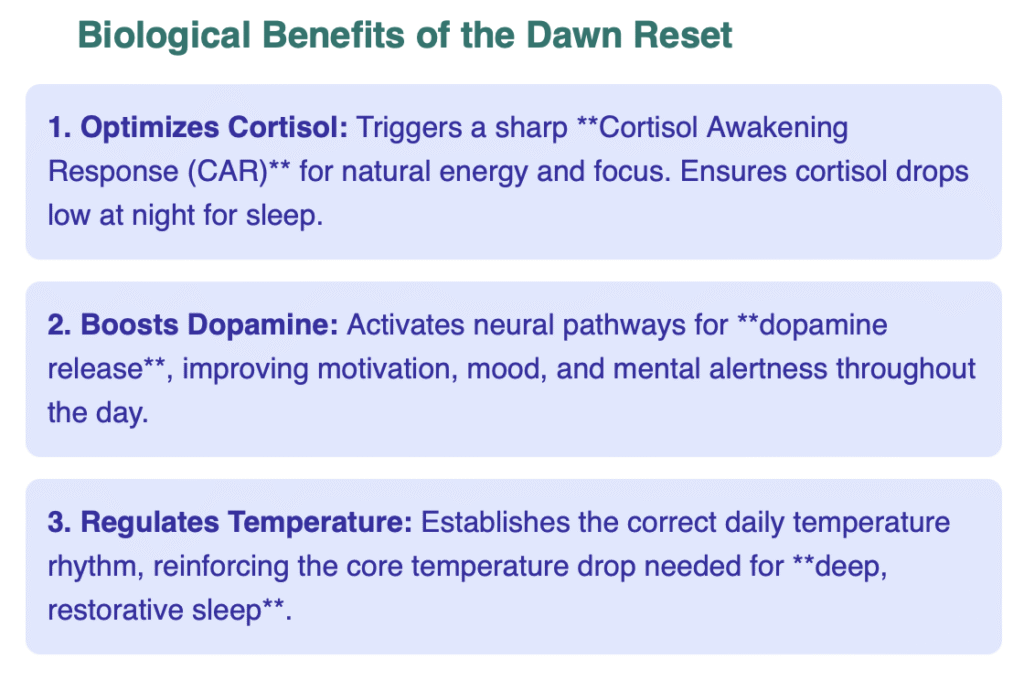
Cortisol is often viewed as a stress hormone, but it is essential for waking and alertness. Your body needs a sharp spike in cortisol in the morning, known as the Cortisol Awakening Response (CAR), to transition effectively from sleep to wakefulness.
- Morning Light and CAR: Strong morning light exposure is a key trigger for a healthy, robust CAR. This sharp, timed release of cortisol provides natural energy and alertness.
- The Midday Dip and Nighttime Calm: When the CAR is healthy, cortisol naturally dips during the afternoon, and more importantly, drops to its lowest levels at night, allowing the body to easily transition into sleep. A poorly timed CAR, due to lack of morning light, often results in a blunted cortisol curve, leading to grogginess in the morning and inappropriately high cortisol levels at night—a recipe for stress-induced insomnia.
2. Boosted Dopamine and Mood
Morning light exposure activates neural pathways in the brain that promote the release of dopamine.
- Motivation and Focus: Dopamine is the primary neurotransmitter associated with motivation, focus, and drive. By setting the circadian rhythm correctly, you naturally optimize your dopamine levels early in the day, leading to better mood, energy, and an improved ability to concentrate. This is why morning light is a powerful, non-pharmacological intervention for seasonal affective disorder (SAD) and general mood disorders.
3. Core Body Temperature Regulation
Melatonin is closely linked to core body temperature. The body must drop its core temperature by 1-3 degrees Fahrenheit to initiate and maintain deep sleep.
- Light’s Role: Morning light helps establish the correct temperature rhythm for the day, ensuring that the body reaches its temperature trough in the middle of the night and its peak alertness during the day. By stabilizing the circadian rhythm, morning light indirectly reinforces the temperature drop required for a smooth sleep onset 12-14 hours later.

Melatonin Supplements vs. Melatonin Programming
This understanding fundamentally changes the way we view melatonin supplements.
- Supplements are a Band-Aid: Taking exogenous melatonin may force sleepiness, but it does not fix the underlying malfunction of the Master Clock. It is a temporary signal that doesn’t reset the timing mechanism.
- Programming is the Cure: By getting morning light, you are ensuring your body produces its own perfectly dosed, perfectly timed pulse of melatonin that is natural and in sync with your entire hormonal system.
For those struggling with sleep, the first step is always to optimize the signal, not just supplement the hormone.
The Evening Protocol: Reinforcing the Morning’s Work
While the morning light sets the time, your evening habits must not interfere with the natural melatonin release programmed hours earlier.
- Dim the Lights: As the sun sets, dim your indoor lights. Use lamps instead of overhead lighting, and ideally switch to warm-spectrum light bulbs (red/yellow) that have less blue light.
- Avoid Blue Light: Minimize screen time (phones, tablets, computers) in the 1-2 hours before bed, or use blue-light filtering applications and glasses. Remember, the melanopsin cells that sense morning light are also highly sensitive to evening blue light, which can easily suppress the carefully timed melatonin release.
- Cool Down: Lower the temperature in your bedroom (ideally to 65-68°F/18-20°C) to facilitate the necessary core body temperature drop.
These evening practices are only fully effective when they are built upon the robust foundation laid by the strong morning light signal.

2-Minute Read Takeaway
The secret to a great night’s sleep isn’t found in a pill or a complex bedtime routine; it’s a simple, ancient signal delivered by the sun.
Your body programs its nighttime sleep hormone, melatonin, in the morning. A weak or absent morning light signal delays the release of melatonin, resulting in insomnia, fatigue, and a lifetime of fighting your own body clock.
The most powerful 60-second habit you can adopt is to step outside within 30 to 60 minutes of waking and expose your eyes to 2 to 10 minutes of direct outdoor light, without sunglasses or windows.
This single act of timing flips the switch, calibrates your Master Clock, ensures a powerful cortisol spike for daytime energy, and sets the stage for a strong, timely melatonin release and the deep, restorative sleep that follows.