


For millennia, cultures across the globe have instinctively turned to intense heat—from ancient Roman baths to indigenous sweat lodges and the Nordic sauna—as a powerful tool for relaxation and revitalization. Modern science is now catching up to this ancient wisdom, revealing that the benefits of intense heat exposure are far more profound than mere stress relief. They trigger a fundamental survival mechanism in your cells, engaging your body’s internal repair crews: the longevity proteins.
This process, known as hormesis (a biological principle where a low-dose exposure to something harmful or stressful is beneficial), is proving to be a highly effective, accessible, and enjoyable way to enhance cellular resilience, reduce inflammation, and dramatically lower the risk of chronic age-related diseases like heart disease and dementia.
The key to unlocking these benefits lies in the careful application of temperature and session length. Simply sweating for a few minutes isn’t enough; you need a protocol designed to optimize the biological response.
https://www.youtube.com/watch?v=ycJTKpQZync
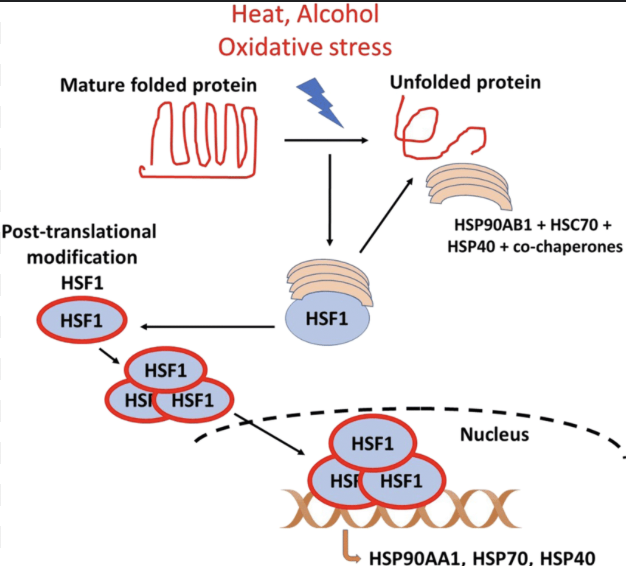
💡 The Heat-Shock Response: Your Cellular Repair Crew
When the body is exposed to intense heat—such as in a sauna—its core temperature begins to rise. While this might seem harmful, the cells interpret this rise as a temporary stressor, immediately activating a crucial protective cascade known as the Heat-Shock Response (HSR).
The primary molecular players in the HSR are the Heat-Shock Proteins (HSPs).
The Function of Heat-Shock Proteins (HSPs)
HSPs are the cell’s master maintenance and quality control specialists or chaperone proteins. Their job is to ensure that other proteins within the cell maintain their correct three-dimensional structure (their native shape, or “folding”).
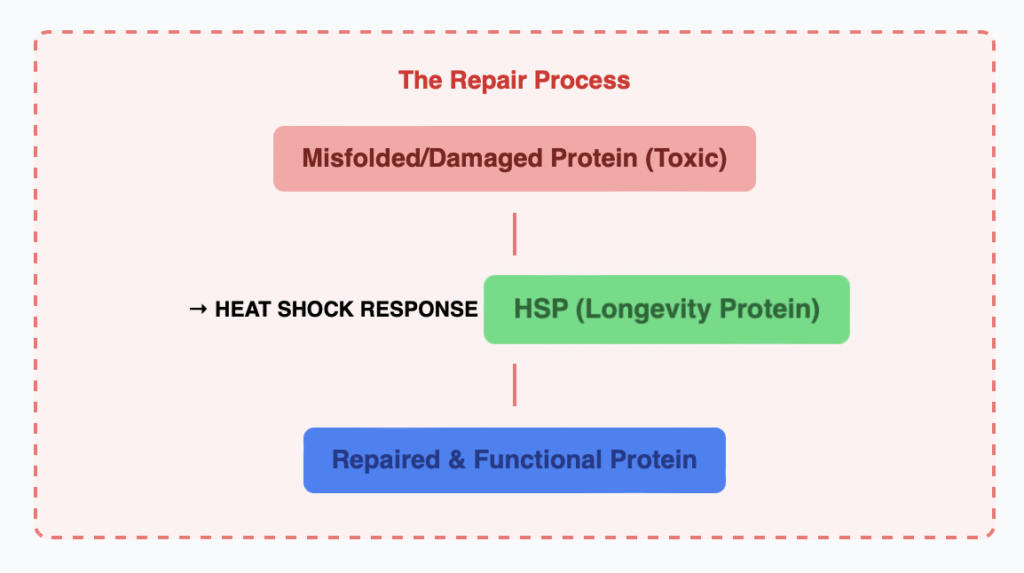
- Repair and Refolding: When proteins are damaged, stressed, or improperly folded (a process often accelerated by age, oxidative stress, and disease), they can aggregate and become toxic to the cell. HSPs rush to these misfolded proteins, essentially unfolding the damaged sections and helping the protein to re-fold correctly, rescuing the protein and allowing the cell to survive.
- Clearing Debris: If a protein is too far gone to be rescued, HSPs help flag it for the cell’s disposal and recycling system (ubiquitin-proteasome system and autophagy). This clears out cellular “garbage,” which is essential for cellular longevity.
- Anti-Inflammation: HSPs are also potent anti-inflammatory agents, stabilizing the internal cellular environment and protecting cells from immune stress.
The bottom line: Heat exposure acts like a training session for your cells. By inducing a mild, controlled thermal stress, you force the body to ramp up its production of HSPs, leaving you with a higher baseline of these critical longevity proteins long after you step out of the sauna.
🧠 Systemic Benefits: Dramatically Lower Disease Risk
The effect of the Heat-Shock Response extends far beyond the cellular level, translating into significant, measurable reductions in the risk factors for major chronic diseases.
Cardiovascular Health (The Heart’s Workout)
Regular sauna use subjects the cardiovascular system to a form of passive exercise.
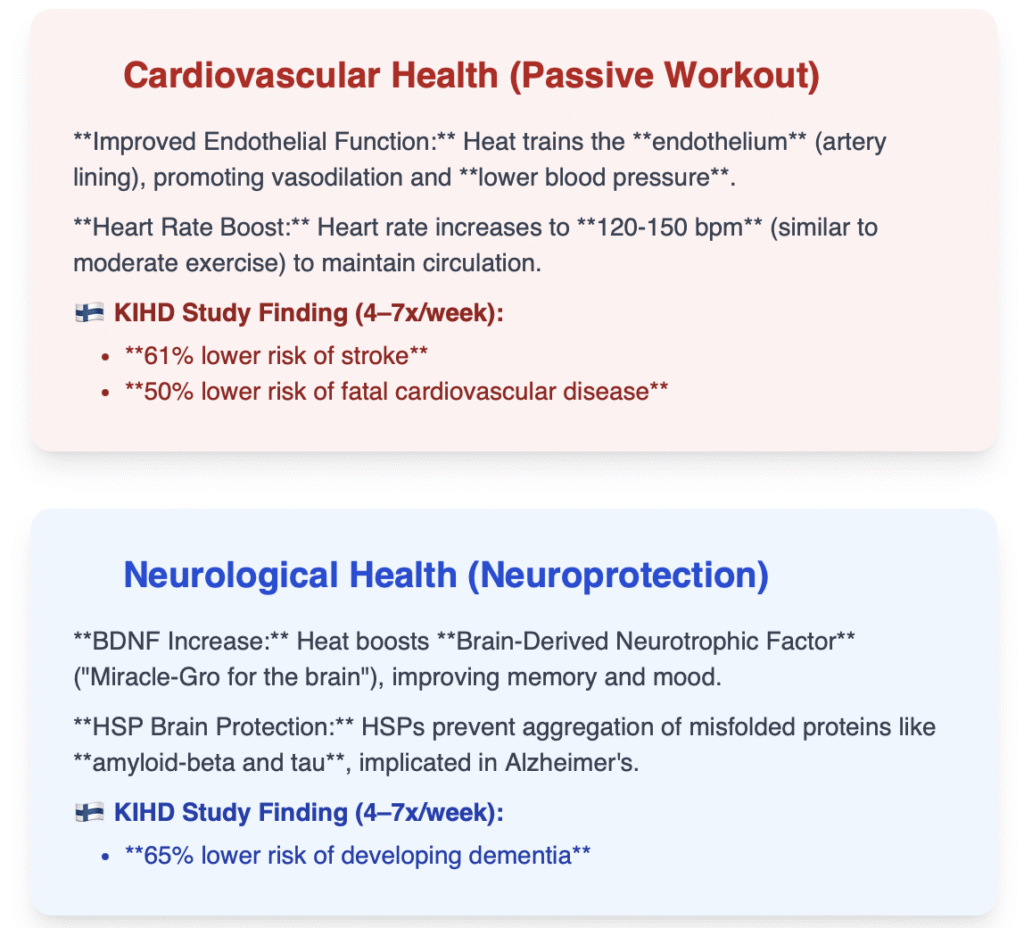
- Increased Heart Rate and Cardiac Output: As the body heats up, blood flow is shunted to the skin to dissipate heat. The heart must pump harder (increasing heart rate to 120-150 beats per minute, similar to moderate exercise) to compensate and maintain core circulation.
- Improved Endothelial Function: Consistent heat exposure has been shown to improve the health and function of the endothelium (the inner lining of blood vessels). Healthy endothelium is crucial for vasodilation (the relaxation of arteries), which leads to lower blood pressure.
- Reduced Risk: The landmark Kuopio Ischaemic Heart Disease Risk Factor Study (KIHD) in Finland tracked thousands of middle-aged men over two decades. The findings were staggering:
- Men who used a sauna 4–7 times per week had a 61% lower risk of stroke and a 50% lower risk of fatal cardiovascular disease compared to those who used it only once per week.

Neurological Health (Fighting Dementia)
The benefits extend deep into the brain, where heat stress appears to be a powerful neuroprotector.
- Brain-Derived Neurotrophic Factor (BDNF): Heat exposure has been shown to increase levels of BDNF, often called “Miracle-Gro for the brain.” BDNF promotes the growth of new neurons, improves synaptic plasticity, and is strongly linked to improved mood, memory, and cognitive function.
- HSP Protection in the Brain: HSPs are crucial for preventing the aggregation of misfolded proteins in the brain, such as amyloid-beta and tau—the characteristic protein plaques and tangles associated with Alzheimer’s diseaseand other dementias.
- Reduced Risk: The KIHD study also found that men who used the sauna 4–7 times per week had a 65% lower risk of developing Alzheimer’s disease and other forms of dementia compared to those who used it once a week.

👀 Protocol Matters: Temperature and Session Length
The benefits are dose-dependent, meaning they increase with the frequency, temperature, and duration of the sessions.Merely stepping into a mild sauna for a quick sweat isn’t enough to induce the robust Heat-Shock Response that drives these longevity benefits.
The Optimal Sauna Protocol for Longevity
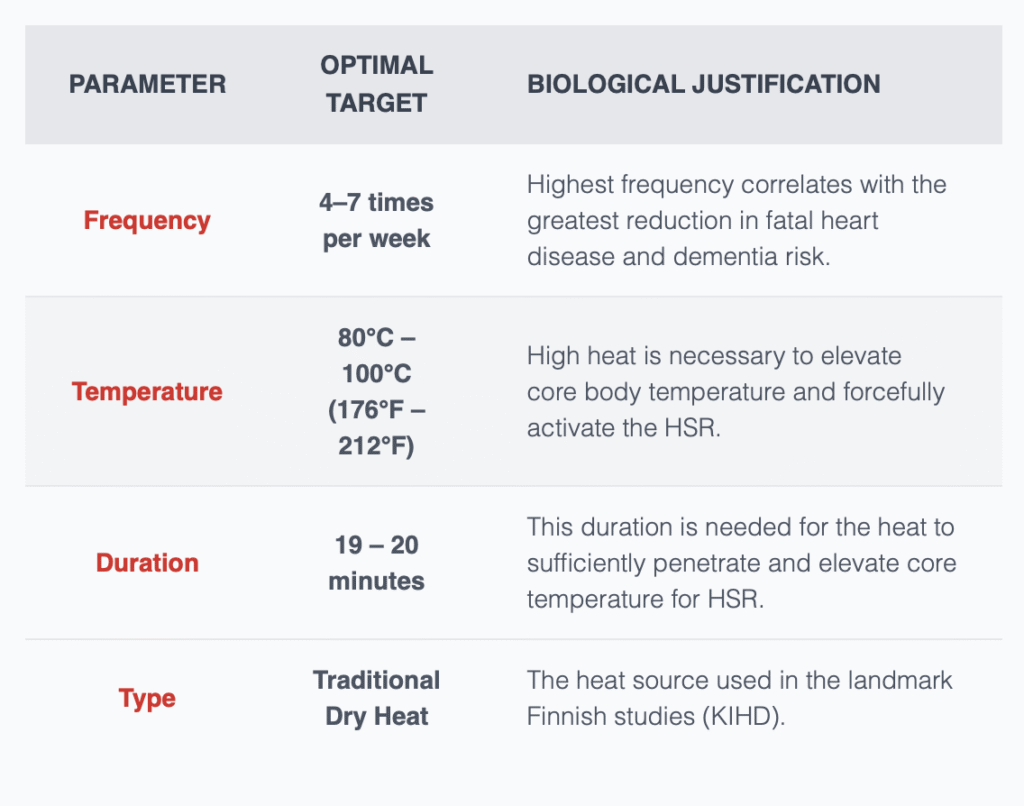
Based on the research from the long-term Finnish studies, the following protocol maximizes the activation of HSPs and the resulting disease-risk reduction:
| Parameter | Optimal Target | Why it Matters |
| Frequency | 4–7 times per week | This high frequency is strongly correlated with the greatest reduction in cardiovascular disease, stroke, and dementia risk. |
| Temperature | 80°C – 100°C (176°F – 212°F) | High heat is essential to achieve a core body temperature rise sufficient to activate the robust Heat-Shock Response and significantly increase HSP production. |
| Duration | 19 – 20 minutes per session | The most significant benefits were seen in individuals who averaged sessions lasting this long. This duration is needed for the heat to penetrate and elevate the core temperature. |
| Type | Traditional Finnish Sauna (Dry Heat) | This is the type of heat used in the key longevity studies (KIHD), though infrared saunas, when used to achieve a similar core temperature rise, may confer similar benefits. |
The Role of Cooling
While not the focus of the HSP response, the transition out of the heat is also key to maximizing cardiovascular benefits.
- Cool-Down: A quick, cold shower or a plunge after the hot session causes rapid vasoconstriction, training the blood vessels and enhancing the circulatory effects. This alternating heat-stress/cold-shock is excellent for vascular health.
The Broader Metabolic and Performance Gains
Beyond preventing disease, regular heat exposure offers immediate and tangible benefits for metabolism and physical performance:
1. Improved Insulin Sensitivity
Heat exposure acts as a mimic of exercise. Research has shown that frequent heat therapy can improve insulin sensitivityand reduce blood sugar levels. This is thought to be partly due to the increased activity of HSPs, which play a role in regulating glucose uptake, making cells more responsive to insulin. This is a powerful, passive tool for metabolic health.
2. Muscle Preservation and Growth
Heat exposure can help preserve muscle mass, particularly during periods of immobilization or reduced activity.
- HSP70: One specific HSP, HSP70, acts as an anti-atrophy signal. It helps stabilize muscle fibers and reduces the degradation of muscle protein.
- Growth Hormone: Some studies have shown that intense, repeated sauna sessions can dramatically increase the secretion of growth hormone (GH). GH is a critical anabolic hormone that supports muscle repair, fat metabolism, and bone density.
3. Pain and Inflammation
The anti-inflammatory effects of HSPs and the promotion of endorphin release make saunas an excellent tool for chronic pain management. Regular use has been shown to reduce generalized pain, improve the symptoms of chronic fatigue, and speed up recovery after intense exercise.

Read Takeaway
Heat therapy, specifically regular high-temperature sauna use, is far more than a luxury; it is a scientifically validated longevity practice. By intentionally subjecting your body to a manageable thermal stress, you activate the ancient Heat-Shock Response, forcing the production of longevity proteins (HSPs) that actively repair damaged cells and clear toxic protein debris.
The collective impact of this cellular maintenance is powerful: a 50-65% reduction in the risk of fatal heart disease, stroke, and dementia for those who commit to the practice 4–7 times per week.
Your action step is simple: adopt the optimal protocol—aiming for 4 sessions per week, lasting 19–20 minutes, at 80°C or higher—to put your cellular repair crew to work and unlock a powerful, natural pathway to health and resilience.