


SEO Summary:
- The Vagus Nerve is the longest cranial nerve and the main component of the Parasympathetic Nervous System (PNS), acting as the body’s “brake pedal” for stress.
- Stimulating the Vagus Nerve reduces the inflammatory response and instantly lowers the physiological signs of anxiety, improving resilience (Vagal Tone).
- A specific technique involving deep, resonant humming creates a vibration that mechanically and acoustically stimulates the Vagus Nerve fibers near the vocal cords.
- This takes under 20 seconds and requires no equipment or complex meditation. Click to learn the simple sound technique that can be done anywhere to activate your body’s relaxation response.
The Vagal Brake: Your Body’s Instant Off-Switch

You have two primary settings for your nervous system: the Sympathetic Nervous System (SNS)—the accelerator, responsible for “fight or flight”—and the Parasympathetic Nervous System (PNS)—the brake, responsible for “rest and digest.”
In our modern, high-stress world, most of us have a faulty brake. Our SNS is perpetually running, leading to chronic anxiety and fatigue. The solution to engaging the brake is stimulating the Vagus Nerve (VN).
The Anatomy of Calm

The Vagus Nerve is often called the “wandering nerve” because it travels from the brainstem down through the chest, connecting to virtually every major organ, including the heart, lungs, and gut.
The VN is the central highway of the PNS. When it is strongly engaged (high Vagal Tone), it sends inhibitory signals to the heart and the adrenal glands, resulting in:
- Reduced Heart Rate: It immediately slows the heart rate, reducing the physical feeling of panic.
- Anti-Inflammatory Response: Vagal stimulation releases acetylcholine, a neurotransmitter that dampens the body’s inflammatory cytokine production, literally turning down systemic inflammation.
- Improved Digestion: It restores the “rest and digest” state, maximizing nutrient absorption and motility.
The goal of any effective stress management technique is to stimulate this nerve and increase its responsiveness, known as Vagal Tone.
The Stressed System: Signs of Low Vagal Tone
When the Vagus Nerve is underactive or has low tone, the Sympathetic Nervous System runs unchecked. Your body is always on high alert, even when no real danger is present.
Common Signs Your Vagus Nerve Needs a Boost
- Chronic Anxiety and Intolerance to Stress: Small stressors trigger oversized, long-lasting reactions. You find it difficult to “let things go.”
- Digestive Issues: Persistent bloating, irritable bowel symptoms, or chronic constipation, as the body never fully transitions into the restful, optimal digestive state.
- Low Heart Rate Variability (HRV): This is the clinical measure of Vagal Tone. Low HRV means your heart rate doesn’t fluctuate much, signaling a rigid, stress-dominant nervous system.
- Tension and Headaches: Persistent muscle tension, particularly in the neck and shoulders, and stress headaches are signs of chronic SNS activation.
- Poor Recovery from Illness: Since Vagal Tone regulates inflammation, a low-tone individual often suffers from longer recovery times from infections and higher baseline inflammation markers.
Fortunately, the Vagus Nerve is one of the few nerves we can intentionally stimulate through non-invasive, mechanical means—and sound is the fastest way.
The Vagus Nerve’s Secret Pathway: Why Humming Works
The Vagus Nerve is an incredibly long and complex structure, but the key to stimulating it with sound lies in its physical location around the vocal cords and the muscles of the inner ear.
The Science of Vibration
When you create a low, sustained, resonant sound, two things happen:
- Mechanical Stimulation: The vibration of the vocal cords and the deep resonance in the chest cavity mechanically stimulates the Vagus Nerve fibers that run through the neck and throat.
- Inner Ear Connection: A small branch of the Vagus Nerve, the auricular branch, travels into the inner ear. The low-frequency sound creates pressure waves in the inner ear that acoustically stimulate this pathway.
The key is not to hit a precise musical note in Hertz (which would be impossible without a tuning fork), but to maximize the depth and duration of the vibration. A low-frequency, drawn-out “Mmmm” sound is a perfect, actionable way to deliver this mechanical massage to the Vagus Nerve.
The Humming Protocol: Finding the Frequency
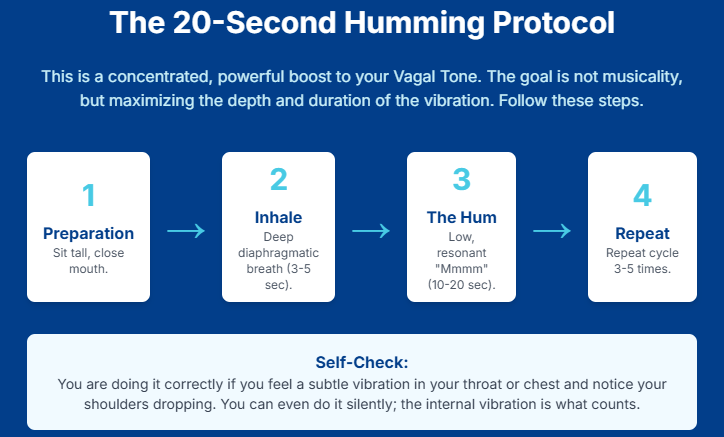
The most effective “frequency” for Vagus Nerve stimulation is the one that produces the deepest, longest, and most sustained vibration in your chest and throat. This is achieved through breath control, not musicality.
The Advocate’s 20-Second Calming Checklist
| Step | Action | Timing & Focus | Rationale |
| Preparation | Sit or stand with a tall spine. Close your mouth gently. | 5 seconds. Focus on posture. | Opens the throat and chest cavity for optimal resonance. |
| Inhale | Take a deep, slow, diaphragmatic breath. | 3–5 seconds. Fill the abdomen. | Provides the necessary air volume for a long, sustained sound. |
| The Hum | Exhale slowly through your nose, making a low, resonant “Mmmm” sound. | 10–20 seconds. Aim for deep chest vibration. | The duration and low frequency activate the Vagus Nerve fibers. |
| Repeat | Repeat the cycle 3 to 5 times. | Total time: under 2 minutes. | Provides a concentrated, powerful boost to Vagal Tone. |
The Vagal Tone Test: You are doing it correctly if you can feel a subtle vibration in your throat or chest, and if you notice your heart rate slowing down or your shoulders dropping immediately after the first long exhale.
Beyond Humming: Integrating Vagal Activation into Daily Life
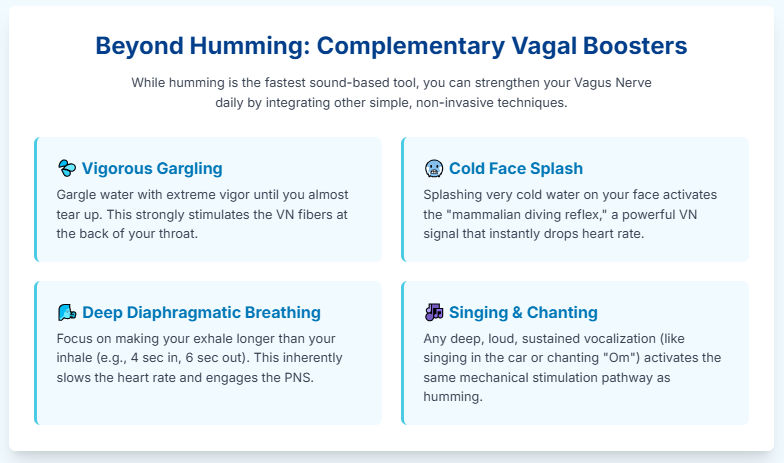
While humming is the fastest sound-based tool, you can build on the practice by integrating other simple, non-invasive techniques that stimulate the Vagus Nerve daily.
Complementary Vagal Boosters
- Gargling with Vigor: The Vagus Nerve also innervates the muscles at the back of the throat. Gargling water with extreme vigor—until you almost start tearing up—is a powerful mechanical stimulator of the VN.
- Cold Face Splash: Splashing very cold water on your face, particularly over the eyes and cheeks, activates the mammalian diving reflex. This reflex is a strong Vagus Nerve signal that instantly drops your heart rate and redirects blood flow, providing an immediate calm.
- Deep Diaphragmatic Breathing: Long, slow exhales are inherently vagal-activating. Focus on extending your exhale to be longer than your inhale (e.g., 4-second inhale, 6-second exhale). This slows the heart rate and reinforces the PNS.
- Singing and Chanting: Any deep, loud, sustained vocalization works. Singing loudly in the car or chanting (like the “Om” sound) activates the same mechanical stimulation pathway as humming.
Integrating these practices ensures that you are constantly strengthening your Vagus Nerve, making it more resilient and responsive when true stress hits.
My Personal Advice as a Health Advocate
I often recommend the humming protocol as an “emergency brake” for stress. When you feel anxiety climbing—in a meeting, before a public presentation, or while sitting in traffic—you don’t have time for a 20-minute meditation. You need an instant physical intervention.
The great thing about the hum is that you can make it nearly silent. Simply take a deep breath and make a low, soft “Mmmm” that only vibrates internally. No one around you needs to know you’re actively calming your entire nervous system.
I find that the longer I can draw out the exhale and sustain the low sound, the more profound the effect. Aiming for that 15 to 20-second exhale is the magic marker. It forces your heart rate to drop and signals to your brain that the immediate threat has passed, providing instant physiological relief. Use it any time you feel a shift toward the “fight or flight” mode.
Myths vs. Facts: Vagus Nerve Stimulation Misconceptions
The Vagus Nerve has gained popularity, leading to some common misunderstandings about how it works and what is required to stimulate it.
| Myth | Fact |
| Myth: Vagus Nerve stimulation requires an expensive electrical device. | Fact: While electrical VNS exists for clinical treatment, simple, natural methods like humming, deep breathing, and gargling are highly effective for day-to-day stress management. |
| Myth: Humming is just a distraction technique. | Fact: Humming is a physiological intervention. The mechanical vibration directly stimulates the Vagus Nerve, causing a measurable drop in heart rate and an increase in Vagal Tone (HRV). |
| Myth: Only meditation and mindfulness can truly calm the nervous system. | Fact: While meditation is powerful, techniques that physically stimulate the Vagus Nerve (like cold exposure or sound) are faster and more reliable for acute stress reduction because they bypass the thinking brain entirely. |
| Myth: I must be loud for humming to work. | Fact: You need resonance and duration, not volume. A deep, long, low hum that you can feel vibrate in your chest or neck is what delivers the therapeutic signal, even if it’s soft. |
FAQs (Frequently Asked Questions)
- What is Vagal Tone and why is it important?Vagal Tone is the measured activity of your Vagus Nerve. High Vagal Tone means your nervous system is flexible, resilient, and can shift quickly between stress and relaxation. It’s a key marker of physical and mental health.
- Can I hum too much?No, humming is generally safe and beneficial. However, if you experience dizziness, stop immediately, as this may be due to over-exhaling (hyperventilation). Simply return to normal breathing.
- Does chanting or singing work as well as humming?Yes, any sustained, deep vocalization, particularly on a low note or with a long exhale (like the “Om” sound in chanting), is highly effective because it achieves the same mechanical vibration and breath control.
- Why do I sometimes feel teary when I gargle vigorously?The Vagus Nerve stimulation caused by vigorous gargling can be so strong that it triggers a parasympathetic response that includes watering eyes or yawning, which is a sign that you are successfully activating the nerve.
- Is the cold face splash better than a cold shower?The cold face splash (diving reflex) is a faster way to drop heart rate. The cold shower/plunge provides a deeper metabolic benefit (BAT activation). Both are effective for vagal stimulation, but serve slightly different purposes.
Conclusion & A Final Word of Encouragement
The ability to instantly manage your stress response is not a matter of willpower; it is a matter of knowing how to engage your body’s largest internal calming mechanism: the Vagus Nerve.
By understanding the simple physics of sound—that a low, resonant, 20-second hum creates the specific vibration needed to massage this nerve—you gain an unparalleled tool for self-regulation.
Commit to trying this simple protocol today. Use the hum during a stressful meeting, before bed, or while stuck in traffic. Give your nervous system the reliable brake it desperately needs, and unlock a calmer, more resilient state of being.
Disclaimer: I am a health advocate and writer, not a medical doctor. The information in this article is for informational purposes only and is not a substitute for professional medical advice, diagnosis, or treatment. Consult your physician for severe anxiety disorders or chronic inflammatory conditions.