


The Earth is an electron reservoir, and modern life has insulated us from its power. For centuries, humans walked, slept, and worked directly on the ground. Today, rubber-soled shoes, elevated homes, and synthetic flooring separate us from the planet’s subtle, yet profound, electrical charge. Emerging research on Grounding (or Earthing) suggests this daily disconnection is a silent factor contributing to chronic inflammation and poor cardiovascular health.
The key finding is startlingly simple: direct physical contact with the Earth can electrically re-tune the human body, leading to rapid, measurable changes in the blood, particularly by reducing blood viscosity and clumping. This shift from a state of “thick” blood to “thin,” free-flowing blood has critical implications for circulation, inflammation, and heart health—effects that some studies suggest rival the impact of certain pharmaceutical interventions, achieved simply by changing where you stand.
Part I: The Electrical Science of the Human Body

The Earth’s surface maintains a slightly negative electrical potential due to a constant supply of free electrons provided by the global atmospheric electrical circuit. The human body is highly conductive, and the branch of physics known as electrostatics dictates that when two conductive objects with different electrical potentials touch, there is an instantaneous transfer of charge until the two objects equilibrate to the same electrical potential.
When you make bare skin contact with the Earth, your body essentially becomes an extension of the planetary electrical system, absorbing these free electrons. This process is not a surge of electricity, but a subtle yet profound re-balancing of the body’s internal electrical environment.
The Role of Free Radicals and Inflammation
Chronic inflammation is widely considered the root cause of most modern chronic diseases, including cardiovascular disease, diabetes, and autoimmune disorders. This low-grade, systemic inflammation is often fueled by Reactive Oxygen Species (ROS), commonly known as free radicals.
Free radicals are molecules with an unpaired electron, making them highly unstable and destructive. They scavenge the body for an electron to pair with, often damaging cell membranes and DNA—a process called oxidative stress.
The Grounding Mechanism:
- Antioxidant Power: The Earth’s surface provides a virtually limitless supply of mobile free electrons.
- Neutralization: When the body is grounded, these electrons are hypothesized to enter the body and act as natural antioxidants, neutralizing the destructive free radicals involved in the oxidative burst that characterizes inflammation.
- Microenvironment: This electron transfer creates an antioxidant microenvironment, slowing or preventing the ROS from causing “collateral damage” to healthy tissue.
By effectively quenching oxidative stress at its source, grounding becomes a simple, natural, and accessible health strategy against chronic, “smoldering” inflammation.
Part II: The Profound Effect on Your Blood
The most significant and clinically measurable effect of grounding relates directly to the blood—specifically, its viscosity.
Blood Viscosity is the measure of the thickness and stickiness of your blood. Higher viscosity means the blood is thicker and flows with greater resistance. This is a critical factor in cardiovascular disease because thicker blood forces the heart to work harder to pump, increases friction against vessel walls (leading to abrasions and plaque buildup), and elevates total peripheral resistance.
The Zeta Potential Revelation
Scientific studies have demonstrated that grounding the body for as little as two hours can significantly reduce blood viscosity and clumping. This change is directly tied to a mechanism involving the Zeta Potential of red blood cells (RBCs).
- RBC Surface Charge: Red blood cells naturally carry a negative surface charge, known as the zeta potential.This negative charge causes the RBCs to repel one another, preventing them from clumping together (aggregation).
- The Grounding Effect: When the body is grounded, the influx of electrons from the Earth increases the negative surface charge (zeta potential) on the red blood cells.
- The Outcome: The stronger negative charge causes the red blood cells to push farther apart, reducing their tendency to clump. This reduction in RBC aggregation is what, in turn, reduces overall blood viscosity.
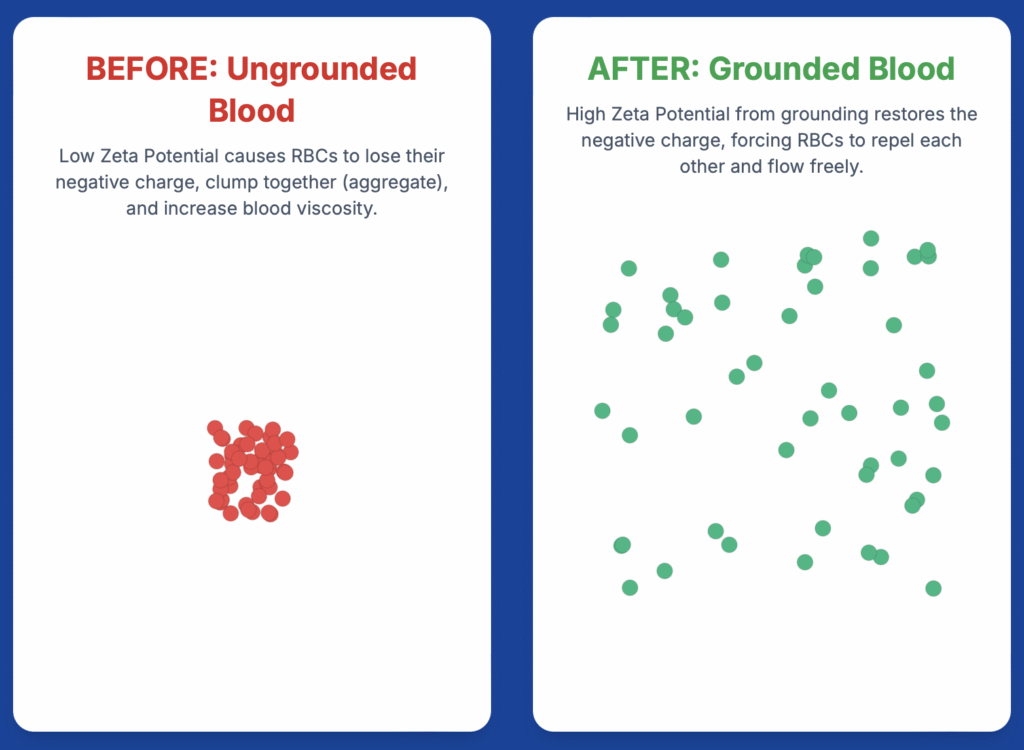
The reduction in blood viscosity and clumping is a critical improvement, as elevated blood viscosity is considered a strong, independent predictor of cardiovascular events like heart attack and stroke. Grounding, in this context, acts like a natural blood thinner, improving circulation and reducing the work required by the heart—an effect that the medical literature has called one of the “simplest and yet most profound interventions for helping reduce cardiovascular risk.”
Part III: The Therapeutic Shift

The simple act of being grounded initiates a cascade of systemic benefits that move it from a lifestyle trend to a powerful therapeutic adjunct.
1. Enhanced Circulation and Wound Healing
The improved flow characteristics of the blood (lower viscosity and clumping) mean oxygen and nutrients are delivered more efficiently to peripheral tissues, and metabolic waste is removed more effectively.
- Local Blood Flow: Studies using medical infrared imaging have shown that grounding can rapidly reduce the cardinal signs of inflammation—redness, heat, swelling, and pain—following injury.
- Wound Repair: This improved local circulation and antioxidant effect are thought to accelerate wound healing.Case studies have demonstrated remarkable resolution of chronic, non-healing wounds, where just 30 minutes of daily grounding led to noticeable pain reduction and significant wound closure.
2. Autonomic Nervous System Rebalance
https://www.youtube.com/watch?v=XVTQrllNP4M
Grounding has been shown to shift the Autonomic Nervous System (ANS) from a state of sympathetic activation (the “fight-or-flight” stress response) toward parasympathetic activation (the “rest-and-digest” relaxation response).
- Cortisol Rhythm: Regular grounding helps to normalize the day-night cortisol rhythm, leading to better stress management and improved sleep quality. High, chronic cortisol is a hallmark of stress and a driver of systemic inflammation.
- Heart Rate Variability (HRV): Grounding has been shown to increase Heart Rate Variability, a key marker of ANS balance and overall heart health. A higher HRV indicates a body that is more resilient and better able to adapt to stress.
3. Pain and Immune Modulation
By reducing inflammation, grounding directly addresses the mechanism of chronic pain. Furthermore, it alters the numbers of circulating inflammatory markers and white blood cells (like neutrophils and lymphocytes), suggesting a direct modulatory effect on the immune system’s response to injury and chronic disease.
Part IV: The Practical Prescription—Where to Stand?

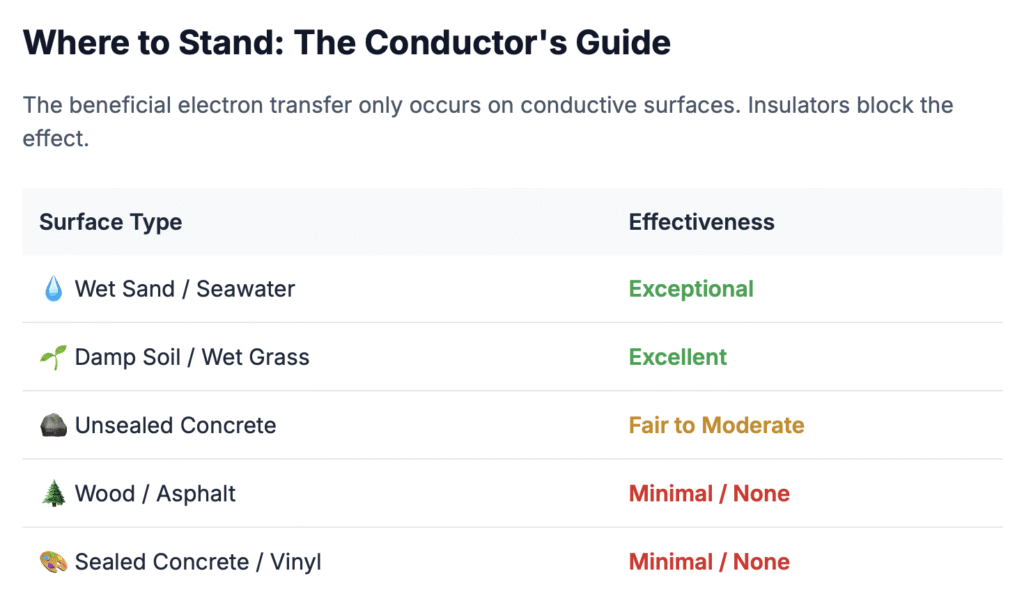
The beneficial electron transfer only occurs on conductive surfaces. The effectiveness of grounding is entirely dependent on the material and its direct connection to the Earth’s main electrical circuit. This is why the simple act of walking in shoes can be electrically meaningless, while walking barefoot in the right spot can be profoundly beneficial.
The Golden Rule: Conductive Surfaces are Key
| Surface Type | Grounding Effectiveness | Notes |
| Damp Soil | Excellent / High | Rich in moisture and minerals, providing a potent and direct electron transfer. |
| Wet Sand / Seawater | Exceptional / Very High | The combination of water, salt, and minerals makes this highly conductive. |
| Grass (especially wet) | Excellent / High | Morning dew or post-rain grass is ideal due to moisture. |
| Unsealed Concrete/Stone | Fair to Moderate | Must be unsealed (no paint, plastic, or tar sealant) and ideally damp, as the concrete’s mineral content allows some conductivity. |
| Wood, Asphalt, Vinyl | Minimal / None | These are insulators. They block the flow of electrons, making grounding impossible. |
| Sealed/Painted Concrete | Minimal / None | The sealant acts as an insulating barrier, even if the concrete beneath is connected to the Earth. |
The Minimum Effective Dose:
Research suggests that the most dramatic changes in blood viscosity (zeta potential) can be observed after just two hoursof grounding. However, even short, frequent exposures are beneficial.
- Target: Aim for at least 30 minutes daily of uninterrupted skin-to-Earth contact.
- Surface Area: Maximize contact—stand, walk, or lie down on the ground. Damp surfaces (wet grass, beach shoreline) are significantly more effective than dry ones.
- Consistency: Sustained contact yields sustained benefits, making the use of indoor grounding products (mats, sheets connected to a grounded wall outlet) a practical method for long-duration grounding while sleeping or working.
Conclusion: Reconnecting to the Earth’s Circuit

The evidence is clear: the Earth is not merely a platform upon which we live; it is a global electrical circuit with which our biology is designed to interact. Chronic disconnection, facilitated by modern lifestyle and insulating materials, has created an electrical deficit that manifests as inflammation and poor circulation.
“Touching the Earth Changes Your Blood” is not hyperbole; it is a statement of biophysics. By simply removing our shoes and reconnecting with a conductive patch of ground, we initiate a profound physiological change in minutes. We leverage the Earth’s electron power to neutralize the free radicals that drive inflammation and restore the electrical potential of our blood, literally helping to make the fluid of life flow more freely.
The prescription for this potent intervention is free, requires no complicated equipment (just bare skin), and is accessible in nearly any natural environment. Your next step toward better health could be as simple as finding a patch of wet grass and standing still for a few minutes.